Friday, November 23, 2007

On speaking a language without using sentence subjects, the joy of funny English all around me, and a golden "Santa-san"?

One thing you don't hear very often when speaking English is someone saying, "Wait, what's the subject of your sentence? Oh, okay." But in Japanese, a language that often omits the subject since it's understood by both parties anyway, it's possible to be in the middle of a conversation and suddenly need to verify what the other person is actually talking about. While cutting down a sentence like "Shall we go to lunch now?" to just "Go?" may sound odd to English speakers, it's usually not a problem in Japanese -- if you were talking about someone specific going somewhere, you'd put that in the sentence, but if the meaning is obvious from the context, it makes sense to shorten things. I've noticed that when Japanese speak English they sometimes use the wrong third person singular pronoun, saying "she" when talking about a man and so on, and this seems to be related to the fact that in their native language they never have to consciously specify a gender-based pronoun for a person when referring to them. There's nothing more embarrassing than when the invisible Japanese subject causes you to lose the thread of what's being said around you, and one skill smart learners master early on is how to B.S. others, making them think you're following along when you have no idea what's being said. Phrases like so desu ne, which should mean "Yes, that's so," but often means nothing at all, are a good place to start.

Without a doubt, one of the most enjoyable things about living in Japan is taking in all the funny English that comes my way. Although mistakenly-used English is often the result of translators with more self-confidence than actual linguistic ability, a lot of amusing English comes in the form of products sold by companies that can presumably afford to hire native speakers to check things. Some of these wacky product names are known to people outside Japan, for example, the most popular brand of powered milk for your coffee is Creap, short for "creamy powder," and Pocari Sweat, which brings to mind the image of floating on a cloud (pokkari) after a hard day's exercise. (Note: the product contains no sweat ^_^) Some other products that have caused snickering by gaijin living here have included Beaver and Woody, two separate air conditioning systems sold by Mitsubishi, which apparently has some wise guys working in their new products department. Japanese snacks are often named strangely, with Crunky, Asse or Meltykiss being good examples. Some other funny-sounding products that I've seen include Birdy, a canned coffee apparently aimed at golfers; Toyota's Carina ED, which was taken out of the market when ED came to stand for something else entirely; and the popular homogenized fish sausage from the Maruzen Corporation with the unbelievable name of Homo Sausage. Ah, Japan, don't you ever stop being so wacky.

The world is officially in "Holiday mode" now, and Japan is no exception. Here you can celebrate the season in a unique way, with your very own solid gold statue of St. Nicholas. A famous shop in Tokyo's Ginza area is selling the 24-carat gold image of "Santa-san" (as the Japanese usually call him), complete with a gold-mesh bag full of gold coins, to well-heeled collectors. The idea is that owning something made of gold will bring good luck, although it seems to me if you can afford the $1.8 million for the golden Santa you've already had more than your fair share. The Japanese have historically been big fans of gold -- Hideyoshi Toyotomi, who rose from a peasant farmer to the de facto ruler of Japan, built a tea room made of gold -- and you can see that many of the omamori and other traditional good luck charms that J-List sells have gold imagery incorporated into them in some way, for example the gold coin (called a koban) around the neck of the famous Lucky Cat.

J-List has more than 4000 excellent reasons to check the site this weekend, as we're just loaded to the gills with great products and gift ideas for your loved ones, from Totoro blankets to plush toys to delicious Japanese snacks to our Japanese T-shirts and warm hoodies and more. J-List has the fun and exciting items that the people on your list will really love and remember all year long. We've beefed up our stock of virtually every product we carry and have also added extra staff, allowing us to ship items out to you as quickly and efficiently as possible. Let J-List help make this a really great Christmas for everyone important to you this year!

Thursday, November 22, 2007

All about "joshiki" (Common Sense) and the Japanese, negative aspects of this, and some thoughts on turkey

Unlike the U.S. or most of Europe, Japan is a very homogenous country, where people tend to consider themselves part of the same genetic stock despite the sometimes obvious differences in facial features and hair and skin tint due to the presence of Korean, Mongolian, Ainu, Russian and other blood in the veins of "pure" Japanese. Somehow this tradition of "one-ness" has amalgamated into the unifying body of knowledge known as joshiki, things that any reasonable Japanese person is expected to know. Just as all Japanese take it for granted that chrysanthemums are a flower reserved for laying on gravestones rather than giving to one's wife, as I accidentally did to her great amuseent, we foreigners often have our own joshiki that can seem alien to the Japanese. We have a friend who owns a company and once complained that he had rather a lot of debt, including several different bank loans at different interest rates. I made the obvious (to me) suggestion that he get one new loan at as low a rate as possible and use it to retire all the other loans, and this was the most brilliant idea he'd ever heard -- apparently no one thinks of things like that here. When it comes to saving for a rainy day, the common sense of many people is to put their money in the bank, even if it pays a paltry 0.2%, or a whopping .75% if you opt for a 10 year CD. I once tried explaining one American joshiki of investing -- that the younger a person is, the better it is to hold stocks, since you have more time to recover from any problems you run into -- to my conservative mother-in-law, who has never owned stock in her life because some people have lost money in stocks in the past. Suffice it to say that she didn't see the point I was trying to make.

While this Japanese tradition of most people being on the same wavelength is usually a positive thing, there are downsides, one of which I call the "tyranny of the majority." My wife made breakfast for me the other day, which included two eggs fried "eyeball" style (what fried eggs are called in Japanese) and several strips of bacon. "This is turkey bacon, right?" I asked her, and she gave me a sidelong glance at my sarcasm. While Japan is a great place, with warm and friendly people and many beautiful sights to see, it lacks some of the choices you'd expect to find in a wealthy, modern country, including any kind of healthier products made with turkey meat. Whenever I go back home to San Diego I bask in the many choices around me, from the variety of imported beers available in stores to authentic Rold Gold pretzels to delicious whole-grain breads, and bagels, oh those bagels. I drink skim milk most of the time when I'm back home, not because I like it, but because it's all but impossible to find here in Japan, a country where the majority has decided that milk should be thick and creamy, with 4.7 per cent milk fat. This can make it a challenge for people with special needs to live in Japan, for example vegetarians often have trouble finding food that is completely free of animal products. Before I started J-List, I worked for a few months at the local city office as a "Facilitator of Internationalization," basically helping other foreigners who needed help getting city services. The person who had been in the job before me had left early due to various frustrations that reportedly included not being able to drink anything, since everything from cola to green tea has caffeine in it, which was against his religion.

All of us at J-List wish everyone in the U.S. a warm and happy Thanksgiving on Thursday. This is one of those holidays that can be hard to follow when you're far from home, and it's quite common for our entire Thanksgiving to consist of a bucket of "Kentucky," as KFC is called here. It's possible to find frozen turkeys imported from Brazil (which contain guidance about how the turkeys were prepared in accordance with the laws of Islam, since they are also exported to the Middle East), although the bird we got last year was so small we had to modify the cooking instructions downwards. This year we've got a box of good American stuff like mashed potatoes, gravy, cranberry sauce and of course pumpkin pie, but we've decided to substitute turkey with pollo a la brasa, spit-roasted chicken from our favorite Peruvian restaurant. While you're recovering from dinner, remember that J-List stands poised and ready to help you with any and all shopping needs this long weekend, and we've got thousands of rare and amazing products for the Japan-focused person on your list this year.

We've got an announcement for fans of our PC dating-sim games today: the upcoming Snow Sakura has been declared "Golden Master" and is now being duplicated, just in time for the start of winter (don't you love our timing?). This is a really special game of love and "H" in Japan's northernmost island of Hokkaido, in which you play Yuuji, an average Japanese youth surrounded by a circle of beautiful girls, Saki, Kozue, Rei, Misaki and Misato. Although you knew the girls when you were small, for some reason you can't remember much about those days, only that you made a promise to one of the girls under the magical Snow Sakura tree. The mystery is, which girl was it, and why did you forget? This game has it all -- great characters, a long story with lots of depth, hilarious comedy scenes and a huge number of beautiful "ero" game CG. You can still preorder it and get free shipping when it ships!

Monday, November 19, 2007

My family treating me like an "American," thoughts on learning a foreign language, and the pain of sitting in "seiza" style

Being an American in rural Japan can be a challenge, and while I do my best to fit in with the larger society around me, sometimes I just gotta be me, which incidentally is known as "going my way" in Japanese. It's common for my wife to get on my case about my being "too American," which (to her) is usually about my tendency to be loose with my schedule, to forget important dates because I know she'll remind me anyway, and to say "yes, I'll be there in fifteen minutes" then show up three hours later. But my wife isn't the only one who takes me to task for being such a Yankee -- my kids do it too, which never ceases to amuse me, since they're, y'know, American as well. A few weeks ago I was driving in the mountains with my daughter, and we stopped at a restaurant that serves the most delicious thin-crust pizza, although we had to hunt around for the place since they have no sign indicating which road to turn at. When I mentioned my intention to tell the owners that they might consider investing in a lighted sign, my daughter said, "Why do you have to say anything to them at all? You always say whatever comes into your head without thinking -- you're such an American." One of my most embarrassing moments as a parent was when my son was three or so, at the playground. It was time to go, but of course he wanted to stay, so I had to gently insist that he go now. He got mad, and in front of dozens of amused parents shouted, "Don't you know there are rules grown-ups have to follow when they want a kid to leave the playground? You're an American, and Americans don't understand rules!" It's always interesting to see one's self through the eyes of a child.

Naturally, mastering a foreign language requires hard work and many hours learning things like grammar and vocabulary, but you also have to develop a "sense" for the language itself, internalizing the "real meanings" behind what you hear. Two handy words students of Japanese encounter soon into their studies are sukoshi (su-KOH-shi) and chotto (CHO-toh), both of which essentially mean "a little bit." If it's a little cold, you could say either chotto samui desu or sukoshi samui desu and your meaning would be communicated properly. One slight difference between the two words, however, is that chotto sometimes has a negative context, especially when used by itself without an adjective after it. If a girl makes a not-too-delicious bento lunch for you then wants to know how it tastes, you might reply "chotto..." which essentially means, "it doesn't really taste that good, but I'm too polite to come out and say it directly." Or, if there was someone you disliked, you could imply something bad about them without actually saying anything, by using "ano hito wa chotto..." ("That person is kind of..."), with the details of what you were going to say left up to the imagination. Although the Japanese have perfectly good words for "yes" and "no" -- hai and iie, pronounced HA-ee and EE-eh -- they're not really used that often. Instead, agreement or disagreement is more commonly expressed with softer, more nuanced and less direct words and phrases.

One of the banes of foreign visitors to Japan is seiza (SAY-za), the traditional way of sitting on your knees. Written with the characters for "proper sitting," it is an important part of many traditional Japanese cultural activities, from tea ceremony to flower arrangement to martial arts, and somehow sitting that way seems to encourage reflection and calm the mind. To sit seiza style, kneel with your knees together, then sit back so that your rear end is planted on the bottoms of your feet. Unfortunately, sitting this way for more than a few minutes can be quite a challenge for those not born here, and Japanese always chuckle amusedly at the sight of a gaijin trying to keep his legs from going to sleep while he kneels. One of the wackiest items we've ever carried at J-List is the Girlfriend Knee Pillow, a soft set of knees siting seiza style that's great for single guys to lay their head on after a hard day's work.


Friday, November 16, 2007

The joy of "onigiri" rice balls, observations on cooperative elements of Japanese language, and man, that's a really Nice Boat!

If you were to plan a picnic, you might pack a basket containing things like sandwiches, potato salad or maybe some pickles, but a Japanese person would almost certainly bring along onigiri, the delicious rice balls from Japan. Formed using the honorific o prefix that can be seen on many Japanese words and nigiri, meaning "to squeeze," onigiri are a popular way to grab a quick snack in Japan. Although they can be as simple as a hunk of salted rice pressed into a shape, there's usually a bit of fish, konbu seaweed or ume plum inside, and nori covering the outside. Onigiri are a major product category for convenience stores in Japan, and even before a new gaijin learns to start reading the language around him, he often memorizes the all-important onigiri color code at Seven Eleven -- red for salmon, blue for "sea chicken" aka tuna mayonnaise, and so on. Onigiri are a staple of bento culture, and Japanese housewives get up extra early to press rice balls to include in lunches for their kids or husbands. Onigiri can be heated but are usually eaten cold, but there's a subset called yaki-onigiri that's basically a triangle of white rice that's roasted over a flame while being painted with soy sauce -- delicious. Along with popular bento items, we sell a lot of onigiri related products on the site -- I thought today's Hello Kitty Onigiri Maker is especially cool.

A language reflects the character of the people who use it, and vice-versa, and I'm sure that if I were to study German, I would see that the precision and attention to detail that Germans are famous for would be evident in their speech. One interesting area of Japanese grammar students learn early on is the verb ending masho, which corresponds to "let's..." as in "let's eat" (tabemasho), "let's go" (ikimasho) or "let's not smoke" (tobacco wo yamemasho). In situations where verbal or written warnings would be worded in a command form in English (do not smoke, do not ride on the escalator backwards), it's common for Japanese to express the same message with this softer "let's..." verb form, making statements like "let's put our telephones into vibration mode" (maanaa modo ni shimasho) or "when a pregnant woman or elderly person gets on the train, let's give our seat to them" (seki wo yuzurimasho). These statements subtly create a warm and fuzzy "let's all cooperate" atmosphere that make people want to do their part for the good of everyone, an important pillar of Japanese society. Every year, the Japanese tax office sponsors commercials featuring famous TV personalities walking to their post office to mail their income tax forms -- "Let's fill out our tax forms accurately and honestly," is the message. Language like this presents a challenge for translators -- if translated literally, the message might not convey the same meaning to everyone.

The various forms of popular otaku culture in Japan and around the world continue to grow, making barriers like geographic location mean less and less, and the recent events surrounding the broadcast of the last episode of the popular anime School Days were a further example of this. School Days is an anime series based on a dating-sim game about a love triangle between Makoto, his girlfriend Kotonoha and their friend Sekai, which combines beautiful characters and a complex (and fairly violent) story. The day before the last episode was to air, a girl killed her father with an axe, and fearing that the act might have been inspired by the show somehow, the TV studios decided to replace the much-awaited last episode with soothing classical music and images of a boat somewhere in Europe, which fans immediately dubbed "Nice Boat!" spreading images all over YouTube. The boat is now a part of pop culture history, and because we love to make esoteric things for otaku, we've made a limited-edition T-shirt to commemorate this really excellent boat.

Wednesday, November 14, 2007

Thoughts on Japan and group culture in anime, hard and difficult areas of Japanese, English etc., and various mysteries of life in Japan

Japan is famous for its cooperative group culture, and you can see this in many places, from clubs in schools to doujinshi circles to more formal organizations. In the past few years I've noticed that many anime series have been made by groups rather than individual creators or companies, for example the Ikki Tousen Committee, the Claymore Production Committee, and the School Days Production Committee. These groups are generally made up of a variety of members working on the project, including producers, artists, representatives from companies like Bandai, and quite often, major anime retailers like Toranoana or Animate, who can give input that will help make the project successful with fans. One reason these committees come into being is financial -- having a group of experienced individuals be responsible for a project and makes it easier to raise funds -- but it also spreads responsibility around to more members. When Steamboy, the most expensive anime film ever made, failed to make back even half of its $26 million price tag, I'm sure Akira creator Katsuhiro Otomo was glad to have had the Steamboy Promotion Committee to take some of the blame off him.

Each language is unique, and presents special challenges to learners coming in from other language groups. For example, Chinese or Thai are tonal languages, Romance languages have noun gender to keep track of, and so on. According to the J-List staff, the most difficult areas of learning English are the "helping verbs" that fly around English sentences ("she shouldn't have been able to drive, should she have?"), or knowing whether to answer a statement with a tag question on the end in the positive or negative ("You're Japanese, aren't you?"). The Japanese language also has some rough patches, beyond the obvious challenge of mastering kanji, which include getting used to grammatical particles that "mark" the parts of sentences, including the often-confusing "topic marker" (wa) and "subject marker" (ga) of a sentence; getting used to verbs coming in formal and informal forms; and (as a male) learning not to imitate female speakers too much, since you can easily find yourself speaking effeminately. Happily, Japanese is not an especially difficult language to pronounce, once you train the muscles in your mouth to say the five vowels, which are "a" (ah), "i" (ee), "u" (oo), "e" (eh) and "o" (oh). These sounds are so tightly formed compared to the "lazy" sounds of American English, though, that I've actually experienced muscle pain in my mouth from speaking too much Japanese.

There are certain mysteries associated with living in Japan, as any gaijin will tell you. Why does your boss say so desu ne ("Yes, that's so") right before shooting your idea down? Why are some trains called nobori (climbing) trains and others kudari (descending) trains? (Trains headed in the direction of Tokyo are the former, and away from the capital, the latter.) Why do stores suddenly start playing Auld Lang Syne from speakers fifteen minutes before closing? (To politely let you know you should complete your purchase and leave.) Then there's the great mystery of the kanji characters for "small" and "big" (sho and dai) which you see on most toilet flush handles. Although Japan is generally wasteful when it comes to its natural resources, often covering the sides of mountains with concrete just in case there might be a rock slide someday, it has a green side too, taxing less efficient car engines at a higher rate, selling refill versions of products to cut down on trash volume and promoting low-energy lighting. Japanese toilets are set up to conserve resources, too: you can turn the handle to the right to perform a normal flush ("big"), or hold it to the left for a few seconds to just let out a little bit of water ("small"). It took me a few years to make the connection, but of course the "small" character stands for shoben (meaning number 1, literally translated as "small convenience"), while the other turn of the handle stands for daiben (number 2, or "big convenience"). One more mystery solved.

As you probably know, J-List sells a wide range of delicious Japanese snacks, with the newest releases from companies like Glico, Meiji, Morinaga and more always on the site. Although our Japanese snacks are fun to much on any time, they can also make great gifts for the upcoming holidays, and what's why we've added a new Best Snacks Stocking Stuffer set, featuring a selection of the best snacks we carry, from Meltykiss to Kit Kat to Pocky to Meltykiss and that delicious Charcoal Roasted Coffee Candy.

Monday, November 12, 2007

All about Japanese swords, thoughts on the "horse with a heart mark" and government, and, can you ski?

Japanese swords are famous around the world, up there with ninjas and Hello Kitty as a symbol of the country. Like the kanji writing system and Buddhism, sword-making was imported from China, and was immediately embraced by Japanese craftsmen who sought to perfect the art. Most famously worn by the samurai warrior class between the 14th and 19th centuries, it was common to carry both a long katana sword and a shorter blade, called a wakizashi. The law that governs carrying of weapons in Japan is known as the Firearms and Swords Control Law, something I've always been amused by, since one doesn't usually worry about something like the need for "sword control." While samurai swords are quite common in Japan -- my wife's parents have a pair of swords on display in their bedroom -- it's rare for one to be used in a crime. But that's just what happened in Tokushima Prefecture, where the president of a construction company who was known for his collection of ancient Japanese swords seems to have gotten into a heated argument with his son about something. Things got out of hand, a sword was drawn, one managed to kill the other before taking his own life. (Police are still investigating the details.)

There's a new "horse idol" in Japan's racing world that's claiming the hearts of fans. Her name is Treasure Smile and she's popular because she's got a natural heart shape on her head, which has caused thousands of fans to flock to Iwate Prefecture in Northern Honshu to take pictures of the "horse with the heart mark." The local track is milking Treasure Smile's popularity for all its worth, advertising that anyone wearing a heart on their clothes can get into the races for free. Along with boat and bicycle racing, horse racing is popular in Japan, and there are thirty tracks in various places around the country. It's also one of the many areas of society that the Japanese government is heavily involved in, much to the confusion of gaijin like me who wonder why the government needs to be operating race tracks at all. Unlike the U.S. with its tradition of individual sovereign states, Japan's history since the Meiji Restoration has been one of modernization from the core outward, with the government taking an active role in a range of industries from the publically-run Japan Tobacco which once controlled the distribution of all cigarettes and salt in the country, to the sprawling Japan Post Office, which operated as the world's largest savings bank and also sold life insurance on the side. One by one, these industries have been slowly privatized, with the old Japan National Railways becoming JR and the inefficient government-run phone company becoming the modern NTT. Presumably these moves have improved efficiency and competition, although the invisible bonds between these former public entities and government are still significant.

Suki desu ka? One of the first useful words a student of Japanese learns is how to say "like" (suki), which is pronounced quickly so that it sounds rather like the English word "ski," leading all students to immediately make the joke Sukii ga suki desu ka? (Do you like to ski?), since the words sound similar. The word suki is often a student's introduction to the concept that a word or idea in one language might have many possible meanings in another language, depending on the situation. Right off the bat, suki can mean "like" (in the context of your favorite food or hobby) or "love" (when said in reference to another person). Like all Japanese words there's some ambiguity involved, which is the subject of more than a few melodramatic misunderstandings in anime or television dramas. For example, if a woman was looking at a cake and said suki desu, she could theoretically be expressing her love of cake, or else she could be confessing her feelings for a boy who was also in the room. A couple of years ago I saw a variety show in which former JAV actress slash novelist slash TV talent Ai Iijima walked around New York, asking Americans Kyonyu suki? which sounds like "Can you ski?" in English, but is really asking if they prefer women with, er, large oppai. It was funny to see the Americans on the show nodding their heads for the camera at her question. Try it on your friends!


Friday, November 09, 2007

Foreigners' relationship with Japanese slippers, International Pocky Day, and reading my wife's English homework from 20 years ago

I'm often asked how I can come with so many observations about Japan, to which I usually respond that it's hard to filter them out, since Japan is literally all around me. Like most people who love onsen (hot springs) and sento (traditional Japanese public baths) here, I keep a basket in my car that contains all the bath related things I need: razor, toothbrush, small towel, a tape-covered paperback novel that I don't mind trashing. I also have a small notebook and pen for scribbling down ideas that come to me while sitting in the tub. For example, the other day I realized how complex something as basic as slippers can be. In Japan, shoes are removed at the front door in all homes and many businesses (including J-List), and slippers are worn while indoors. When you visit a Japanese family at home, they'll usually put out a pair of slippers for you to use, which can be problematic when since only Ewoks could wear the tiny things comfortably. Thus, every foreigner living in Japan must choose what kind of relationship he will have with Japanese slippers -- will he politely accept them, or refuse and wear his socks, knowing that he's breaking a minor social rule? Incidentally, did you know that the modern concept of slippers is actually a Japanese invention? Back in the early Meiji Period, when Westerners would visit a Japanese home they'd walk right in without taking their shoes off. So in 1907 (or 1876, according to another theory), a shoemaker named Risaburo Tokuno came up with an "outer shoe" that covered the dirty boots of foreigners, keeping the house clean. These supposedly evolved into the modern concept of slippers as an indoor shoe.

The other day we found an old English textbook my wife had used in Junior High School. My kids and I delighted in reading her English homework from 20+ years ago, especially rejoicing in finding any errors she made at the time (we're kind of mean that way, I'm not sure why). One thing we noticed were little numbers written above words in her textbook. For example, in the sentence "Jane's arrival livened up the party," there was a 1 above "Jane's," a 3 above "arrival" and so on. My wife had been doing what a lot of Japanese do when learning English, being consciously aware of the number of syllables in correctly pronounced words. The Japanese language is based on syllables rather than individual sounds represented by letters, and as a result they unconsciously extend the limited repertoire of sounds from their own language into English, which is where the often thick Japanese accents come from. You and I know that the word "weekend" has two syllables, but to a Japanese who hasn't internalized the rules of English pronunciation, it sounds like "oo-EE-koo-EN-doh," a five-syllable word. If you're a native speaker of English, thank your parents next time you see them -- you don't know how fortunate you are to not have to go through the difficulties of learning English.

Pocky has gone from being a wonky snack that a few anime fans knew about to being a major representative of Japanese snack culture all around the world. The chocolate-covered pretzel stick, which gets its name from the pokki! sound you hear when you snap one in half, was first introduced in 1965 by the Glico Confectionery Company under the not-so-cool name of Chocoteck, where it was an instant hit. Glico was founded by Riichi Ezaki, who after the death of his infant son swore to improve the health of Japan's children by introducing sweets containing glycogen harvested from oysters, which is where the name Glico comes from. There are many different flavors of Pocky released each year, from traditional chocolate to half-bitter "Men's Pocky" to delicious variations like Pocky Crush (almond, cookies n' cream) to Green Tea Marble Pocky to the new Pocky Dessert, essentially a cake wrapped around a biscuit stick. The Glico corporation has declared that November 11 (11/11, which looks like four Pocky sticks lined up) to be International Pocky Day, and to help everyone celebrate, J-List is having a special sale this weekend, with an extra 5% taken off any purchase of ten or more boxes of Pocky (cases included). It's a great time to score some delicious Pocky!


Wednesday, November 07, 2007

Finding the geographic center of American English, adventures in New Zealand with plenty of sheep, and getting complimented on chopstick use

One question I've been asked by my ESL students in Japan is, just where is "standard" American English located geographically? Most countries define a given region as the "official" dialect of their language, which is then used in textbooks nationally. In China the standard language is the Beijing dialect of Mandarin, in Italy its based on the regions of Florence and Tuscany, and in Britain it emanates from the twin pillars of "Queen's English" and the BBC. The "official" English used in the U.S. is a bit harder to pin down, and it's sometimes referred to as Standard Midwestern, since it tends to flow from that part of the country. In 1868, Japan's capital was officially moved from Kyoto to Edo, which was renamed Tokyo meaning "east capital," in imitation of China's cities of Beijing and Nanjing, the "north" and "south" capitals. This meant that the "standard" Japanese language changed from the colorful, intoned speech of the Kansai region to flatter, more robotic-sounding dialect of the Kanto Plain, something that Osaka hasn't quite forgiven Tokyo for yet. Like the U.S. and Great Britain, Japan does not have an "official' body to define its language is like the Acadmie franaise, and it's generally up to the publishers of the Kojien, Japan's answer to Oxford and Webster as the most prestigious dictionary, to bless new words by including them in its pages.

My son is back from New Zealand, and he had a great time there, doing homestay with a local family and getting to use his English a lot. New Zealand is a beautiful country, very similar to Japan if you take away 96% of the people, concrete and asphalt and add a lot of rolling hills and sheep, and the students loved it there. It's funny how social barriers can be laid low through the power of shared popular culture. For example, the kids Kazuki was staying with were into Yu-Gi-Oh battle cards, and since he had remembered to bring his collection with him, everyone immediately became fast friends, doing battle and comparing the English and Japanese cards. The students at my son's school generally learn North American English, and several of the kids in New Zealand commented on their "American" accents, something that no one from the U.S. would ever perceive. The kids at the school were interested to hear that Kazuki's father had gotten to meet Temura Morrison, the Kiwi actor who played Jango Fett and all the Clone Troopers in Star Wars episodes 2 and 3, at the Star Wars Celebration IV convention this year, and had in fact sung the New Zealand National Anthem to him. Sometimes I think that I might not be the most representative American my son could have had for a father...

Although Japanese kitchens are well stocked with spoons, forks and knives, most meals in Japan are eaten with chopsticks. Children usually learn to use chopsticks around the age of 4, when they start attending preschool, and this is quite possibly the first of many adjustments to the larger Japanese group that children have in their school lives. Every foreigner living in Japan knows the embarrassment of being told by a Japanese person hashi ga jozu ("you use chopsticks very well"). While one popular response is to compliment the speaker on their use of a knife and fork, I've found you can have more fun telling them okagesama de (oh-KA-ge sah-mah deh). This is a complex phrase which literally means "Yes, thanks to you," almost as if you had leaned how to use chopsticks from the person, even though you've never met them before. The phrase is a useful way of showing Japanese-style humility whenever someone compliments you on something, and since few would expect a gaijin to know it, it's fun to see their surprised expressions when you whip this phrase out. (If you're trying to learn to eat with chopsticks, we recommend the training chopsticks we have on the site.)

J-List is the best place to find Domo-kun related items, from plush toys to wacky T-shirts and warm hoodies to our great 2008 Domo-kun calendar that's in stock right now. Today we're happy to announce a line of cool Domo-kun hats, professionally embroidered with cool images of the official mascot of NHK, Japan's public broadcasting channel. We've got not one, not two but three new Domo-kun hats, the "Domo face," our popular "outlined Domo" design and a new one featuring Domo saluting you as he greets you. All hats are made of stone- washed cotton denim by American Apparel and are extremely well made, and are also fully size adjustable. Browse our new items now!

Tuesday, November 06, 2007

A useful Japanese slang word, changing in the Japanese savings rate, and one "key" to understanding Japan and America (?)...

Recently we took our daughter to a resort hotel in Kusatsu, a hot springs town in the mountains with more than 1000 years of history. When we checked in, the hotel employee handed us a standard old-fashioned metal key for our room, which made me realize another difference between my home country and Japan. Most hotels in the States employ a computer-control card-key system, which allows the hotel to assign a unique code for each card then change it the next day. While these convenient hi-tech devices give the hotel a more modern appeal with guests, the main driving force behind their adoption has been litigation, with hotels often liable for theft or other crimes that occurred inside their rooms. With the ability to prove exactly when an individual (including hotel staff) entered a given room, hotels in the U.S. can better control their liability for such things. Since Japan is for all intents and purposes a country in which no one sues anyone else -- remember, I've never met a single lawyer in my 16 years living in Japan, they're so rare -- it's not a problem for hotels to keep using the old metal key systems.

I'll teach you a word of Japanese that can be quite useful. The word is -kei, part of the word kankei, meaning "relationship." Basically, you take a word and put -kei on the end and you've essentially widened its scope, for example cha-kei would mean any kind of tea-like beverage, from Western iced tea to green tea and so on. The suffix is often used to create slang words related to fashion and popular culture, and new words are created almost daily to describe the ever-changing world we live in. One buzzword you hear a lot these days is Akiba-kei ("related to Akihabara"), describing anything that can be found in this popular area of Tokyo, from anime to manga to electronics and maid cafes. More specific otaku-related slang words might include moé-kei, i.e. related to moé (mo-EH) or "the warm, happy feeling you get when you look at your favorite anime character," or otome-kei (oh-toh-meh-kei), used to refer to anything related to yaoi or BL. The -kei suffix is used in music as well, for example the visual-kei rock bands pioneered by X Japan and now represented by the likes of Gackt or Malice Mizer, or the currently popular genre of club music known as Shibuya-kei. One slang word for the hip-hop culture that Japanese young people often like to imitate is B-kei, for black, while the type of man most Japanese females would like to date would probably be Johnny's-kei, men who are attractive in the way that Japanese male idols like SMAP or KAT-TUN are. Japanese magazine publisher Recruit publishes Gaten, a job magazine for workers in physically-demanding fields like road construction or moving, and a popular slang term for strong men who can work in these jobs is Gaten-kei, similar in meaning to the word "blue collar."

One aspect about living in Japan I like very much is the custom of a family's finances being handled by the woman of the household, a good thing since Japanese females generally tend to be very organized and level-headed, a lot more than me anyway. In past decades, Japanese households have been famous for their high savings rate, with the average family keeping around US$120,000 in standard cash savings accounts. Now that Japan finally seems to be permanently past the terrible period of recession that followed the bursting of the Tokyo land bubble in 1991, known officially as the Great Heisei Recession and unofficially as the "Lost Ten Years," some are seeing signs that this era of high savings may be coming to an end. In 1973 the average Japanese household managed to put away a whopping 23% of their annual salary, but this number has fallen to around 2.7% today. A lot of changes are afoot in Japan these days, with many households remodeling their homes to make them "barrier free" so that elderly parents can live at home safely, and of course those aging Japanese workers are retiring, reducing the income available to save. Lifestyles are changing too, with people getting married later and later, living at home into their thirties and forties. Some Japanese households are no doubt fed up with the miniscule interest paid on savings here in Japan -- the rate paid by a major bank in our area is just 0.2%, if you can believe that -- and are looking for other vehicles than straight savings. Unlike the old days when Japan had many barriers to entry for foreign firms, many investment companies are active in Japan, offering a range of more interesting alternatives for families wanting to save for the future.

Saturday, November 03, 2007

Funny moments in Japan, Tokyo's famous Asakusa district, and limitations of Japanese "humility"

(It looks like we were experiencing some problems with the site due to heavy server load, although it's fixed now. If you should have a problem accessing the site, just try back in a few minutes and it should be okay.

Today was my ningen dokku or "human drydock," an annual health check-up that tests every part of your body with assembly-line precision, a modern tradition that's one reason why Japanese have such long life spans. While I was waiting for the next test I saw on the TV that Enola Gay pilot Paul Tibbets had passed away at the age of 92. He was the pilot who flew the plane that dropped the atomic bomb on Hiroshima, something that made him rather infamous here in Japan. It was an interesting moment to be an American surrounded by Japanese people, and the room suddenly seemed to get a little quieter around me -- I probably had one of those big drops of sweat on my head like in anime. It can be hard to know how to feel about the bombing of Hiroshima, an event so terrible it's hard to comprehend, yet it helped end a war that might have gone on for two more years and claimed another million lives. When I took my kids to see the excellent museums in Hiroshima I tried to present the complexity of these problems to them so they can make their own decisions about the past, since they're both American and Japanese.

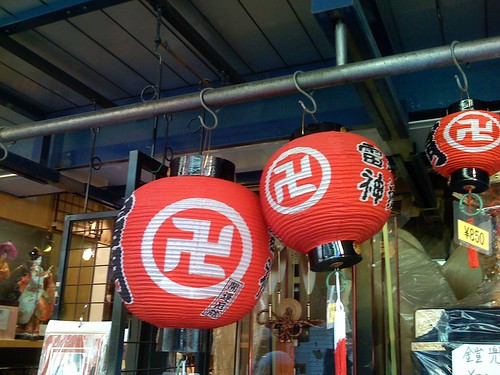
One of the most famous spots in Tokyo is Asakusa (ah-SAH-ku-SAH), home of the Senso-ji temple and a nice place to eat, drink or take part in a festival. Several famous corporations also happen to be located in the district, including the Bandai Company and Asahi Beer, which has a giant golden, er, shape on top of its headquarters which is supposed to remind you of the head on a cold beer...but everyone agrees it looks like a giant golden unko (poop), which the president of the company probably did for good luck purposes. Asakusa is a popular destination for foreign visitors to Japan, the last time I was there I was impressed to see a local shop owner barking prices at various customers in English, Chinese, German, French, Korean and occasionally Japanese. I'm sure more than a few foreign visitors have been surprised to see the beautiful lanterns that line Nakamise Dori with big, bright swastikas on them. They're nothing to do with the Nazis, of course -- the hooks go to the left, not to the right -- but seeing to this symbol in daily life takes some getting used to. Look on any map in Japan and you're sure to see many of these symbols indicating the presence of a Buddhist temple. Other symbols used on Japanese maps include a Japanese arch which marks Shinto shrines, and one of my favorites, the "onsen mark" or registered symbol indicating a volcanic hot springs. All of these characters are included in Japanese fonts and can be produced on any Mac or PC. (We've got a few cool T-shirts incorporating some of these designs on the site.)

From a certain point of view, the Japanese are all about "kenson," or modesty, and there are many customs related to avoiding appearing boastful to others. Right off the bat, this tendency towards humility is built into the language, and to speak very polite Japanese is to alter between using words that lower your own status while raising up the person you're talking to, actually changing the verb depending on whether you're talking about yourself or the person you're trying to be polite to. For example, the normal verb for to eat is taberu, but if you were speaking very polite Japanese, you'd use meshiagaru when referring to your teacher, boss, etc., and itadaku (as in "Itadakimasu!" which is said when you start a meal) when indicating your own lowly self. Modesty works like am umbrella, covering everyone in your respective in-group, and it's common for a mother to talk "badly" (as seen from my American point of view) about their own children to other mothers in the neighborhood -- they never study, the read manga all day, and so on -- as a way of appearing self-effacing to others. I've noticed that Japanese modesty stops short when it comes to money, however, and like most people in the world, they know how to flaunt it when they've got it. I once taught English to the wife of the former president of the Sapporo Ramen Company, who lived in a traditional Japanese house that was so fine, I thought I had been transported back to Nara Period Japan. There's a variety show on TV called Minna-san no Okage ("All Thanks To You") which features a chair that rises along a big slope. Famous idols, actors and athletes come onto the show, make some small talk with the host, then the chair moves up the slope to indicate how much money they make annually. Poor swimsuit idol Yoko Kumada was stuck near the bottom of the hill, while famous actor and former baseball star Eiji Bando was happy to be carried all the way to the top, indicating his considerable wealth.

Asakusa


Wednesday, October 31, 2007

Thoughts on biculturalism and Halloween, types of ramen you should try, and my fascination with Japanese females

Happy Halloween from J-List. Halloween is one of those "American" holidays (although originally Irish and Scottish) that has a way of working its way around the world, and although Japan doesn't exactly need an excuse to engage in cosplay, what with their strong tradition of dressing in anime costumes and all, awareness of October 31st grows here year by year. Raising kids who are part of two countries has always been a challenge for my wife and I since we want them to really be a part of both, which means (on the American side, at least) having a cultural awareness of things like trick-or-treating and Scooby Doo and being able to sing the School House Rock songs (they can). So we've gone out of our way to make trips to the U.S. for Halloween and Thanksgiving, not on our regular travel schedule, although it was a lot easier to do when the kids were small and didn't have the pressure of school to deal with. This year we decided to be traditional, and carved a (fairly ugly-looking) Jack-o'-lantern. We had a bit of culture shock when I asked my mother-in-law for a candle to put inside the pumpkin: the only ones she had in the house were the long candles for lighting at the family's Buddhist altar in remembrance of the dead...which is actually closer to Halloween's original meaning, if you think about it.

Picture of a bad Jack-o-Lantern


Ramen is one of the most famous "Japanese" foods around, although its history in Japan isn't very long, having been imported from China in the Meiji Era. While instant ramen has proven to be a revolutionary product, allowing the cost of a meal to brought way down in price, readers who have never enjoyed "real" ramen in a good restaurant are missing out. The basic type of ramen familiar to most people is shoyu, made with a soy sauce-based soup, although there are other varieties, including "salt" (a clear soup sold under the tastier-sounding "chicken" moniker in the West) , "tonkotsu" (white "pork bone" broth), and sura-tanmen (think "sweet n' sour ramen"). Another popular type of ramen is miso, the delicious soy bean curd that my mother thought was peanut butter when she saw it, which is one of the "meibutsu (famous things) of Sapporo in Hokkaido. Right now, the Sapporo Ramen Company is running a commercial featuring a beauty pageant in which different brands of ramen compete in for the title of "Miso Universe," a great tribute to the current Japanese Miss Universe.

One constant source of fascination and confusion for me since coming to Japan has been trying to understand Japanese women. Like the country itself, they're incredibly complex, and can just as easily delight you as leave you scratching his head in confusion. First, Japanese females generally tend to be calm, cool and good at planning ahead. Sometimes (from the standpoint of my over-exuberant American self) they can seem rather emotionless, and the thought has occurred to me that I know what it's like to be married to a Vulcan from Star Trek. "Lack of spontaneity" is another label you could apply to most Japanese females I've known: when I went to Europe I brought a backpack, a Lonely Planet book and a credit card and played everything else by ear, which shocked my wife, who so loves to plan every minute detail of a vacation ahead of time. I've mentioned before that Japanese females often seem to have problems with constipation, which no doubt arises from eating rice three meals a day. Japanese females also seem to be subject to chills, and the Totoro Lap Blankets made by Sun Arrow are no doubt used by more than a few OLs ("office ladies," i.e. female company employees) trying to stay warm with the air conditioning on around them. Japanese females often seem to have some rather strange and inexplicable fetishes. For example, several women I've known have loved pulling my chin hairs out by the roots, and have begged me to not shave for a few days so that they could rip my hairs out with tweezers -- totally bizarre. Although they can be confusing to men, learning a little about the care and feeding of Japanese females can certainly have its rewards.

Monday, October 29, 2007

NOVA goes "nova," the latest trends in women dressed up as men, and little "incompatibilities" between Japan and the U.S.

Well, what everyone feared has come to pass: the chain of English schools called NOVA has gone, well, nova, officially filing for bankruptcy protection. While I'm happy to get that damned pun off my chest, it is unfortunately a dark day for English teachers everywhere. Nova is (has been) the largest of Japan's "big four" McEnglish conversation schools, with a staggering 4000 native English teachers in its employ, and most of these teachers are now in the market for other jobs. Sadly, they haven't been paid for a month or more, and the status of their back pay is up in the air thanks to the bankruptcy. Nova brought these troubles on themselves through massively bad management, preferring to railroad students with "discounts" that involved multi-year contracts -- and you thought the U.S. cell phone industry was bad -- rather than satisfy their customers by teaching them well. Now, its the poor eikaiwa teachers and former students who end up paying the price. Having worked for a failing ESL school in the past, I do feel the teachers' pain, and I hope they'll all be okay. The president of the company, Nozomu Sahashi, has done what many Japanese company presidents do when things get rocky by going missing, and if I'm right he'll mysteriously take ill and have to be checked into a hospital soon, as a way of staying away from the news cameras.

The only constant in life is change, and in that tradition Japan's otaku world is always coming up with something new for us. Everyone knows about Maid Cafes, where beautiful Japanese women dressed in exotic maid uniforms pour coffee for their (usually male) customers, whom they address as "Master." Now women who are interested in yaoi comics, anime and PC gaming culture can enjoy Japan's first "BL Cafe." In Tokyo's bustling commercial district known as Ikebukuro there's a street called Otome Road (Maiden Road), fast becoming the yaoi answer to the more traditional otaku culture found in Akihabara. On that street is a restaurant called Lily Rose, staffed with incredibly attractive men who look like they stepped out of a BL comic. Oops, scratch that -- the staff is actually all women who are dressed as yaoi-esque males, complete with male names like Keisuke-kun. The employees of the restaurant are known as gyaru-son, which combines the word "gal" (i.e. hip young Tokyo girl) with "son" to make garcon, a really fabulous joke. Why would women want to eat in a restaurant staffed by women dressed as effeminate men? One patron said: "Because the staff are really women, I can eat without fear of a man trying to pick me up, allowing me to take in the beauty of the 'men' around me as I enjoy my food."

Japan is a great place, and I do love living here. That's not to say that things aren't plenty of large and small "incompatibilities" that foreigners need to get used to when coming here. First of all, the Japanese use the metric system, so if you're from the U.S. you'll find yourself learning to think in meters, kilograms and degrees centigrade, to the great annoyance of friends back home, and before you know it you'll be like me, unable to remember your weight or shoe size under the American system. In lieu of paper sizes like "letter," the Japanese use the A4 stanard, which takes time to get used to but is very logical -- A4 is similar in size to letter, A3 is twice that size making it similar to tabloid, and so on. Japanese plugs are the same shape and voltage as used in the U.S., but they nearly never have the third prong for a ground (or "ass" as they say in Japanese, the local pronunciation of "earth"), and this causes you to get pretty savvy about carrying a plug adapter with you in your laptop bag. DVD regions are different, of course, with most discs sold in Japan encoded as region '2,' although we've got our region free DVD player at home to take care of that for us. The air nozzle for bicycle tires is a special type used in Japan (and France), so if you bring a bicycle from the U.S. like me, prepare to be unable to add air to your tires. Finally, there's probably nothing taken for granted less than paper coffee filters, but they're quite important to us: the large filters are not available in Japan, with its tiny "girly man" coffee makers, so if we want to have our morning coffee we need to plan ahead.


Friday, October 26, 2007

All about the Japanese and shoes, the benefits of living in another time zone, and understanding the world through its taxis...?

You probably know that the Japanese take their shoes off when they enter a house. Shoes are considered to be extremely dirty objects which must never be brought inside unless they're thoroughly cleaned first, and my wife keeps our old washing machine outside our house specifically for shoes, since washing them in our normal machine would be unthinkable. I once had the gaul to stand on a bench with my shoes on and got yelled at by my students for causing inconvenience to the next person who wanted to sit there, something that had never entered my mine before that point. Shoes are always left in the "genkan," a recessed area by the front door which is officially considered part of the outside of the house (in the old days, the genkan was much larger and animals were kept there). One staple of TV dramas and boy-meets-girl anime involves a girl who comes to her boyfriend's apartment only to see another female pair of shoes already there, an interesting dramatic twist that would be difficult to translate culturally to the West. The other day, my daughter came out to carry some bags from the car without putting her shoes on, which caused me to realize what a gaijin my little girl was. Because the soto (outside) of a house is so much dirtier than the uchi (inside), it's all but unheard of for Japanese children to walk around outdoors barefoot.

Japanese taxi

You can view the world in many ways, from the standpoint of history, politics, the arts, or if you're like me, comparative popular culture. Or if you like, you could focus on taxi cabs. Although we all take taxis for granted, they're often an interesting symbol of each respective country, from the iconic Black Taxis of London to the multi-cultural mish-mash that are taxis in New York City. When my son went to Malaysia he was fascinated to see that all the taxis there were vehicles made in that country, apparently required by law, which caused us to start paying attention to taxis whenever we went somewhere new. If you ever come to Japan, be sure and take a lot of taxi rides, as it's a real treat. Just as taxis in Germany are usually well-apportioned Mercedes Benz vehicles, 90% of Japanese taxis are the Toyota Comfort, made by Japan's most famous automobile company specifically for the industry. Japanese taxis are extremely clean, and when they're not driving someone to a new location, taxi drivers are usually lavishing care on their vehicles to keep them spotless. The most interesting aspect of Japanese taxis for foreigners are the passenger side doors that open and close automatically, using a hydraulic mechanism the driver can control. It's the ultimate in convenience.

One issue of living in Japan and running an international company like J-List is dealing with the time difference between here and the rest of the world. Japan is 16 hours ahead of California, which means that when people on the West Coast of the U.S. are sitting down to dinner, we're all just starting our morning the next day. Being ahead of everyone else has several benefits, including the ability to forget birthdays or Mother's Day without penalty, since you can be a day late but still be in the zone. It's a benefit for Mac users, too: I got to get Leopard, Apple's new OS, 16 hours ahead of most of the world. Although people grumble about having to remember to set their clocks for Daylight Savings Time, it's not a problem here since Japan never adopted the system. While not having to spring forward or fall back is nice, having it get dark at around 4 pm then going to bed while the morning sun peers through my window is kind of lame.

Wednesday, October 24, 2007

Thoughts on innovation and cameras in cell phones, the "next" Brad Pitt as an Otaku, and update on all those lovely fires...

Is teen heart-throb Zac Efron, the so-called "next Brad Pitt," an otaku? That's the question asked in a Japanese magazine I happened to come across the other day. Zac is getting a lot of press in Japan because of the popularity of the High School Musical films which made quite a splash here, and he's accumulated a sizeable base of screaming female fans. The article was especially interested in whether or not Zac's love of anime like Dragonball Z, Death Note and Evangelion qualified him as a bona fide otaku or not. Zac is quite taken with Japan, and whenever he's here he reportedly heads to Akihabara for some serious shopping. In a way I guess it's no mystery that Zac's name goes hand-in-hand with anime in the minds of Japanese fans, since he's named after one of the most famous mecha from the Gundam universe, the MS-05J Zaku, the backbone of the Principality of Zeon. The Japanese certainly are no strangers to cute male idols. Between the constant flow of new "boy talents" from the Johnny's Entertainment management agency and the current crop of South Korean male idols hoping to make it on Japan's lucrative idol circuit, Japanese fans have a place in their hearts prepared for Zac.

As in most other parts of the world, the cellular phone has taken root in Japan in a big way, and a lot of the innovations we now take for granted came about as a result of the stiff competition in the "keitai" (portable phone) market here. Take the humble in-phone digital camera, a feature that just about every unit sports nowadays. The first phone to feature a built-in camera was the Sanyo J-SH04, released back in 2000 by J-Phone, formerly Vodafone and now part of Yahoo Japan mogul Masayoshi Son's Softbank empire. This feature started the era of "Sha-Mail" (picture mail), allowing people to email 80x160 pixel postage stamp-sized pics to each other, surely a landmark in the progress of mankind. Which brings me to one more big difference between Japan and the U.S. -- patents and how they're used. While all modern countries allow for new ideas to be patented for a period of time so that the owners can realize benefit from their inventions, I've seen some pretty bizarre patent claims over the years, including individuals asserting "ownership" of the concept of the mouse click, a virtual shopping cart, and the hierarchial menu. Somehow, the Japanese manage to get by without these kinds of "patent wars," and it's very rare that the subject comes up at all. When Nissan comes up with a nifty new way to add storage space to a sedan, they don't try to patent it to keep Toyota from copying it, and when the first camera was put inside a phone, no company tried to get a own the concept of "A method for mounting a CCD censor in a communications device." Yet somehow, the Japanese economy seems to move along pretty well, with competition making sure the best products are chosen most often by consumers. I wonder what it is the Japanese are doing differently when it comes to patents?

Although my adopted country is always fun, I still have love my real home town of San Diego -- the beautiful weather, the laid-back attitude, being able to go to the beach in January. Unfortunately the warm Santa Ana winds that make California such a nice place most of the time to be are causing absolute havoc right now, as fires engulf hundreds of thousands of acres. San Diego has several fires still burning, and winds are still whipping the flames to incredible temperatures, causing tragedy for many and forcing a mind-blowing 300,000 people to be evacuated. Our thoughts are with everyone caught up in these events, and we hope things will start to turn around soon. While J-List's San Diego office isn't in danger, several of our employees are affected by the flames, including two who can't get to work because of closed roads. We're striving to make sure any delays in shipping products are minimal while firefighters get the flames under control, and we thank everyone for your understanding in advance.


Monday, October 22, 2007

Little differences between Japan and America like sandwiches, crime and honesty in Japan, and vending machine costumes?

Sometimes it's fun to notice the little differences between Japan and the U.S., like the way packaging of products is much sturdier here, with two or three layers between you and that Kit Kat bar and drinks in steel cans thick enough to stop bullets. Another difference I came across recently involved the preparation and consumption of sandwiches. Last night I decided to make grilled cheese for dinner, something I don't usually do since the only sliced cheese available here is a bland-tasting Mozzarella called "melty cheese." I asked my wife and daughter how they'd like their sandwiches cut, launching into a slightly obsessive explanation of the many ways to approach the cutting of bread, and how I personally preferred a single diagonal cut from corner to corner, or in the case of grilled cheese cut into four triangles so you can see the melted cheese as it slowly cools. My family stared at me with blank expressions, though, and it dawned on me that the Japanese, who eat rice far more often than bread, have less "sandwich culture" than us. That's not to say sandwiches don't exist at all here -- popular varieties include ham, egg salad, whipped cream and strawberry, cucumber and mayonnaise, and one of my favorites, Katsu-Sand, or a fried pork cutlet with that heavenly sauce called "sauce" on it inside bread. In keeping with the Japanese traditional of ensuring that all females are constipated all the time, sandwiches are usually served with the crusts completely cut off (to avoid roughage).

If you checked the Internet over the weekend, you may have caught one of the dozen or so blogs that linked to a wacky image of a person dressed as a Coca-Cola vending machine, from a piece last week in the New York Times. The article stated with a straight face that fear of being assaulted while walking down the street was causing Japanese females to disguise themselves as vending machines to feel safe, which immediately compelled me to check my calendar to see that I hadn't somehow time-slipped to April 1st. For the record, the Times reporter got this one wrong, taking a parody creation intended as social commentary for a product people would actually use. It is, of course, easy to get the wrong idea about Japan, a country that seems at times to be specially created to perplex Westerners. I remember as a child hearing about the paper walls in Japan and wondering how they kept rain and wind out -- but of course, shoji doors are only used inside, and there are sturdy walls of wood and concrete between you and the elements. Before I came to Japan, I got some advice from an older gentleman in a barber shop to "Stay away from those geisha! They'll get ya!" I've yet to find anything resembling real geisha in modern Japan, although I drank beer with a Shinto shrine maiden once. And those weird Japanese inventions you may have seen, like tiny umbrellas for your shoes or a small electric fan you attach to your chopsticks to cool your noodles as you eat them? They're a long-running gag called "chindougu," or "useless Japanese inventions" and they don't exist, although we always get a few requests for them at J-List.

Vending Machines

For the record, Japan is statistically quite a safe country when it comes to crime, and visitors here probably have nothing to fear (as long as you watch out for those geisha). Murders are so rare in Japan that when one occurs, it's often discussed for days, and the idea of a murder not being reported in the news because it was "too normal" is unheard of. Japan has been rumored to be a country so honest that you could forget an expensive camera on a park bench and go back for it the next day to find it still there, and this has proven to be true for me on several occasions -- also, a gaijin friend of mine managed to lose his wallet in three different parts of Japan yet it was returned to him through the police all three times. It doesn't always work that way of course -- I once managed to have an expensive Zero Haliburton case taken off a train in "safe" Japan, then a week later in the U.S. my wife lost her purse with $800 in cash inside (silly Japanese females, will they never learn?), yet it was returned to her with all the cash inside. If you're planning a trip to Japan, you should have nothing to fear as long as you take certain precautions. Avoid bringing too much cash, of course, and keep valuables close to you, and if a place looks seedy and dangerous, it may well be -- use common sense and try to go with a local friend as a guide if possible.

J-List specializes in Japan's excellent PC dating-sim games, which feature intricate stories and beautiful anime-style characters you can interact with in many ways. One of our favorite titles is also one of the most unique: Casual Romance Club, a game that was released in English and the only game in which the girls will chat with you in beautiful (Japanese accented) English as an option. It's one of the most realistic "dating-sim" games ever conceived of, since that's what you do, interact with the girls in the "dating club" and find out what makes each girl tick, then ask them out for a date -- but watch out, since the girls can be quite jealous of each other, just like in real life. For a limited time, you can get this game sent to you with free shipping, quite a savings since it ships from Japan in a large heavy box with the most beautiful computer manual you'll ever see in a PC game.

Remember that J-List carries tons of wacky Japanese T-shirts, with designers that use the aesthetic beauty of kanji to create a great original look for you. Whether you're looking for wacky messages like "Support the Emperor and Expel the Foreign Barbarians" (a popular 19th century political slogan), subtle messages like "Warning: Rated H" or are more interested in shirts with cultural appeal, we've got plenty of designs for you, with both standard men's shirts as well as stylish fitted T-shirts for girls from American Apparel. Also, now that it's starting to get cooler, we humbly suggest you check out our line of extremely warm hoodies, which are made using the best quality 80/20 cotton blends available for years of softness.


By request, I present pictures of our "reform" (remodeling), at least as far as my wife will let me take pictures of, since the house is dirty and all that. We mainly did two things, replace the "unit bath" and tore out the ceiling in our living room, leaving a big space and making a little guest room up there.


This is the tatami room, which we retooled to use square "Ryukyu-datami" Okinawa-style tatami which we like better because we just gotta be us. Our builder cleverly wrapped natural wood pillars around the old ugly ones, making everything look cool. My wife insisted on a big red wall in the background, to break up our otherwise colorless home.


Since shoji doors came up today, here are ours. They're much more functional, since they slide into the side parts so they're completely out of the way. The bottom rails where the doors slide on is also "barrier free" so you won't stub your toe on them.


Close-up of the Okinawa-style tatatmi mats.


The little room upstairs is quite unused right now. We call it the Uno room since that's all we do up there, play Uno, but we'll get some kind of chairs up there later.

Friday, October 19, 2007

Thoughts on how English loan words are used in Japanese, public affection in the English classroom, and the "V" sign

Sometimes it can seem that the Japanese use of creative English is totally random. I mean, how can you quantify the giant sign near J-List that says "SPLUSH IS NOT ONLY THE PROBLEM OF AGE"? But there do seem to be subtle rules for what words get brought in, if you pay attention. Obviously, words for modern technology tend to get imported a lot, and you'd be hard pressed to talk about routers, servers or internet packets without using loan words. Another use of English is to capture a particular emotion, which you see with words like like skinship (スキンシップ, the feeling of a mother or father holding their baby in the bath), love-love (らぶらぶ, a mushy word for being in love) or my-home (マイホーム, a person fulfilling the dream of building their own home). One thing I've noticed is that "positive" words tend to get borrowed more often than negative ones, which goes hand-in-hand with the idea that English is the language for optimistic people, an opinion I've heard expressed here several times over the years. This positive thinking can be seen in product and company names like Cook-Do, a line of easy-to-prepare Chinese food for housewives; "I'll," a travel company who's name makes you think of all the wonderful things you'll do when you reach your destination; Power Up Coming Life, the slogan of a computer store chain; and Try, a school that sends tutors to your home to teach your children. Let's all level up our happiness with English!

Level Up

My wife continues her volunteer work at our daughter's elementary school, despite her misgivings about having the regular Japanese homeroom teachers being involved in teaching English when they often have no skills in that area. (The other day a boy got barked at for saying "How are you?" to my wife before she said it to him, as if there were a set rule that you could only greet others when greeted first.) Yesterday my wife was invited to eat lunch with the 5th graders, so she got to sit and have her first kyushoku (Japanese school lunch) in twenty years -- they served gratin, curry and minestrone soup. When it was time for her to go, my daughter gave her a big hug, which caused everyone in the room to stare in silence. The Japanese are not really into public displays of affection, and it was quite shocking for them to see. I'm sure it will give the kids the impression that Americans are all wildly emotional people who hug each other all the time.

Have you ever noticed the "peace sign" (aka the victory or V-sign) that Japanese people make with their fingers whenever they're having their photographs taken? It's almost the Japanese National Gesture, and quite puzzling to foreigners who wonder why every single Japanese seems to make this sign in every photograph, especially cute girls. While the origins of this strange pose are not known, I would guess that U.S. soldiers probably made the sign (originally popularized by Winston Churchill) while posing for photographs during Japan's occupation, and it entered the Japanese mind set at that time. When you say "peace" your face naturally smiles, the same as saying "cheese." Another way the Japanese get you to smile for a photograph is asking, "What's one plus one?" (in Japanese, Ichi tasu ichi wa?). The answer of course is ni (two), another word that naturally makes your face smile for the camera.

Japan's otaku culture continues to spread around the world, and the latest boom is called dakimakura (dah-kee MAH-koo-rah), also known as "hug pillows" or "body pillows." Essentially life-sized long pillows around which a beautiful printed pillow case is wrapped, these large pillows are the ultimate otaku decoration for your room, great to lay around with while watching TV. J-List now carries the popular hug pillow covers from Machi Chara and others, and we've posted the first great dakimakura for you, with your very own life-sized version of Choco from Chocotto Sister and Louise and Siesta from the anime Zero no Tsukaima. See them on the site now!

Remember that there's still time to get that special wacky item delivered by Halloween, thanks to speedy yet affordable EMS shipping method. Whether you want to decorate your door with the Hello Kitty Jack-o-Lantern items we have or you're trying to score one of those killer Anbu masks we just got back in stock, we'll rush your order out to you. Since we've got the best selection of Japanese snacks outside of the Land of the Rising Sun, you can also give something really special to the kids this year!


Wednesday, October 17, 2007

On the evolution of language into new forms, thoughts on internationally famous Japanese, and my connection with New Zealand

Every language is constantly evolving, and while the English major in me isn't always happy about the LOLification of my own native tongue or seeing teenagers going weeks without typing an upper case letter or using punctation, I know that it's natural for language to be pulled in different directions by its various speakers. It's normal for words to be borrowed from other languages and adjusted for meaning to fit new situations, too, and fully half of all English words come from French -- for example, words like beef, pork and poultry came to indicate the meat of cows, pigs and chickens through the interaction between French-speaking landowners (who ate the meat) and their English-speaking hired help (who tended the animals). The Japanese borrow words from other languages too, and not just silly phrases like SUPER HAPPY LUCKY. While most foreign loan words are 20th Century imports, quite a few came into use in the Edo Period and before, including tempura (from the Portuguese word for spice), garasu (window glass), ko-hi (coffee), and kirishitan (Christian). In fact, these words have been in use for so long they have kanji assigned to them, which violates the rule that katakana be used to write foreign-based words. Since these kanji words have old-world charm associated with them that's not unlike archaic spellings of words in English ("Ye Olde"), it's common to see these kanji words used to create a unique atmosphere in coffee shops, etc.

I talk a lot about the special status assigned to any Japanese person who becomes internationally famous. Raising the stature of Japan in the eyes of the world gives those individuals an incredible boost in popularity at home, and names like Shirow Masamune, Hayao Miyazaki and Akira Kurosawa are treated with almost god-like reverence because they're so well-known outside of Japan. The current issue of Newsweek Japan presents 100 Japanese who are distinguishing themselves in their respective careers around the world, with musicians, architects, horse jockeys and even a wine sommelier introduced. Among the more well-known names in the list were the beautiful Miss Universe Riyo Mori and animation director Mamoru Oshii, the mind behind the Ghost in the Shell films. Shigeru Miyamoto, the genius who brought us Super Mario Bros., the Legend of Zelda and the Wii, also got a big mention, which was long overdue since he's almost totally unknown in his own country (poor guy). Another interesting name on the list was none other than Domo-kun, the spokesmonster of NHK, Japan's public broadcasting network. The Japanese are tickled that this cute brown monster has found so many fans around the world.

I've always had a special connection with New Zealand, it seems, beyond that of any normal fan of Tolkien and Star Wars. (The Lord of the Rings films were all filmed in the country, and Tem Moirrison, the actor who plays bounty hunter Jango Fett and all the clone troopers comes from there.) When I was six, my family moved to New Zealand for a year, allowing me to get my first experience living in a country other than the USA. I was young and it was confusing for me -- why was everyone pronouncing the letter "zee" like "zed"? -- and they only had one TV channel back then. But I have a lot of good memories of the place, from Big Ben's Meat Pies to Farmers Department Store in Aukland, and the experience probably prepared me for my current expat existence. Today my son is off to New Zealand for a month long homestay in the country, where he'll study with the other students from his experimental English elementary school. I wanted to make sure he paid attention to everything around him, so I gave him a list of 100 things I want him to take pictures of, from New Zealand school uniforms to convenience stores to what power lines were like in the country. (Japan has laws against burying phone lines to protect the telephone pole industry, which make Japanese streets look quite ugly.) I'm a firm believe that every young person should be made to live outside of his home country for a time, if nothing else than to teach them him how good they have it back at home, and if you've got a child who could use improved perspective in life, consider shipping them off somewhere for a few months.

J-List carries a lot of fun products from Japan, one of our favorite categories are the 2008 calendars we've got in stock right now. Printed for the domestic Japanese market, these calendars feature large, glossy pages with beautiful printing that will look great on your wall, or the walls of the lucky people you give them to. Best of all, the art and photographs from the calendars are original and made just for this year's calendars, allowing you to enjoy beautiful images of your favorite anime characters, never published before. Remember that calendars are a very seasonal item and within a couple of weeks we won't be able to order any more of them, so don't delay ordering the cool calendars you want.


Monday, October 15, 2007

Having fun with perceptions, all about Japanese steak, and my trip to a Caribbean Beach

Perceptions are funny things, and it's surprising how easily they can be wrong. One day a student of mine asked me with a straight face, "Do they have McDonald's in America?" Like most Japanese, the student had grown up with "Makudonarudo" around her all her life and had naturally assumed it was a Japanese chain. Another student of mine was sure that Sony was an American company, since it wrote its name in katakana, and was quite surprised when he learned the truth. In Japanese, the word for detective is keiji (刑事), which has the same pronunciation of Nicholas Cage's last name, prompting my son to become confused about why the actor only made police drama stories (he thought each movie was part of a series called the Detective Nicholas series). Compared to Japan with its strict social rules, America can seem like a very "free" place, and a lot of times Japanese who study English get carried away with this, saying whatever comes to mind because they're sure that's what Americans are doing all the time...

Before I came to live in Japan, I didn't expect to find much in the way of steak, since (I was sure) beef would be so expensive that a person would have to sell one of their kidneys in order to afford it. In reality, the Japanese eat quite a lot of beef in many forms, from gyudon (beef bowl) to yakiniku (Korean BBQ) to sukiyaki to high-end Kobe Beef that costs $50 per plate. While the most common form of beef consumption in the U.S. is probably the All-American hamburger, in Japan it would most likely be the "hamburg steak," a steak made from ground beef, which costs around $6-10 for a complete meal. (Quick quiz: a hamburger is to a frankfurter as a hamburg is to a ____________?) Our our favorite chain of steak restaurants offers many varieties of hamburg steak, with the most popular variety being a steak served on a sizzling plate with sauce made from grated daikon radish poured over the top. Steak is always served with a side of steaming white rice, and because meat is considered "Western" food you always call the rice by its English name (raisu) rather than Japanese (gohan) for some odd reason. To the Japanese, a really good steak means fattier fare, and the best meat is ripped throughout with fat to make it succulent -- although it can be a bit too rich for my palette. When our family makes our weekend trips to the mountains, we often eat Korean BBQ, which is essentially pieces of marinated beef cooked over a fire and eaten on rice, and we've learned that the cheapest type of meat suits us the best since it's the leanest.

Over the weekend I took my kids to Caribbean Beach, a wave pool that lets us experience a visit to the beach in the middle of landlocked Gunma Prefecture. It's quite an ingenious system, with all energy for the pool being provided by a massive 10-story trash incinerator next door, which converts everyone's "burnable trash" into heat and captures nearly all the smoke. Like many aspects of modern Japanese life, it was built by our local city with tax dollars rather than as a private enterprise, and the cost of going to the pool is partially subsidized by the fact that we've already paid taxes. While the pool is a an example of a well-conceived service, there are plenty of instances where the Japanese government has thrown money away on facilities no one has asked for and few will use. The biggest bank in the world isn't Citibank, or Chase Manhattan or Bank of America: as determined by deposits, it's the Japanese Postal Savings Accounts, which hold a staggering $2 trillion in cash. Unable to resist this low-hanging fruit, Japanese politicians have allowed some of it to be used for construction of a chain of large resort hotels throughout the country, which never seem to have many guests. With the privitization of the Japanese Post Office, most of these facilities are to be decommissioned, (hopefully) sold to private companies or just demolished. It's hard to be happy about having the facilities be closed, but since they're all operated in the red anyway I guess it's for the best.

2008 Japanese Calendar Season is in full swing, and we currently have stock of tons of great anime, Japanese idol, sports, kanji and other 2008 calendars for you. We've also posted stock of a dozen or so calendars to the site today, with a focus on traditional photographic and art calendars, including Heart of Garden (beautiful images of Japanese gardens), Love Nature Bonsai, Four Seasons of Japan, Utamaro (traditional art of the Edo Period), and more. Browse our great selection of calendars now!


More pictures from my trip to Asakusa. For lunch, I stopped at this place, since the name was just too cool.


This is of course one of the most famous places in Japan, the Kaminari Gate at Sensoji.


I was having fun looking through all the shops. Some sell cool souvenir items you might want to buy. Others sell stupid stuff, like this "oppai pudding in a cup".


This is always a shocker. Of course, the swastika's arms are going the other way from the Nazi one, and it's an ancient mark used for thousands of years.


This kid was really surprised when I translated his T-shirt for him.


I discovered place where famous people had put their hand prints. This is film director Takeshi Kitano...


...who has the same size hand as me.


(The answer to the above quiz is, a frankfurt, which is what a frankfurter with no bun around it is called.)

Friday, October 12, 2007

Nuances of how you call people in Japanese, writing systems in Japanese and how they've changed, and gaijin fingerprinting

First, we apologize for an outage on the J-List and JBOX.com websites, which was caused by a bad router at our ISP. During part of the problem, the J-List site was functional but search and shopping cart functions were broken (ouch). The issue has been fixed and the site is up and ready for you right now.

One interesting aspect of Japanese relationships are the invisible rules that govern what you should call others, which can be very complex can nuance-filled. A man named Taro Yamada might be called "Yamada-san" by his co-workers (polite), "Yamada" by his boss at work or his male friends, and "Taro" by his family or his girlfriend. What you call someone is important, since it defines your perception of your relationship with the other person, and choosing the "wrong" thing to call them might lead to misunderstandings or bad feelings. In an episode of an anime I'm watching now, a girl and boy who've started dating struggle to get past calling each other by their family names, which places a distance between them that neither wants. When the girl's younger sister asks why the boyfriend calls her sister by her last name, the two turn red-faced as they struggle to get used to using each other's first names so their relationship can progress. What's interesting to me is that this is such a conscious, out-in-the-open thing that everyone is aware of, not under the surface at all. As usual, my impressions of Japan are filtered through my experiences as an American, and I often get the sense that some of the customs that seem odd to me might not feel so strange to someone from the U.K. -- in the Narnia books, for example, I've noticed dialogue between characters that seemed to follow these Japanese-style naming rules even though it was in English. It wouldn't be the first time I was confused by someone I encountered in Japan only to have it turn out to be somehow related to England instead.

FOR RESTROOMS, GO BACK TOWARDS YOUR BEHIND

You may know that there there are a total of four writing systems used in Japan: hiragana, a syllable-based script for writing basic Japanese words and grammatical particles; katakana, a mirror of hiragana that's used to express foreign loan words and names; kanji, the Chinese writing system used for more complex verbs, nouns and adjectives; and unofficially, the Roman alphabet romaji, for expressing concepts like FOR RESTROOMS, GO BACK TOWARDS YOUR BEHIND. While constantly mixing multiple writing systems sounds like a confusing mess, learning to read Japanese effectively isn't nearly as difficult as you may think -- it's a logical framework that you can approach in a methodical fashion. Reading Japanese from a different era, however, can be quite a challenge, and even Japanese written around World War II can be quite hard to read, between archaic versions of kanji and hiragana (like the always fun ゐ or ゑ), writing that sometimes went left-to-right and other times right-to-left, and decidedly odd ways of writing kana resulting in something about as strange to my eye as Shakespere must look to Japanese readers. It turns out that after the war ended, there was a movement to standardize and modernize the Japanese language, which eliminated a lot of weird and unused characters, resulting in a much more approachable language overall. I'd like to say, on behalf of gaijin everywhere, thanks to whoever was in charge of this.

The next time you come to Japan, you will probably be fingerprinted and photographed in accordance with a new program about to be put in motion by the Japanese government. It's not that big a deal, of course -- every foreign visitor to the U.S. has been going through the same process for years, smiling for the camera and presenting their right forefinger. While part of the impetus for the move is embarrassment that a member of Al Qaeda managed to enter Japan in 2004, I know the move for what it really is: the latest example of Japan following the lead of West, in this case specifically the U.S. In many areas, Japan as a nation seems content to follow behind the United States and Europe, taking cues on everything from its laws on seku-hara (sexual harassment in the workplace) to how much money you can bring into the country in cash (US$10,000), and the fingerprinting of incoming foreigners (Japan-born Koreans are exempt) is just another way of imitating America. Another factor is probably Japan's desire to feel that it's a part of the global "war on terror" despite the fact that Japan is a pretty peaceful place that's not generally hated by most of the world -- Japan clearly wants to be nakama-iri (part of the same in-group) as the U.S. and Europe. Considering that all terrorist attacks in Japan have come from domestic elements like the Aum religious cult and the Japanese Red Army, I predict the whole finferprinting project will be a big boondoggle that does nothing but create a database of information that no one will ever look at.

Interested in learning some Japanese? Whether you'd like to just learn the basics of hiragana and katakana, learn some fun phrases that can make you the life of the party or make an organized plan to master the entire language, J-List offers a wide range of textbooks, kanji study cards, workbooks, electronic dictionaries and other useful tools that can really help you reach your goal. Why not browse our lineup of study related items now?


Here are some pictures, if you want them. I took a trip to Tokyo on the Shinkansen on Thursday. Snapping random shots out the window, I just happened to catch this love hotel.


Our destination was Asakusa, a popular tourist spot since they have a famous temple there, and a lot of shops. This is the famous "Unko Building" (it's an Asahi Beer creation that looks like golden poop to everyone) with one of the famous Rick-Shaws (which is 人力車 in Japanese in case you were wondering).


We were walking and happened to bump into the headquarters of Bandai.


Ultraman, Doraemon, all the cool characters were out to play.


Passed by a really old used book store that had to have been there since the Taisho Era. This old-style sign is mighty cool, I thought.