Friday, December 09, 2005

All about the busy month of December, Japanese dialectology, and the new color of money

We've entered that hectic time near the end of the year that the Japanese call shiwasu, which was originally the name for the 12th month under the lunar calendar, and which now describes that extra-busy few weeks at the end of the year when no one has enough time to do the things they need to get done. This is the month companies will have their bonenkai (boh-nen-KAI) which literally means "forget the past year party," a long tradition going back to the Kamakura Period (1185-1333). A bonenkai is a big party held by companies or other groups where everyone eats, drinks and looks back on the events of the past year -- it's a great stress reliever, and lots of fun. December is also the season for OH-soji or "big cleaning": you always clean your house from top to bottom in December so you can start the new year with a clean house (especially the doors -- for some reason clean doors are very important). Every third TV commercial these days is an advertisement for cleaning supplies with bizarre names like "Quickle Wiper" and "Charmy Green."

Like all languages, the Japanese language has many dialects, from well-known ones like Osaka-ben and Kyoto-ben to the unintelligible utterances of people from the Tohoku region of northern Honshu, whose strangely inflected speech is caused (according to one theory) by centuries of living in the cold, which encouraged people to learn to speak with shorter words and not open their mouths as widely while talking. When the capital of Japan was officially moved from Kyoto to Edo (which was renamed Tokyo or "East Capital" in homage to the cities of Beijing and Nanjing, "North Capital" and "South Capital" respectively), the official language of Japan became the dialect used in Tokyo. Today Japanese from all regions of the country have to come to terms with this bi-dialectical aspect of their language, the existance of their own local dialect in relation to the "official" language taught in schools, which can differ quite a lot. In the U.S., we don't have a physical region that we define standard American English by, just as we lack an official body to define the boundaries of our language like the L'Académie française in France -- whatever dialect they're using on the evening news is the most accurate bellweather of standard American English, for the most part.

I see that the U.S. Treasury is going to be adding color to its bills soon, introducing shades of blue and orange to the $20 and $50 bills. The Japanese have always used money that was colored very differently -- blue for the 1000 yen note, purple for the 5000 yen and brown for the 10,000 yen note. Having differently colored money makes it easier to use and lessens the chance you'll plunk down the wrong bill at the supermarket, an important consideration in a country where 20% of the population is age 65 or older. When Japanese go to the U.S., they need to be careful to avoid making mistakes with their dollars.

It's 2006 calendar season around here, and we're happy to announce we got about 20 restocked calendars on the site, including lovelies Leon Kadena and Ryoko Mitake, lots of Japanese gardens, castles and beautiful kimono idols, anime calendars like School Rumble and Fullmetal Alchemist, and other cool calendars like The Dog, Gamera, and more. Our calendar stock continues to be under a lot of pressure as dozens of orders flow in daily, so browse our restocked calendars today before the items you want disappear. J-List products make great gifts for those special otaku on your list, and we hope you'll check out our new products and put in your order!


Went with my son up to Karuizawa last weekend. With only two of us instead of the usual four, we were able to take...my Miata! Despite the snow and freezing temperatures around us, we had fun.


These mountains are a bit more beautiful when it's not the dead of winter.


The tip to Karuizawa was enjoyable, but getting the car stranded and needing to ask some passersby for help was ot exactly fun.


Not all Lucky Cats are cute. This is the mangiest Lucky Cat I've ever seen in my life.

Wednesday, December 07, 2005

Japanese recommendations for living longer, sadness in the news, and all about capsule toys

The Japanese are some of the longest-lived people on the planet, with women living 84 years and men 78 years, on average. A recent feature story in National Geographic delved into the reasons for the especially long life spans in places like Okinawa, Japan and Sardonia, Italy, and came up with some interesting advice for readers: eat more vegetables and foods like beans, drink red wine, reduce sugar intake, maintain lifelong social relationships, and always have an ikigai, a Japanese word meaning "reason for living" -- something you do every day that gives you pleasure and a reason to keep doing it. There are other factors that contribute to Japanese longevity, including its network of competent hospitals and clinics, it's system of national health insurance for people who aren't insured through their workplaces, and the thorough regular check-ups called ningen dokku, which literally means "human dock" and implies going into "dry dock" for a top-to-bottom inspection, like a ship. I recently had my first ningen dokku and boy, they really do check for everything: five hours of tests including blood screening, hearing/vision tests, x-rays and ultrasound imaging of internal organs, and more. Everything went smoothly, although there was a small snag with the machine that took a picture of my cornea -- Japanese eyes are all brown (although they'll tell you "black" if you ask them), and apparently, the tint my own blue eyes caused the machine to keep registering an error. The hardest part was the dreaded stomach-cam, a snake-like CCD camera they slide down your throat, important in Japan since stomach cancer is a leading killer here.

It's a sad time to turn on the television in Japan these days, with nothing but heart-wrenching headlines, it seems. First, a seven year old girl in Hiroshima was killed, surprisingly by a Peruvian man, a rare violent crime committed by a foreigner here (most gaijin-related crimes, when they occur, involve selling drugs). Next, another first grader was kidnapped and murdered in Tochigi Prefecture, not far from where we are, in what may have been a copycat crime. While the loss of any human life is a tragedy and Japan's rate of murders is very low (1/16 that of the U.S.), there seem to be a disproportionately high number of incredibly cruel and senseless crimes that should never happen to anyone. Recently, companies have begun offering new services for parents who want to make sure their kids are safe, such as a small GPS device you can buy from security company Secom that lets you check where your child is via a web browser (we've already ordered ours). Part of the problem is the die-hard Japanese tradition of making kids walk to public school, no matter how far it is (my daughter walks 2 km to her school). Walking miles to school every day builds character, the thinking goes, and my wife and her mother have walked the same exact road to the same school, so this Japanese tradition isn't likely to change anytime soon.

Capsule toys are called gashapon, an onomatopoeic word that describes the turning of the knob and the sound the capsule makes as it falls out of the machine. In Japan's vending machine-happy culture, these miniature toys sold in plastic capsules have been popular for decades, and Japan's toy makers have really worked hard to bring a new level of detail to the toys that are created. Another word for capsule toy is gacha gacha, again describing the sound of the capsules rattling around inside the machine, and we've got a cool item for you today: Gacha Gacha Doraemon, a large toy featuring Japan's famous "cat of robot type" that is a fun capsule toy vending machine game.

Remember that J-List is loaded to the gills with fabulous 2006 calendarsright now, with great anime, JPOP, cute idol, sports and other calendars in stock, all sold only in Japan. Our calendars are going fast, though -- just a week ago we had more than 200 different ones in stock, but we're already down to 160+ as our stock of calendars is depleted. If you'd like to brighten your room or office with a unique Japanese calendar in 2006, we highly recommend that you browse our selection now, before the calendars you want are gone.

Monday, December 05, 2005

Japanese concepts of friendship, my life as "Santa-san" and phone straps from the Edo Period

It's funny how how tenuous the meanings of seemingly basic words can be. In English, the word "friend" is pretty straightforward, meaning someone you are friendly with, or just maybe, someone you are romantically involved with, but don't want to admit it to others. Most of my English-speaking "friends" are close in age to me, but I certainly could have a friend who was 25, or 45, or 75, if I wanted to. It's not uncommon to classify someone I know only as a passing acquaintance as a "friend," too, for convenience or to avoid being rude. In Japanese, however, the concept of what a friend is can be quite different. The most common word for friend is tomodachi (which literally means "those who you go with"), and it has a more "close" feel to it than the English word. Tomodachi in school years are almost always the same age; otherwise you'd use the term senpai (for upperclassman) or kouhai (for underclassman), which are quite different concepts in Japan's vertically-oriented society. The other day, my son was playing dodgeball with a boy he's known since preschool -- they've played together for years. I talked about the boy with my wife, using the word tomodachi. My wife corrected me, saying the boys weren't friends in that sense, but were instead osana-najimi (o-SAH-NAH NAH-jee-mee). The word, which comes up in anime and bishoujo games quite a lot, refers to someone you were very close to since childhood, and it seems to be both more and less than the English word friend. "An osana-najimi is different from tomodachi," my wife explained to me. "They're always there, and you don't even notice them after a while. You get so used to being with each other, it's like air."

There comes a time in the life of every gaijin that he is called upon to perform a service for his Japanese hosts. I'm talking, of course, about dressing up as "Santa-san" (as he's usually called by Japanese kids) for the school Christmas Party. Christmas is a very bright and happy time in Japan, and no Christmas Party would be complete without a real live gaijin Santa Claus, dressed from head to toe in bright read "Santa wear." This year I was asked to play Santa at a preschool run by a friend of ours, and I was happy to oblige, handing out gifts to all of the kids with a hearty ho-ho-ho! and being careful not to speak Japanese so as not to break the mood. The kids were happy to see a "real" Santa Claus and thanked me as I handed out their presents. As usual, not everyone was happy to see a big, red foreigner invade their school, and several of the younger kids were bawling their eyes out while the preschool teachers comforted them.

If you've browsed our website, you've probably seen the "phone straps" we sell, which are popular in Japan as stylish attachments for your cell phone, although you can use the straps with camera, PDAs like Palm Pilots, Sony PSP, and as a keychain, since the nylon string is very strong. Well, did you know these phone straps were actually an updated form of Japanese art going back to the 17th century? Since kimonos have no pockets, men in the Edo Period needed a way to carry their money and other belongings, and they started using small cloth pouches with drawstrings and intricately carved figures called "netsuke" (net-TSOO-keh) on the ends of the strings. To help you add a little bit of classic Japanese tradition to your daily life, we've added some great netsuke straps featuring Lucky Cat Hello Kitty, which promise to bring you good luck in the form of business success, passing a difficult test, succeeding at finding love, and traffic safety. If you have a cell phone or similar portable gadget, why not snag a cool netsuke strap for it?

J-List sells region free DVD players for customers who want to be able to enjoy DVDs from all over the world, not just the Hollywood-approved region you happen to be living in. Our popular players include the Karaoke-enabled DVD-7880K and the excellent DIVX-capable DVD-7050. We also sell our outstanding portable player, the AMW M-280, a 7 inch widescreen DVD player that's loaded with features, including region free disc playback, PAL/NTSC support, the ability to output DVDs to the beautiful 7 inch 16:9 screen or to an external TV and also play external video on the build-in screen. The M-280 comes with a 1-year warranty, like all our DVD players. We've dropped our price on the M-280 by $10, to just $168, a fantastic price for a well-made portable player like this.

As a general rule, Japanese houses and many businesses have a recessed area called a genkan where you leave your shoes before entering. J-List's genkan is currently a massive mountain of hundreds of wrapped boxes, calendar tubes and other packages, waiting to be taken to the post office first thing in the morning (we fill up about two vans per day this time of year). J-List's staff is primed and ready to speed your order out to you ASAP, either from Japan or from San Diego. Please browse our site and let us know how we can serve you!

Friday, December 02, 2005

A new way of thinking about Japanese animation, and this year's Japanese slang words

Japanese animation has been a huge influence on the West over the years, and there are many ways that American media has reflected that influence, from the anime-style Colonel Sanders to the Powerpuff Girls to The Matrix. But no country is an island, even an island nation like Japan, and there are many ways that anime and related culture has been influenced by the West. In the Japanese dub of Bewitched, Samantha's husband Darren was named Darling, for phonetic purposes similar to why Americans think banzai and the bonsai trees are the same, and Lum calling Ataru her "darling" in Urusei Yatsura is a reference to this. Many anime series of the 80s have included tributes to the final scene from the film The Graduate, a long-running joke that pops up repeatedly. Increasingly, the popularity of anime outside of Japan decides the flow of things here. For example, manga-ka (comic artist) Shirow Masamune and Akira director Katsuhiro Otomo attained god-like status when their works exploded outside of Japan, and the popularity of Dragonball and Saint Seiya in the U.S. caused them to experience a revival in Japan, too.

Language is ever-flowing, always in motion, and it's always interesting to see what slang words become popular here. One year everyone was saying Bye Bye-Kin ("bai bai-KEEN"), popularized by a Listerine commercial that combined the English word "bye bye" and baikin (bacteria), the next everyone was saying "oh-HA!!" as the morning greeting instead of ohayo. The slang that's bouncing around these days is also fun to pay attention to. Since Japanese verbs usually end in ru (for example, taberu, "to eat"), some Tokyoites have invented a new word, caferu (cafe + ru), meaning "to enjoy a cup of coffee in a cafe." Another word you hear in the aftermath of the recent Japanese election is the Evangelion-esque Koizumi Children, referring to the young politicians who rode Prime Minister Koizumi's coattails into office over the Postal privatization issue. The most popular drama of the year was Densha Otoko ("Train Man"), and a lot of this year's words are "Akiba-kei" (related to the otaku culture you find in Tokyo's Akihabara area), such as moé (mo-EH) which refers to the passion fans feel for the manga or anime that they love, and Kitaaa!! ("Yes, this is it!"), which you can see on our Mona Neko shirts. Finally, comedian Masaki Sumitani has created a rather odd on-camera personality called Razor Ramon HG (you might not want to know what the "HG" stands for), who does a silly dance and shouts "Foh!" Currently Japanese from elementary schools to the elderly are hooked on this strange word, and imitate him often.

Last time we posted the new Hello Kitty soft acrylic blankets, which are extremely luxurious and stylish. Today we've got another treat for you: My Neighbor Totoro blankets featuring one of the most famous characters in all anime-dom. There are three sizes of blankets on the site -- full sized for use on a bed, a half sized blanket that's great for curling up in front of the TV with, and a handy lap blanket.

J-List works hard to bring you the fascinating PC dating-sim games from Japan, translated into English and great for fans of bishoujo ("pretty girl") games all over the world. Today we've added convenient sets of games by Peach Princess to allow you to buy these great games and save. There are three sets to choose from: X-Change 1 & 2, the Crowd set (which add Tokimeki Check in! and Brave Soul), and the Will set (four games by Will).

J-List is ready and eager to serve you this holiday season, and our hardworking Japanese and U.S. staff are ready to speed your order out to you with speedy speed. Please browse our stock and let us know what we can do for you?

Wednesday, November 30, 2005

Japanese people I have known, what makes girls act so cute, and a fun day for parents

During my time studying Japanese and teaching in Japan, I've met many different types of Japanese people: hardworking salarymen and not-so-hardworking ones, serious students and not-so-serious ones, young people who love the literary works of Osamu Dazai (author of the powerful novel "No Longer Human") and others who read nothing but manga. I've always enjoyed observing the various types of people I've been able to meet during my time here, and teaching ESL was one of the best jobs I could have asked for -- it allowed me to come into contact with hundreds of people, from small children to young individuals trying to determine what path they want to take in life to older Japanese who could tell me about their past experiences.

One archetype of Japanese female I've been fascinated with over the years are the burikko (boo-RI-ko), girls who are extremely concerned with appearing "cute" and girlish in front of others. Coming from the words buru (to pretend) and ko (child), the term refers to girls who act coy and childish as a way of getting attention. The hallmark of a burikko is referring to herself in the third person instead using the word "I" (usually atashi for females). Girl children do this when speaking, and it's a staple of cute anime characters too, such as the character Michiru in the Air TV anime, who introduces herself by saying Michiru wa, Michiru to iu (lit. "Michiru is called Michiru"). This kind of cute behavior is also quite common on TV, especially in the adorable swimsuit idols like Yuko Ogura, who has cultivated the art of appearing cute as a way of turning her fans into melted butter. It's okay, up to a point, but when you see a young woman in her early 20s acting like a 13 year old girl, it can also be annoying.


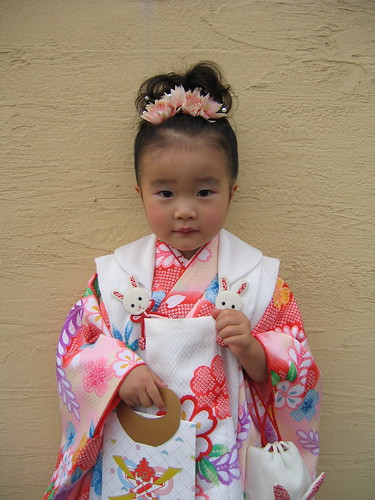
In Japan, there's a fun custom called "753" which is pronounced shichi, go, san in Japanese. It's basically an excuse for parents to get extremely beautiful photographs of their sons (at age 5) and their daughters (at ages 3 and 7) taken. J-List's own Yasu has a daughter who is three now, and they got some really cute pictures taken of her, complete with pink kimono with little bunnies sewn into it. Kawaii!

J-List loves to bring you unique products from Japan, items that let you bring a little piece of the country into your home. In Japan, they sell high-quality acrylic blankets, so soft to the touch you find yourself stroking them like a cat. My mother is a big fan of these soft Japanese blankets, and regularly has me bring her back some when I go home to visit. This year we're happy to announce that we've got large-size Hello Kitty soft blankets in stock, a real treat for fans of Sanrio's flagship character. The blankets are full-sized, measuring 140x200cm (55x79 inches), suitable for any use, and boy, are they warm.

Announcing lower shipping on all T-shirts and hoodies! As our way of saying thanks for helping make J-List's wacky Japanese T-shirts and hoodies so popular, we've lowered the shipping rates for you. The new weight-based shipping is especially good if you're ordering multiple items -- for example, the shipping for ordering four T-shirts is now almost half what it used to be. This makes our unique T-shirts and hoodies a fantastic item to consider giving for Christmas, especially with our automatic discount for buying 3 or more. We want you to think of J-List when buying great items for your friends and loved ones, and we hope we can serve you in some way today!


Hey, pictures from Japan! I finally found my card reader and grapped a few weeks worth of pictures off my phone. Here are the iTunes cards and iPods they sell in Seven Eleven, er, I mean Seven & iHolding, or whatever they're calling it. Looks kind of condomish.


The second Zeta Gundam movie came out a couple of weeks ago. Here is my oligatory "look, they have beer in Japanese movie theatres" picture.


Four Murasame looks really good with the new character design.


...Yet one of my favorite scenes, the kiss in the park, was done using hte 1985 footage. D'oh!


The other night was Jiichan's Birthday at our house, which always means a bit-ass plate of sushi. We ate ourselves silly, which is called tarafuku (eating so much you are about to burst) in Japanese.


Of course, beer is a requirement when eating good sush. Or even bad sushi.

Monday, November 28, 2005

All about Japanese roads, a Mongolian sumo wrestler does good, and goodbye Mr. Miyagi

You've been in Japan too long when you see a road with two lanes going in the same direction and assume the one on the left is meant for parking. Since Japan is quite a small country, with half the population of the U.S. crammed into an area 1/25 the size, it's not possible to make the roads as wide as some of us would like, and in some cities (notably, old castle towns that didn't get bombed during World War II) there are roads so narrow a car and a bicycle couldn't fit side-by-side. Since buying land for parking spaces is expensive, it's common for some business to expect customers to park on the street in front, despite the fact that cars stopping along the road effectively closes off one of the the two lanes. Many convenience stores are like this -- you can see five or six cars idling in front of a Seven Eleven, often with with the keys in the ignition and the cars running (since no one would steal your car in Japan). Other minor frustrations that make driving in Japan less than fun include railroad crossings (all cars must stop when they come to one) and of course Japan's never-ending road construction.

Well, Mongolian-born sumo wrestler is kicking butt again: Asashoryu won his 14th tournament victory, his 7th consecutive, and for the first time, a sumo wrestler has won every tournament in a single calendar year. At just 143 kg (315 lbs), Asashoryu is a lot leaner than now-retired giants like Hawaiian-born Konishiki or Musashimaru (both over 270 kg/595 lbs when they were wrestling). The emotional Asashoryu was actually in tears as he clinched his victory on Saturday. In other sumo-related news, Bulgarian wrestler Kotooshu (whose name sounds pretty cool -- it combines a Japanese harp (koto) with oshu, an old word meaning Europe) was promoted to ozeki, the second-highest rank in the sport. Sumo wrestlers fight 15 bouts in each tournament, held six times a year (three in Tokyo and one each in Nagoya, Osaka and Fukuoka). Sumo wrestling, the official sport of Japan, has been around for centuries, and is mentioned in the earliest written records (around 700 AD). Sumo wrestlers fight their bouts from lowest to highest rank, hence you can follow sumo by watching the last 20 minutes or so of each NHK broadcast, since the most interesting wrestlers appear last. This explains the "hurrying home to catch the last few minutes of sumo on TV" phenomenon you see in expat gaijin living in Japan.

I caught the news that actor Pat "Miyagi-san" Morita of Karate Kid fame had passed away at the age of 73 (along with the amusing tag line from Fark, "Cobra Kai wanted for questioning"). I've always felt an odd connection to the famous Japanese actors I watched on TV during my childhood, like Pat Morita and George Takei (although as a former ESL teacher, I can tell that all the grammatical errors Miyagi-san makes aren't ones a real Japanese person would make, since he actor spoke English as his first language). I hope Pat is enjoying a cold one in the Sapporo Brewery in the Sky.

J-List currently has an incredible stock of over 200 different 2006 calendars from Japan, including rare and popular anime (Totoro, Ghibli), JPOP (Gackt, BoA), Japanese idol (Leon Kadena, Yuko Ogura), traditional photo (Idols in Kimono, Famous Castles of Japan), and much more. This year we're also carrying the svelte 2006 Diaries (aka daily planners) sold every year in Japan, which are a great way to stay organized. All the diaries feature full monthly and daily calendars for 2006, allowing you to write in appointments and keep track of everything. Plus, they give you information like which days are the lucky and unlucky Buddhist days, feature maps of Japan, and great photos to look at all year long. Check out our selection of daily planners from Japan!

Remember that J-List sells the very popular iTunes Japan Music Cards, which are the only way to buy JPOP music from Apple's Japanese iTunes music store, unless you happen to have a credit card registered with an address in Japan (even I don't have one of those). Buying music from the iTMS Japan is incredibly easy -- just make a new account tied to an iTMS Japan music card number, and you can browse and make purchases from the iTunes already in your Mac or PC. All functions of iTunes work in your native langauge even when viewing the Japan store, and of course music from Apple's iTMS-Japan is fully compatible with iTunes and iPods from any country.

Friday, November 25, 2005

Japan as the land of contradictions, the benefits of teaching ESL, and our Mona Neko T-shirts

Japan is nothing if not a land of contradictions, where you can connect to the Internet via a high speed cellular connection while speeding on a fast shinkansen, and yet there are still fish-sellers who ride around on bicycles selling fish to households door-to-door, where technology is embraced while traditions, even stupid ones like the guy coming to each house in our neighborhood to collect our 2000 yen NHK fee every month, are preserved. I always enjoy making trips to Tokyo, where you can see an incredible range of on the train with you: the salaryman, the teenager rapidly thumbing her keitai (portable phone), high school girls talking in their own world...and then a gothic lolita, a cute girl wearing a 19th century maid uniform, staring out the window as she waits for her stop. I thought Japan was supposed to be famous for conformity? I guess I don't have this place figured out yet...

If you ever want to learn a subject well, I recommend you try teaching it. When I came to Japan to teach English as a Second Language, I had no idea how much of my own language I didn't understand, and yet in order to do right by my students I had to learn. For better or worse, the Japanese usually study English with a focus on grammar and vocabulary, since that's what appears on university entrance exams (none of this namby-pamby "communicative" English for them, thanks). When a student asks why an infinitive verb (futeishi) is used in a particular sentence instead of a gerend (domeishi), you want to give him an answer more substantive than "it just sounds better that way." One especially difficult part of English are two-word verbs like "take out" "take off" "take over" and so on. Why does "throw up" mean something different from "throw out"? My time as a teacher gave me a lot of respect for anyone who can tackle something as difficult as English, with its dizzying mix of cris- crossing rules and exceptions.

The Japanese have really embraced online culture, as seen by the grown of mammoth communities like famous 2ch BBS (pronounced "ni channel"). In addition to spawning the true story of Densha Otoko, in which an geeky otaku found love with a beautiful woman by asking for advice from readers of the BBS, 2ch is also a popular place for ASCII-art creation, the most famous being the Mona Neko cats. Mona Neko (whose name comes from the Japanese phrase Omae mo na! or "The same to you!" used in online flame wars on 2ch) and his friends have become such a popular symbol of Internet culture in Japan, we decided to make some wacky T-shirts as a tribute, which are on the site now: an image of the Mona Neko cats drinking their sake (they love sake), and a fun tribute to "panchira" (which all men love, whether they admit it or not) Be sure to check out the wacky Japanese Numa Numa video here, with attempts at matching the words with Japanese meanings, here. (It's really cool, I watch this silly thing a few times a day.)

One of the most anticipated snack treats from Japan is finally here: the delicious winter-only Melty Kiss, delicious fudge cubes coated with cocoa powder that are heavenly to eat. The name is also one of the most bizarre and fun bits of wasei eigo (lit. "made in Japan English"), capturing the image of a warm stolen kiss with snow falling all around you. We've got all three flavors for 2005 in stock: Precious Cocoa, Matcha (Green Tea) and Strawberry!

Wednesday, November 23, 2005

The nuances of "Ogenki desu ka?" and a new movements in Japanese politics

Ogenki desu ka? This is one of the first phrases a student of Japanese encounters, and it corresponds to the greeting "how are you?" although "are you well?" is a better translation as it's a yes/no question. In the context of this greeting, genki means "fine" or "well" and you can reply to this greeting by saying Hai, genki desu (Yes, I am fine). But genki can have other meanings, such as describing children running around ("energetic"), or someone beaming with happiness about something, or someone getting healthy after an illness. The word can also refer to a man in state of, er, woodiness. The o on ogenki desu ka is an honorific prefix that shows respect, and it's often found on family titles (okaasan = mother, obaasan = grandmother), Buddhist words (otera = Buddhist temple), and "cute" words often around kids or babies (oshiri = a cute-sounding word for a person's rear end).

The newest theme in Japan's political world is eliminating waste, and Japanese municipalities are nothing if not good at wasting the public's money. Although the concept of company employees enjoying guaranteed lifetime employment faded during the 1990s, Japan's sprawling layer of bureaucratic komuin (koh-MOO- een), public employees who work in city and prefectural offices, have never had to fear recessions or budget cuts or risutora, the Japanese word for layoffs (from the English word "restructure"). Due to the lack of oversight and years of poor planning, there are too many public employees, three million in the entire country of 120 million, and their salaries add up to a whopping $180 billion a year. Engaging in "bashing" of public employees is a popular pasttime by average Japanese, and my wife is always happy to tell me how slow the clerks moved in the City Office when she went to pick up an official copy of a document. When someone from the city needs to come out to J-List to check on, say, a telephone pole, you can be sure that at least three engineers will show up, two more than are probably needed. Before I started J-List in 1996, I was fortunate to get to work for five months in the local City Office, and I got to see first hand how municipal government worked from the inside. My job was to publish a newsletter for the English-speaking residents of our city, and to act as a bridge between Japanese employees in the city government and foreigners who couldn't speak the language. Having seen both sides of the coin, I can say that there is a lot of room for improvement in Japan's municipal government.

Among the many unique products J-List offers are the DVDs, photobooks and magazines of Yulia Nova, a beautiful Russian model who was discovered by a Japanese photographer and became a sensation both here in Japan as well as on the Internet. Her next three DVDs are coming soon, and we've posted them for preorder now. The new titles feature all new footage shot over the past year that allows fans to see Yulia in a variety of amazing scenes through three seasons: Moscow in the Winter, Spring and Summer. The new titles are long playing (85 mins. each) and are mosaic-free, too!

J-List sells our wacky original T-shirts with funny slogans in Japanese, as well as unique Japan-related designs. While many stores only stock the most popular sizes of T-shirts (typically M-XL), J-List goes out of our way to make as many sizes as we can available, from S (and even XS, on some of the girl's shirts) to 2XL and 3XL for the men's shirts and hoodies. We've posted 3XL sized shirts for our popular kanji shirts (Gaijin, Ecchi and Sakebito), so if you need a larger size, come visit J-List now. We've also got many close-out designs that we're clearing out to make room for new shirts, so if you're on the large side, be sure and browse our site for some bargains!

Monday, November 21, 2005

The Old West comes to Karuizawa, and World Peace through Japanese verb conjugations

This weekend we all got in the car and headed off to Karuizawa ("ka-roo-EE-za-wa"), our favorite mountain getaway, for a dip in the hot springs at the foot of volcanic Mt. Asama. Driving through the town, we stopped off at the Cowboy House restaurant, a hilariously overdone recreation of an Old West steakhouse complete with barbecue sauce, baked beans and even Coors beer. The cowboy atmosphere was so complete that a funny thing happened when we left: I momentarily forgot which side of the road I should be driving on. It seems my subconscious had somehow analyzed all the American stuff around me and decided to go into "America mode." Fortunately I caught myself and got back on the right (left) side of the street.

Japanese is an "agglutinating" language, which basically means that it puts lots of information (past tense, passive voice, etc) inside the verb form, which is good because you don't have a lot of helping verbs flying around ("he would have been able to help her if she'd told him"), but a little difficult because you have to memorize more verb forms. Most of the time learning the verbs is not a problem since they follow reliable patterns. For example, three verbs you learn early on are the formal verbs tabemasu (to eat), nomimasu (to drink) and ikimasu (to go), which act as both simple present and future tense (both "I go (every day)" and "I will go" in one verb conjugation). Change the masu to mashita and you have the formal past tense ("I went") -- very easy. Some other forms that exist are informal present tense (iku), also called dictionary form since this what you find in dictionaries; an informal past tense; a command form; and the useful "te" form which you can use to make requests (tabete kudasai, please eat) or join words together (take + come combine to form "bring").

Another verb ending students of Japanese learn early is masho, which corresponds to "let's...," as in "let's eat" (tabemasho), "let's drink" (nomimasho), or "let's go" (ikimasho), to use the above examples. This is more than just a handy suffix to allow you to say many things in Japanese -- it's actually a reflection of Japan's unique group-centric culture. In a non-smoking area in the U.S., you'd probably see signs saying something like "do not smoke," giving you no choice in the matter. In Japan, however, it's common for such notices to use the gentler "masho" ending, effectively saying "let's not smoke in non-smoking areas," (tobacco o yamemasho), "let's put our telephones into vibration mode" (manner mode ni shimasho) and so on. It seems to be part of the Japanese psyche that they respond better to an inclusive request rather than a specific command or rule. This "let's request" form has a very soft sound to it, and parents and care-givers use it to make even the most stubborn child do what's asked of them.

Remember that J-List is brimming with great 2006 calendars
right now, with more than 200 different anime, JPOP, swimsuit idol, nature photo, desktop, sports, and other items in stock. In addition to very popular calendars -- Studio Ghibli, Howl's Moving Castle, Mihiro, Reon Kadena -- we also make it our mission to provide an amazing selection of other calendars that are only sold in Japan, from the esoteric to the bizarre to the just plain fun. Studying Japanese, or just like the aesthetic look of kanji? We've got several calendars that feature Japanese words and slogans, beautiful kanji proverbs, and more. Interested in Japanese contemporary art? We've got some great art calendars in stock this year. Love Japan's attractive actresses or swimsuit models? We've got many to browse through. A word of warning though: Japan is a very seasonal place, and these great calendars are only available now. The best time to make your 2006 calendar order is now!


More random pictures for you to browse. This is Dairy Domo-kun and Cabbage Domo-kun, a rural version of NHK's famous mascot to advertise Gunma's good quality foods.


Daughter holding rabbits at the petting zoo slash farm we went to.


Hey, this is where they sell the Frower Angels.


Pizza Hut's pizza is not bad, but darn if their salads aren't the best in all Japan.


I was amused to see what was written on my salad dressing.

Friday, November 18, 2005

Unique businesses that exist in Japan, Rubik's Cube, and more Funny English Words

Japan is a unique place, and the economic forces that cause this kind of business or that to spring up can be quite interesting to observe. During my 14 years in Japan, I've seen quite a few businesses that don't exist in the U.S., or if they do, I've certainly never come across them. One convenient service are the daiko, or replacement driver taxis, basically a taxi with two drivers; if you drink too much while at a bar, one will drive you home while the other follows in your car, so you have it in the morning. Near my house there is a company called Orange Hat, which is basically a building with nothing but vending machines of every kind inside, from video games to UFO Catchers (e.g. crane games) to dispensers that sell you microwaved meals. Since the business can be operated with just one caretaker employee, it's a profitable concept even in very rural areas. Nearly all Japanese homes and apartments have bathtubs and showers, but a couple of decades ago this wasn't the case, and people went to a sento (public bath; the kanji is 銭湯, so named becuase it used to cost one sen, or 1/100 or a yen, to go there) a few times a week to keep clean; nowadays, sento provide a place to relax and bathe socially. What you may think of as an Internet Cafe is usually called a Manga Kissa (Manga Coffee Shop) here in Japan, a place where customers can sit and read manga, surf the net, play online or console games, study and of course have a cup of coffee. And for those times when couples feel the need to be alone, there are always Japan's famous Love Hotels, where you can enjoy a clean, private environment with or without the Arabian Nights theme.

Japan is experiencing a revival of the classic Rubik's Cube, with sales of the addictive and frustrating (to me) puzzle cube soaring through the roof. The 2005 Rubik's Cube Championship was recently held at Disney World in Florida, and among the 145 contestants was Yuki Hayashi, a well known Rubik's Cubist from Japan, who managed solve the standard 3x3x3 cube in 12 seconds. These guys can solve a Rubik's Cube with blindfolds on -- it's really amazing to see!

The Japanese do like English, and use it to add spice to their speech, but some of the words are changed so much you might not recognize them. For example, the word "my" is used to indicate ownership of something, and banks might use the term to advertise special rates on a "My Home Loan" (home mortgage) or "My Car Loan" (a loan for that special automobile you've been pining for). Various other simplified words abound, for example, a child's crib is a "baby bed," screwdrivers come in "plus" and "minus" varieties, and when a man no longer wants children he's likely to get a "pipe cut." Titles of Western movies can also be hard for Japanese to remember, so they're sometimes reduced into simpler English. "The Professional" was retitled "Leon," "I Know What You Did Last Summer" became simply "Last Summer," and "Honey, I Shrank the Kids" became "Micro Kids."

At J-List, we genuinely love Japan and want to help people around the world learn more about this enigmatic place. During my time in Japan, I've made heavy use of a powerful tool for students of Japanese: Canon's Wordtank electronic dictionary. A great dictionary that's packed full of great features for serious students, including 11+ different complete dictionaries, full English menus, and a handy compact size despite the easy to use QWERTY keyboard that makes looking up words very speedy. We're happy two announce two new models of Canon's excellent Wordtank in stock, the brand new C50 and deluxe G55, two excellent brand new dictionaries for you.

Christmas is coming, and J-List has stocked up on thousands of amazing and unique gifts for the Japanophile on your shopping list (even if it's just you). From our original kanji T-shirts to wacky plush toys to calendars you can only find in Japan and much more, J-List has that unique gift you're searching for. Since most of J-List's products ship from Japan, it makes sense to browse our site and make your order right now, since shipping can slow down around Christmas.

Wednesday, November 16, 2005

Wedding bells in the Imperial Palace, beautiful autumn in Kyoto, and George Bush in Japan

Every autumn in Japan the leaves change to beautiful shades of red and yellow and vermillion, a spectacle called koyo (紅葉, lit. "crimson leaves"). And just as the leaves are starting to turn, we know we'll be tempted with a barrage of TV commercials by Japan's JR train line promoting Kyoto in the fall, showing incredible images of the city with autumn-colored leaves all around, along with the very effective slogan, So da! Kyoto e iko! ("Hey, I've got an idea! Let's go to Kyoto!"). Well, there's a very famous guest in Kyoto right now: none other than George W. Bush, who is in Japan for a two-day meeting with Prime Minister Koizumi. Last night the two leaders took in Kinkakuji, the famous Golden Pavilion, and today they're going to be discussing issues ranging from Iraq to U.S. bases to bird flu. The U.S. is also expected to press Japan to resume beef imports, which have been on hold since 2003 over Mad Cow. Mr. Bush will be the first guest in the newly completed Kyoto State Guest House, a sprawling facility constructed to house international events and foreign dignitaries. I wonder if he got to take a Japanese bath and sleep in a real futon? That would be so cool. As far as world leaders go, I can't think of anyone who needs to be exposed to some outside ideas more than Bush, and maybe he can realize there's an actual world outside of Texas and Washington in Japan. Fingers crossed that there will be no projectile vomiting on any Japanese Prime Ministers this time around...

Japan has been seized with a bout of "wedding mania" after the happy marriage of Princess Nori, daughter of the current Japanese Emperor Akihito, to an employee of the Tokyo Metropolitan Government. The ceremony, while beautiful, was remarkable because it was just another Japanese wedding, despite the royal status of the bride. After a very traditional Shinto ceremony at the Meiji Jingu Shrine in which Norinomiya-sama wore a juni-hitoe, a traditional 12-layer kimono dating back to the 10th century, the happy couple had a fairly unremarkable reception at the Imperial Hotel in Tokyo. The news was all over the story, from interviewing some of the the 6000 people who lined up on the street just so they could wave to the princess as she drove by to giving full report on what was served during the reception. The reception itself followed the well-defined mold of Japanese weddings, starting off with a speech by the groom's boss (in this case, Tokyo mayor Shintaro Ishihara, who you may remember is the guy who wrote "The Japan That Can Say No" a decade ago) and ending with an emotional speech by the bride, thanking her parents for raising her and promising to find happiness in her new life. Princess Nori's husband is a sports car collector and loves driving his Lotus Elise, and the newscasters were laughing at the image of a the demure former Japanese princess zooming around at high speeds with her husband.

Over the years, J-List has been honored to bring anime fans from all over the world a direct link to Japan. Because we're fans of Hayao Miyazaki's films, we've always gone out of our way to bring great Studio Ghibli products to everyone. Today we're happy to announce the release of Howl's Moving Castle
on DVD, complete with full optional subtitles in English, French and Japanese, and full dubbed tracks in English and French as well. We've got both versions, too, the normal 2-disc set and the super deluxe 4-disc collector's edition, with making of, interviews with the director and more. Howl's Moving Castle is the story of a plain girl whose life is touched by the mysterious wizard Howl, and it's a great story for all fans of Mr. Miyazaki! (The DVDs are zoned for region 2, however, and we recommend the excellent region free DVD players we stock, starting at just $68).

Monday, November 14, 2005

All about Japanese TV, the fun of variety shows, and respect I've gained for American medicine

One of the fun things about living in Japan is getting to watch Japanese television. There are 5 national television networks in Japan, NTV, Fuji TV, TBS, TV Asahi, and TV Tokyo, and most viewers enjoy a variety of entertainment from these five channels. Our family watches news (Newsstation 23, World Business Satellite), dramas (my wife is watching the current Fuji drama with heart throb Mokomichi Hayami), sports (my wife's father watches baseball every day, and sumo when it's on), and anime (we never miss Sazae-san on Sunday nights). In addition to the traditional TV stations, there are upstart satellite broadcasting networks like SkyPerfectTV, which carries American programming like CNNj and Fox Japan (for fans who can't wait for the latest episodes of 24 to show up at the DVD rental shop).

A big staple of Japanese television is the variety show, which by definition features a wide variety of subjects, from asking non-bilingual Japanese to answer questions in broken English while a translation of what they're really saying appears on the screen, to shows that challenge people to live for a month on just $100, to "truth or dare" contests where they make popular actresses get into a bathtub of very-hot water for 30 seconds. Often these variety shows go for shock value, like the show I caught that made swimsuit idol Otoha climb to the highest point of the the 509-meter tall Tapiei 101 Tower in Taiwan -- on the outside of the building. Another show offered to grant wishes sent in by viewers, as long as they were interesting. One boy said he'd always wanted to take a bath in a giant vat of caramel custard pudding (aka flan), so the producers got a hundred volunteers from his town to prepare it for him; but in the end, the boy decided he didn't want to jump into the custard since everyone had worked so hard to make it, so they all ate it instead. Another man had always wanted to fly while holding helium balloons, but it takes hundreds of balloons to lift a man off the ground. The show constructed a giant net for him to wear on his back then filled it with balloons until he was able to "fly" 10 cm off the ground, finally fulfilling his dream. Variety shows like to capture bizarre moments of kawaii too, like when one show dressed cute-as-a-button Yuko Ogura as a baby seal took her to the polar bear tank at the zoo. The results were pretty hilarious -- see the video here (Windows Media required)

No matter how much I like living in Japan, there's just no replacement for good old American medicine when I'm sick, and whenever I go back the the States I always pick up Nyquil, Advil, Alka-Seltzer and other medicines I think I might need back in Japan. While my wife usually prefers Japanese medicine -- which is usually too weak for my big gaijin body -- she's starting to see the benefits of the stronger American remedies. Last month when she caught a head cold, she didn't waste any time asking me for "the strong stuff," and she was on her feet in no time. In addition to U.S. medicines being stronger than their Japanese counterparts, there's another difference: Japanese medicine bottles aren't required to have child-proof caps on them. As a result, Japanese almost never know how to open a child-proof cap, and I usually have to step in and help my wife when she's trying to get the bottle open.

When my children were small my mother bought us a book we've come to value a lot: Japanese Children's Favorite Stories, which contains English versions of all the famous children's stories that Japanese know, like Momotaro (Peach Boy) and the Old Man who made the Flowers Bloom. Happily, we've got this excellent book in stock in San Diego, and I heartily recommend it to all parents who want to treat their kids to some great stories from Japan. The book even comes with an audio CD, too!

Friday, November 11, 2005

Educational game shows, winter coming to Japan, and the eerie, sad story of Minako Honda

I've always been impressed with how serious Japan is about education, and a lot of energy is spent on coming up with ways to teach children more effectively, especially with so few of them popping out these days. Recently, Japan's test scores have been on the decline, indicating that the country is losing out to other Asian nations on the education front. Scores on the TOEFL, which tests academic English, were especially embarrassing, with Japan tied with North Korea at the bottom of the list -- although to be fair, 140,000 Japanese took the test, compared with just 50 students from the Kingdom of Bhutan, which isn't exactly comparing apples to apples. In order to combat the fall in Japanese test scores, there's been a slew of TV programs designed to improve knowledge of subjects like history, math, English and kanji. One show I caught a few days ago placed famous "talents" (actress/singer/idols) in a mock-up of an Indiana Jones-style ore car, hurling down a bluescreened mine shaft. Questions popped up in front of them, and the people in the ore car had to choose the answer by leaning left or right. If they chose correctly they escaped from the mine, but if they chose wrong, their ore car was cast into a pit of flaming CG lava.

Japan is grieving right now after the tragic death of Minako Honda, one of the brightest JPOP stars of the 1980s (right up there with Seiko Matsuda and Akina Nakamori). The 80s were a special time in Japan, when people were filled with an unstoppable optimism about the future of their nation, and the bouncy, fun pop stars of the era left a deep impression on everyone. Japan can be a superstitious place, and a lot of beliefs about how luck is generated revolve around a person's name. There are lucky and unlucky kanji, for example, and even the number of strokes in a person's name are believed to affect their karma. For example, when we named our daughter, my wife made sure to choose kanji that had the same number of strokes as her own name, so her daughter would share in her own good luck (since she was lucky enough to meet me, ha-ha). Last December, Minako officially changed her stage name to Minako Honda. (本田美奈子.), with a period as part of her actual name (similar to the way JPOP group Morning Musume is always written with a small circle at the end). Her goal was to improve her own personal luck and aid her stage career, but this was not to be: tragically, she was diagnosed with acute myelocytic leukemia a month later, which has many superstitious Japanese (including my wife) nodding knowingly about the dangers of trying to influence your own destiny through artificial means.

Winter is threatening to descend on Japan in earnest. Because Japanese homes lack central heating, it can be hard to keep warm, especially for a San Diego gaijin like me. We've turned on our kotatsu, which is a low table with a blanket over it and a heater inside; you put your legs in the kotatsu, which warms your whole body, and for the complete Japanese winter experience, drink hot green tea and eat mikan (mandarin oranges) at the same time. In lieu of central heating, we use stand-alone kerosene heaters called "stoves" (suto-bu), or electric-kerosene heaters that blow heated air (called "fan heaters"), the latter being better for you since they have a built-in 3 hour reminder to open a window and let some fresh air in. Kerosene heaters are economical, but the smell they make when you turn one on or off can give you a headache, and don't get me started on the freezing agony of having to go outside and refill the kerosene tank when it runs out.

Glico has declared that November 11 is Pocky Day, because of the way 11 11 looks like Pocky sticks lined up. In celebration (?) of this day, we've added stock of several flavors of Japan's most favorite snack. Remember, you can always buy Pocky by the shrinkwrapped case and get 15% off.

Wednesday, November 09, 2005

The challenge of the Japanese toilet, how place names work in Japan, and words for "I"

There are many challenges for foreigners who come to Japan: learning the unwritten social rules (which probably don't apply to you anyway, as a visitor); coping with large, easy to read signs explaining where you're supposed to go (too bad they're in kanji); and learning to enjoy food even though you might not know what it is. Another difficulty that must be overcome is the washiki toire, or Japanese-style toilet, seatless toilets usually found in restaurants, train stations and other public places that you squat over to use. Although Japanese love them because they keep your body away from touching anything dirty, foreigners generally have difficulty with them, since you can't exactly ask for instructions. Well, here's a handy link that that should give you some pointers in case you encounter one of these babies:

Place names in Japan are another interesting subject. The names of the various towns, cities and prefectures are nearly always written in kanji, however all name kanji tend to have many different readings, which can cause confusion. While almost all Japanese can read the standardized kanji everyone learns in school, it can be quite difficult to read kanji place names in another region of Japan. When I take a trip to Northern Japan or the Kyoto area, I know my wife will suddenly become unsure how to pronounce the names of the towns we're passing through, even though she's Japanese. There's another complication: most every part of Japan has both a modern name and an old (Edo period) name, the result of the massive changes during the Meiji Restoration, when the old feudal domains (han) were replaced by a modern system of prefectures (ken) patterned after France. Gunma's old name is Joshu, and neighboring Nagano's old name is Shinshu, and these names pop up from time to time (for example, a ramen shop advertising the "old taste of Joshu").

In Japanese, words can carry a lot of hidden nuances specific to each gender. There are different versions of the first person pronoun for men and women in Japanese, and which word a person chooses to use carries information about how that person views himself. For women, the words for "I" are watakushi (in formal situations), watashi (neutral, slightly feminine) or atashi (very feminine and cute). If a girl is tomboyish she might use a "boys" word for I, boku, and if she's trying to project an extremely cute image, she might even refer to herself in the third person. My daughter, who is eight, calls herself "Rina-chan," although some women in their 20s do this, to the annoyance of many around them. Men will use watakushi (formal), boku (neutral, slightly polite), or if they want to project a "manly" image, ore (OH-reh). Words for "you" include anata (slightly formal, and a little romantic if used by a wife to her husband), kimi (used when talking to someone younger than you), and for men only, the masculine word, omae (oh-MY-ae). A common alternative to using a second-person pronoun is to refer to the person you're speaking to by his name, e.g. Tomo or Fujita-san, if you were talking to Tomo.

We're proud to take the wraps off a new section on the J-List: Japanese textbooks & books about Japan, where we'll be carrying many great new books to help you study Japanese, learn grammar, practice your kanji and kana, and learn about Japanese culture. Look for books on contemporary Japanese home design, learn to play Go or Mah Jong, and much more! For your convenience, these new books are stocked in San Diego, and can be shipped to you in a very short time. Browse our new selection of Japan-related books today!

Monday, November 07, 2005

Successful foreign companies in Japan, and the story of Coca-Cola, vending machines and more

Japan is a unique place, and it's not always easy for foreign companies to succeed here. There are many barriers to making it in Japan, from the confusing multi-leveled tonya distribution system to the often-quirky tastes of Japanese consumers. Still, many famous gaishi-kei" (foreign capital") firms have built successful businesses here, with some companies like Nestle, Proctor & Gamble and Northwest Airlines having been in the marketplace for so long people often don't realize they're foreign (Northwest has been flying commercially to Japan since 1947). The Japanese have a lot of respect for the icons of America and Europe, and happily embrace brands such as BMW, Michelin, Jack Daniels and Harley-Davidson, all of which have found a great deal of success here, and when a famous brand finally claims "mind share" in the Japanese marketplace, it usually enjoys long-term success. On the other hand, Japan is a very competitive place to do business, with many companies actively pursuing every market, and Japanese consumers are especially demanding of high quality. But the benefits of succeeding in Japan can be enormous: some companies, such as Louis Vuitton and AFLAC, have encountered so much success when they expanded into Japan that it basically springboarded the rest of their company to new heights worldwide.

One of the most incredible success stories of any gaishi firm is that of Coca-Cola. Along with Hershey's chocolate and Levi's, Coke was an enigma to Japanese of the occupation era, a mysterious treat enjoyed by the victorious American soldiers. Over the course of a decade, Coca-Cola overcame the Byzantine, almost Soviet-style regulatory hurdles it had to to face in order to flourish in Japan, and now Coke has something like 90% of the cola market to itself (spikes from Pepsi Star Wars bottlecaps notwithstanding). The rise of Coca-Cola in postwar Japan went hand-in-hand with the popularity of vending machines (there's one for every 23 people here), and Coca-Cola solidified its position in part by taking the lead in developing the most innovative vending machines of any company (including one I saw the other day that let you watch current Coke TV commercials on a built-in LCD screen). Now Coke is somewhat analagous to Toyota in the U.S., a large, smart outside competitor to Japan's Big Four beverage companies (Asahi, Kirin, Sapporo and Suntory).

Foreign companies provide an interesting alternative to working at more traditional Japanese establishments. Foreign companies in Japan have an image of being more socially progressive than Japanese firms, and women interested in seeking serious careers might consider working for American or European firms operating in Japan. The idea of semi-guaranteed "lifetime employement" came to an end in Japan the 1990s, but it's still common for most full-time employees to expect to stay at the same company their entire lives. Japanese who decide to work for a foreign company generally expect more performance-based pay than they might find at traditional Japanese corporations, along with opportunities for advancement beyond those based on age and seniority, which is still quite rare in more traditional Japanese companies. On the other hand, there's apt to be less stability at a gaishi-kei company, which is an important factor in conservative Japan.

Among other things, J-List sells hundreds of amazing DVDs of all types from Japan. While most of our DVDs are issued as "region free" (meaning you can play them on any DVD player), many of the indies, anime and other discs are zoned for region 2, meaning you need a special player to watch them. Happily, J-List carries three excellent region free DVD players that make it easy to enjoy *all* DVDs from Japan, including PAL discs from Europe. We have the full-featured DIVX-compatible DVD-7050, the handy portable M280, and the great half-height Karaoke-enabled DVD-7880K. Just in time for the busy Christmas season, we've dropped our price on the affordable 7880K to just $68! All players are very well made, are manufacturered for the North American market, feature international power supplies, and come with full 1 year manufacturers warranties. Also, all players are shipped double-boxed by our loving San Diego.

Friday, November 04, 2005

Japanese vs. American houses, and lots of fun with Japanese onomatopoeia sounds

(It looks like Wednesday's update had some trouble going out to everyone. If you missed it, please go to the J-List main page and scroll down to read it.)

There are many differences between my house in Japan and our home in San Diego. My Japanese house includes a large genkan (a lowered area by the front door to take your shoes off), a tatami room (for receiving guests, although it's usually cluttered with stuff), and a wide veranda (for hanging clothes out to dry, as Japanese don't usually use clothes dryers). There's no basement or attic, as these are difficult to build in Earthquake-prone Japan, and we lack central heating, too. Another big difference is the lighting in our house: while our San Diego home is lit with a variety of lamps and a few built-in spotlights here and there, almost every room in our Japanese house sports at least one oversized fluorescent light in the ceiling, which makes the room very bright. The Japanese are big fans of fluorescent lighting, due (I've heard) to the government promoting the use of low-energy lighting after an Earthquake in the 1970s caused gas and electrical fires. I prefer to have lots of light when I'm sitting in a room, and the Japanese have developed soft yellow fluorescent lights that are very pleasant.

It's fun to learn Japanese onomatopoeia, which come up in anime quite a lot and are very colorful. If someone guesses the correct answer to a question, you can say pin-pon! which is a verbal represenatation of the "correct answer" bell on game shows (it sounds like the English word Ping Pong, but is totally unrelated). The opposite of "pin-pon!" is a low-pitched buuu! buzzer sound. Animal sounds also have onomatopoeia assigned to them, and they sound different to Japanese ears than they might to us: nya nya, wan wan and "kero kero" correspond to "meow meow," "ruff ruff" and "ribbit ribbit." Instead of saying "moo moo," Japanese cows say moh moh, and one of the classic jokes in Japanese is to draw a cow saying something like moh yamete! ("please stop, already"), since the cow sound moh sounds like the word that means "already." I've seen quite a few political posters making use of this famous Japanese pun.

Similar to onomatopoeia, which are based on our perception of actual sounds, are gitaigo, words which sort of assign a sound to describe a state or action. If you go to the doctor because you've got a headache, he might ask you if it hurts gan gan (a pounding pain), jiito (a constant, slow pain) or perhaps zukin zukin (a throbbing). If you're very happy about something, you might use the word uki uki (OO-ki OO-ki) to describe yourself, but the feeling of frustration would be ira ira (EE-ra EE-ra). Japanese are very health conscious, and there are TV shows informing people what they should eat if they want their blood to be sara sara (smooth-flowing) instead of doro doro (thick and syrupy). These words often add information about how how an action is performed, for example, koso koso (sneaking around), kotsu kotsu (slowly, one step at a time) and giri giri (doing something in the nick of time). Don't worry, these won't be on the test.

J-List brings you our amazing Japanese T-shirts and hoodies, with cool messages printed in kanji. It's really cooled off, which means it's a great time for you to consider one of our high quality hoodies, soft cotton hooded sweatshirts that will provide plenty of warmth during the cooler months. By customer request, we've added a new hooded sweatshirt
to our lineup: sake-bito ("alcohol-person"), a parody of the famous Okinawan shima-bito ("island-person") shirt which could be translated as "I love alcohol" -- great for anyone who likes to throw one back now and again. Our hoodies are soft, warm and very well made.

Wednesday, November 02, 2005

All about dogs and dog names in Japan, and many way to say "I like you" in Japanese

Yesterday was November 1, designated as Inu no Hi (ee-NOO-no-HEE), or Dog Day, the official day for dog owners and their pets, because 11/1 sounds like wan wan wan or a dog's bark. People here really love canines of all types, and it's quite common to see shoppers walking around with their "brand dogs" (famous breeds like Shiba Inu, Akita Inu, and Chihuahuas). Products that help you pamper your dog abound in Japan, right down to the Louis Vuitton Pet Carriers. The ranking for dog names in Japan, if you happen to be curious, is as follows:

10. Mocha
9. Sora (meaning sky)
8. Nana (meaning nothing in particular)
7. Rin (ditto)
6. Koko (ditto, just sounds cute)
5. Hana (flower)
4. Sakura (cherry blossom)
3. Marron (French word for chestnut)
2. Momo (peach)
1. Choco

Suki desu ka? One of the first useful words a student of Japanese learns is how to say "like" (suki), which is pronounced quickly so that it sounds rather like "ski," leading all students to immediately say Sukii ga suki desu ka? (Do you like to ski?), since the words sound similar. The word suki is often a student's introduction to the concept that a word or idea in one language might have many possible meanings in another language, depending on the situation. Right off the bat, suki can mean "like" (in the context of your favorite food or hobby) or "love" (when said in reference to another person). Like all Japanese words, there can be some ambiguity involved, which is the subject of more than a few melodramatic misunderstandings in anime or television dramas. "(I) like (it)" is Suki desu, and "Do (you) like (it)?" is Suki desu ka? Often Japanese speakers will fill in who is liking what (e.g. Boku wa ninjin ga suki desu, "I like carrots"), but it's usually too cumbersome to add all those words and grammatical particles when the person you're speaking to will understand what you mean anyway. Other phrases you might encounter include suki na hito ("a person you're in love with") and dai-suki (meaning "big like," for when you really like something), although guys should be careful about over-using the latter, since it tends to be onna-kotoba (language used by females). A couple of years ago I saw a variety show in which former JAV actress-turned-novelist Ai Iijima walked around New York, asking Americans Kyonyu suki? which sounds like "Can you ski?" in English, but is really asking if they prefer women with, er, shapely figures. It was funny to see the Americans on the show nodding their heads for the camera. Try it on your friends!

Mars is very close to the Earth right now, so I'm taking off early today, packing the kids into our Mazda Bongo Friendee and heading up to the mountains to visit the Gunma Prefectural Telescope, where we can go gaze at the heavens. See you when we get back!


A picnic up in the mountains. Our car is a Mazda Bongo Friendee, which is a really cool sort of MPV which has a top that opens up.


Us having our lunch in our car.


My son eating his bento. You can buy bento at convenience stores, which is quite convenience.


Trying to photograph my wife through the "communication hole" between the top section and bottom.

Monday, October 31, 2005

Halloween in Japan, some funny Japanese English words, and all about Daylight Savings Time

Happy Halloween from all of us at J-List. Yesterday was the big Halloween Party at my son's experimental elementary school, where 70% of the classes are taught in English although the school itself follows the standard Japanese curriculum. Despite the fact that all the students are Japanese and Halloween is a very foreign idea here (the Japanese love of cosplay notwithstanding), it was a big success, and all the kids had fun dressing up in various costumes. When my kids were younger, we made a special trip to the U.S. in October so they could experience an American-style Halloween, and they just loved it. Somehow the school managed to rustle up some orange pumpkins (which are usually hard to find in Japan, as the Japanese idea of a pumpkin is green and squash-shaped) and the kids got to carve them. My son smelled that oddly sweet smell of candle-burning- pumpkin-flesh and declared that this smelled like America to him (kind of like the smell of Mr. Bubble bubble bath). I'm happy to report that my son, who was dressed as Obi Wan Kenobi, won the award for best hand-made costume.

Language is a fluid thing, and every country makes use of words that suit its particular needs and sensibilities. Often I've encountered "English" words in Japan which didn't make any sense to me for one reason or another, and it took me a while to remap the words in my mind. A person's fanny will often be referred to as the hip in Japan, while a woman who is well-endowed is called glamor (guramaa), which always sounded like the word grammar to my ear (quite unrelated). Like the British, the Japanese use the word "muffler" to describe what you wear around your neck to keep warn in the winter, what I'd always called a scarf. If it's hot out, you turn on the cooler (also known as aircon), and if you need to dial a # key on your phone, be sure and hit the "sharp" button (as in musical notation). When reaching for a screwdriver, you can choose between minus (regular) or plus (Phillips), which is quite logical, really. If you park your car so that it blocks your neighbor's driveway, he might come over and claim (kureemu) -- somehow the English word claim shifted slightly in meaning, so that it now refers to verbally complain about something. A mansion is Japanese-English for an apartment or condominium that is owned, not rented. And if you practice dema you are spreading lies about someone (from the English word "demagogery").

If you're in North America you probably set your clock an hour back on Sunday. Most people grumble about having to remember to set their clocks forward and back in the spring and autumn, this isn't a problem in Japan, the only industrialized country that has not adopted the Daylight Savings Time system in one form or another. Instead, we have to deal with the other extreme -- if I stay up past 3 a.m. watching Japan's bizarre late-night TV, I often have to fall asleep while ignoring the sun lightening the sky outside, which isn't much fun.

Calendar season is in full swing at J-List, and we've currently got over 200 great 2006 Japanese anime, JPOP, bikini idol, sports, and other calendars on the site. As usual, this year the anime calendars lead the pack, with the always popular Studio Ghibli 2006 Calendar (which includes twelve fabulous *all original* illustrations from Hayao Miyazaki's films) again our top seller. Other hit anime calendars this year are Mahou Teacher Negima, Howl's Moving Castle, and all the Naruto calendars. On the JPOP scene, Gackt is in the top spot, followed by Aya Ueto, and the always-cute Morning Musume. For our "beautiful women of Japan" category, Idols in Kimono is the surprise hit, followed closely by Yuko Ogura, Reon Kadena and Misaki Itoh. Finally, our "impressions of Japan" calendar category are very popular this year -- top sellers are Japanese Heritage (traditional scenes of Japanese culture), Haruyo Morita's amazing contemporary kimono girls, and Garden of Four Seasons and Castles of Japan.

Remember, you can easily check the top J-List products using any RSS reader via our XML/RSS feed, which is a very handy way to watch your favorite websites to see when they've been updated. The links to the J-List/JBOX feeds are along the left side of the screen.


Son hanging out with his friends


Pretty pathetic haul by American standards. I told the kids there how I used to take a pillow cover and fill it with candy, since it was the only thing sturdy enough to avoid ripping.


Kazuki won the contest for best hand-made costume!


Wow, what a great costume, I thought, seeing this mother with a Thing 1 shirt on. I am a bit Seuss fan. Sadly, it was just a shirt she bought somewhere.


Sometimes a single TV commercial can make long-term waves in Japan's culture. These horses are a reference to a TV commercial for some product (I can't remember what it was) that showed back in 2001 or so. They look really good...

Friday, October 28, 2005

On stereotypes, how and why words jump from one language to another, and trying to recall the term "gynecologist"

Stereotypes are really not good, since they cause us to make assumptions about people from other countries before we've gotten to know them. When I taught English as a Second Language, I used to do a lot of part-time work, going to people's homes to teach their kids once a week, and I was able to meet a lot of people this way. One family I taught seemed to be a pretty average Japanese family on the surface: bustling mother overly concerned about her kids' education; bright daughter; younger son who loved Pokemon; and a salaryman father who often worked late. The father surprised me one day by showing me pictures of his journey from Vladivostok to Moscow on the Siberian Railroad, which had been a lifelong dream of his, and I was immediately sorry I'd assumed he was such an average guy. On the other hand, sometimes stereotypes can be eerily accurate. When I went to Germany I asked a man to take my picture, and when he couldn't work my camera, he let out a frustrated Ach! just like a parody of a monacled villain from a 1960s spy movie. In Italy, the gentle, matronly mother of a friend of mine punctuated every third sentence with Mama mia! Japanese are famous for saying ah, so (short for ah, so desu ka? or "oh, is that so?"), and they really do say it a lot. I'm always embarrassed when I inadvertently say this in Japanese when my American family is nearby, snickering.

It's common for words to jump from one language to another, and the mechanism of how this works is quite interesting to me. The Japanese have imported many words from other languages, especially technical terms (from English) or medical terms (often from German), and some old reliable Japanese words like tempura are actually foreign in origin (from the Portuguese, in this case). People seem to reach for foreign words when a new concept comes along that current terms don't cover well; for example, the English word address (adoresu) is used to describe an email address, since the Japanese term (jusho) only refers to an actual home address. Sometimes, there seems to be an emotional element in using a term from another language, which provides a certain je ne sais quoi. For example, only the Spanish term aficionado could adequately describe Hemmingway's love of bullfighting, and only the Japanese word otaku can cover the depth of the current generation's fascination with Japanese pop culture. It's common for the meanings of words to shift slightly when imported into a new language, too. For example, English speakers use the word manga to refer to printed comics, but in Japanese the word covers animation you watch on TV as well; the English word "propose" is only used for marriage proposals in Japanese, a potentially dangerous situation for Japanese women who might suddenly blush when you start your next business presentation; and the other day I borrowed my wife's Bvlgari "body shampoo" and, reading the bottle, noticed that the French word for shower is douche, which opens up a whole world of potential linguistic confusion.

One of my favorites from the "YBIJTLW" list: "You've been in Japan too long when it takes you several seconds of deep thought to recall the first name of the President of the United States." It's true -- you'd be surprised what living in a foreign country can do to your ability to recall seldom-used information, or even remember certain English vocabulary words. Try going years without ever hearing or uttering difficult words, like "gynecologist" or "irreplaceable" -- they can be quite difficult to dredge up from the depths of your memory, even if English is your native language. It's a strange feeling, not being able to recall a word you know you should know -- you stand there with a dumb look on your face while your brain googles your hippocampus, trying to find the term. It's especially bad for English teachers in Japan, because you can go for months without hearing any English except the simplified utterances of your students, which invariably begins to affect your language. You find yourself speaking too slowly, pronouncing words too carefully (like clearly annunciating the t in party instead of making it sound like a d), and avoiding some words you know listeners won't be able to understand. Over time, this can change your English, although never fear, it's only temporary.

At J-List, we love to bring cool new things from Japan to you. Today, we're posting some really excellent items to our "traditional" section: famous Kutani Ware teacups (yunomi) and rice bowls (chawan) from Japan, from the Kutani region of Japan, famous for high-quality pottery since 1655. The new items we've got in stock will really allow you to touch and feel Japan in a totally new way. See the items now!

Next, J-List makes dozens of great anime, manga, fashion, toy, sexy idol and other magazines available to you through our revolving magazine subscription service. The magazines J-List offers are colorful, filled with beautiful pictures, and are great for people not lucky enough to live here -- and you can always cancel a subscription at any time, since they're month-to-month revolving subscriptions. Today we're adding two new subscription items for car enthusiasts: Car and Driver Japan, a great all-purpose magazine for fans of Japanese "car life"; and Car Goods Press, a special version of Goods Press that features tons of information on accessories and interior customization options for your wheels.

Wednesday, October 26, 2005

The Japanese and movies, learning Japanese through songs, and the famous food of Kyoto

The Japanese love movies, and watch a lot of them. Happily for gaijin like myself, they usually prefer watching U.S. movies in English with Japanese subtitles, rather than dubbed into Japanese -- quite different from countries like China, where all films are shown dubbed in the local language. Hollywood films are a staple of Japanese theatres, as you might expect, but except for big-budget productions that aim for global releases, movies often open in Japan several months after their debut in the U.S. -- for example, the Brothers Grim is just opening this week, no doubt repositioned as a Halloween film for the local market. There are always several Japanese films showing in our local theatre, such as the live-action adaption of Nana, a popular shoujo manga about two very different girls who share the same name, and the latest installment of the Masked Rider (Kamen Rider) franchise for the kids. Movies tied to anime are popular, such as the live-action version of Touch and the upcoming second Zeta Gundam movie (I've got to catch both of those). Japan's fascination with Korean film continues, with several films showing right now, including April Snow, which seems calculated to recapture the popularity of Winter Sonata. The trend towards foreign films seems to be widening -- in addition to one film in Cantonese, our local theatre is showing Heinahattu ja Vilttitossu, a film from Finland.

Succeeding at studying a language takes hard work, and one bit of advice I often offer to prospective students is, "find what floats your boat," i.e., try to come up with interests that will help move your study efforts forward a little each day. I worked hard to find Japan-related interests, including reading manga in Japanese, which gave me a constant stream of vocabulary words to absorb. Karaoke was another way to tackle the language -- it's always fun when a gaijin gets up to belt out a song in Japanese, and this feedback gave me a reason to learn more. If you're interested in learning Japanese through songs, I've chosen three excellent classics you might consider: Kampai (an emotional tear-jerker sung at weddings); Namida Sousou (a traditional Okinawan song turned into a pop hit); and the excellent Tsunami, which J-List's own Tomo is pretty good at belting out. See the songs and lyrics here.


If you ever make it to Kyoto, I hope you'll try kaiseki ryori, a memorable Japanese dining experience in which a great deal of care is taken with the presentation of the food, from the shape and color and texture to the elegant dishes everything is served on. The meal is very seasonal, and what you're served will depend on what time of year it is -- in the fall your meal with have a momiji (Japanese maple) motif, while sakura petals will adorn your food in the spring. Kaiseki meals are served in courses, similar to fine French dining, and includes sashimi, tempura, grilled fish, rice, and various other foods. To be honest, it's not uncommon to have no idea what you're putting in your mouth when you eat kaiseki, but don't worry, everything is good.

J-List carries Comic AG, an excellent magazine that brings you the best English-translated H manga ever seen outside of Japan. The publisher really has a passion for manga, and he features many of the most popular artists on J-List, faithfully translated into English. Best of all, he's recently accelerated his publishing schedule, with two issues coming out each month. We want to make it easier for fans to buy backissues of AG before they sell out, so we've created the new "AGSET" which lets you buy sets of 5 issues for a special discount. You can also get a subscription, and we'll send you each issue as they come in.