Every language is constantly evolving, and while the English major in me isn't always happy about the LOLification of my own native tongue or seeing teenagers going weeks without typing an upper case letter or using punctation, I know that it's natural for language to be pulled in different directions by its various speakers. It's normal for words to be borrowed from other languages and adjusted for meaning to fit new situations, too, and fully half of all English words come from French -- for example, words like beef, pork and poultry came to indicate the meat of cows, pigs and chickens through the interaction between French-speaking landowners (who ate the meat) and their English-speaking hired help (who tended the animals). The Japanese borrow words from other languages too, and not just silly phrases like SUPER HAPPY LUCKY. While most foreign loan words are 20th Century imports, quite a few came into use in the Edo Period and before, including tempura (from the Portuguese word for spice), garasu (window glass), ko-hi (coffee), and kirishitan (Christian). In fact, these words have been in use for so long they have kanji assigned to them, which violates the rule that katakana be used to write foreign-based words. Since these kanji words have old-world charm associated with them that's not unlike archaic spellings of words in English ("Ye Olde"), it's common to see these kanji words used to create a unique atmosphere in coffee shops, etc.
I talk a lot about the special status assigned to any Japanese person who becomes internationally famous. Raising the stature of Japan in the eyes of the world gives those individuals an incredible boost in popularity at home, and names like Shirow Masamune, Hayao Miyazaki and Akira Kurosawa are treated with almost god-like reverence because they're so well-known outside of Japan. The current issue of Newsweek Japan presents 100 Japanese who are distinguishing themselves in their respective careers around the world, with musicians, architects, horse jockeys and even a wine sommelier introduced. Among the more well-known names in the list were the beautiful Miss Universe Riyo Mori and animation director Mamoru Oshii, the mind behind the Ghost in the Shell films. Shigeru Miyamoto, the genius who brought us Super Mario Bros., the Legend of Zelda and the Wii, also got a big mention, which was long overdue since he's almost totally unknown in his own country (poor guy). Another interesting name on the list was none other than Domo-kun, the spokesmonster of NHK, Japan's public broadcasting network. The Japanese are tickled that this cute brown monster has found so many fans around the world.
I've always had a special connection with New Zealand, it seems, beyond that of any normal fan of Tolkien and Star Wars. (The Lord of the Rings films were all filmed in the country, and Tem Moirrison, the actor who plays bounty hunter Jango Fett and all the clone troopers comes from there.) When I was six, my family moved to New Zealand for a year, allowing me to get my first experience living in a country other than the USA. I was young and it was confusing for me -- why was everyone pronouncing the letter "zee" like "zed"? -- and they only had one TV channel back then. But I have a lot of good memories of the place, from Big Ben's Meat Pies to Farmers Department Store in Aukland, and the experience probably prepared me for my current expat existence. Today my son is off to New Zealand for a month long homestay in the country, where he'll study with the other students from his experimental English elementary school. I wanted to make sure he paid attention to everything around him, so I gave him a list of 100 things I want him to take pictures of, from New Zealand school uniforms to convenience stores to what power lines were like in the country. (Japan has laws against burying phone lines to protect the telephone pole industry, which make Japanese streets look quite ugly.) I'm a firm believe that every young person should be made to live outside of his home country for a time, if nothing else than to teach them him how good they have it back at home, and if you've got a child who could use improved perspective in life, consider shipping them off somewhere for a few months.
J-List carries a lot of fun products from Japan, one of our favorite categories are the 2008 calendars we've got in stock right now. Printed for the domestic Japanese market, these calendars feature large, glossy pages with beautiful printing that will look great on your wall, or the walls of the lucky people you give them to. Best of all, the art and photographs from the calendars are original and made just for this year's calendars, allowing you to enjoy beautiful images of your favorite anime characters, never published before. Remember that calendars are a very seasonal item and within a couple of weeks we won't be able to order any more of them, so don't delay ordering the cool calendars you want.

Wednesday, October 17, 2007
Monday, October 15, 2007
Having fun with perceptions, all about Japanese steak, and my trip to a Caribbean Beach
Perceptions are funny things, and it's surprising how easily they can be wrong. One day a student of mine asked me with a straight face, "Do they have McDonald's in America?" Like most Japanese, the student had grown up with "Makudonarudo" around her all her life and had naturally assumed it was a Japanese chain. Another student of mine was sure that Sony was an American company, since it wrote its name in katakana, and was quite surprised when he learned the truth. In Japanese, the word for detective is keiji (刑事), which has the same pronunciation of Nicholas Cage's last name, prompting my son to become confused about why the actor only made police drama stories (he thought each movie was part of a series called the Detective Nicholas series). Compared to Japan with its strict social rules, America can seem like a very "free" place, and a lot of times Japanese who study English get carried away with this, saying whatever comes to mind because they're sure that's what Americans are doing all the time...
Before I came to live in Japan, I didn't expect to find much in the way of steak, since (I was sure) beef would be so expensive that a person would have to sell one of their kidneys in order to afford it. In reality, the Japanese eat quite a lot of beef in many forms, from gyudon (beef bowl) to yakiniku (Korean BBQ) to sukiyaki to high-end Kobe Beef that costs $50 per plate. While the most common form of beef consumption in the U.S. is probably the All-American hamburger, in Japan it would most likely be the "hamburg steak," a steak made from ground beef, which costs around $6-10 for a complete meal. (Quick quiz: a hamburger is to a frankfurter as a hamburg is to a ____________?) Our our favorite chain of steak restaurants offers many varieties of hamburg steak, with the most popular variety being a steak served on a sizzling plate with sauce made from grated daikon radish poured over the top. Steak is always served with a side of steaming white rice, and because meat is considered "Western" food you always call the rice by its English name (raisu) rather than Japanese (gohan) for some odd reason. To the Japanese, a really good steak means fattier fare, and the best meat is ripped throughout with fat to make it succulent -- although it can be a bit too rich for my palette. When our family makes our weekend trips to the mountains, we often eat Korean BBQ, which is essentially pieces of marinated beef cooked over a fire and eaten on rice, and we've learned that the cheapest type of meat suits us the best since it's the leanest.
Over the weekend I took my kids to Caribbean Beach, a wave pool that lets us experience a visit to the beach in the middle of landlocked Gunma Prefecture. It's quite an ingenious system, with all energy for the pool being provided by a massive 10-story trash incinerator next door, which converts everyone's "burnable trash" into heat and captures nearly all the smoke. Like many aspects of modern Japanese life, it was built by our local city with tax dollars rather than as a private enterprise, and the cost of going to the pool is partially subsidized by the fact that we've already paid taxes. While the pool is a an example of a well-conceived service, there are plenty of instances where the Japanese government has thrown money away on facilities no one has asked for and few will use. The biggest bank in the world isn't Citibank, or Chase Manhattan or Bank of America: as determined by deposits, it's the Japanese Postal Savings Accounts, which hold a staggering $2 trillion in cash. Unable to resist this low-hanging fruit, Japanese politicians have allowed some of it to be used for construction of a chain of large resort hotels throughout the country, which never seem to have many guests. With the privitization of the Japanese Post Office, most of these facilities are to be decommissioned, (hopefully) sold to private companies or just demolished. It's hard to be happy about having the facilities be closed, but since they're all operated in the red anyway I guess it's for the best.
2008 Japanese Calendar Season is in full swing, and we currently have stock of tons of great anime, Japanese idol, sports, kanji and other 2008 calendars for you. We've also posted stock of a dozen or so calendars to the site today, with a focus on traditional photographic and art calendars, including Heart of Garden (beautiful images of Japanese gardens), Love Nature Bonsai, Four Seasons of Japan, Utamaro (traditional art of the Edo Period), and more. Browse our great selection of calendars now!




(The answer to the above quiz is, a frankfurt, which is what a frankfurter with no bun around it is called.)
Before I came to live in Japan, I didn't expect to find much in the way of steak, since (I was sure) beef would be so expensive that a person would have to sell one of their kidneys in order to afford it. In reality, the Japanese eat quite a lot of beef in many forms, from gyudon (beef bowl) to yakiniku (Korean BBQ) to sukiyaki to high-end Kobe Beef that costs $50 per plate. While the most common form of beef consumption in the U.S. is probably the All-American hamburger, in Japan it would most likely be the "hamburg steak," a steak made from ground beef, which costs around $6-10 for a complete meal. (Quick quiz: a hamburger is to a frankfurter as a hamburg is to a ____________?) Our our favorite chain of steak restaurants offers many varieties of hamburg steak, with the most popular variety being a steak served on a sizzling plate with sauce made from grated daikon radish poured over the top. Steak is always served with a side of steaming white rice, and because meat is considered "Western" food you always call the rice by its English name (raisu) rather than Japanese (gohan) for some odd reason. To the Japanese, a really good steak means fattier fare, and the best meat is ripped throughout with fat to make it succulent -- although it can be a bit too rich for my palette. When our family makes our weekend trips to the mountains, we often eat Korean BBQ, which is essentially pieces of marinated beef cooked over a fire and eaten on rice, and we've learned that the cheapest type of meat suits us the best since it's the leanest.
Over the weekend I took my kids to Caribbean Beach, a wave pool that lets us experience a visit to the beach in the middle of landlocked Gunma Prefecture. It's quite an ingenious system, with all energy for the pool being provided by a massive 10-story trash incinerator next door, which converts everyone's "burnable trash" into heat and captures nearly all the smoke. Like many aspects of modern Japanese life, it was built by our local city with tax dollars rather than as a private enterprise, and the cost of going to the pool is partially subsidized by the fact that we've already paid taxes. While the pool is a an example of a well-conceived service, there are plenty of instances where the Japanese government has thrown money away on facilities no one has asked for and few will use. The biggest bank in the world isn't Citibank, or Chase Manhattan or Bank of America: as determined by deposits, it's the Japanese Postal Savings Accounts, which hold a staggering $2 trillion in cash. Unable to resist this low-hanging fruit, Japanese politicians have allowed some of it to be used for construction of a chain of large resort hotels throughout the country, which never seem to have many guests. With the privitization of the Japanese Post Office, most of these facilities are to be decommissioned, (hopefully) sold to private companies or just demolished. It's hard to be happy about having the facilities be closed, but since they're all operated in the red anyway I guess it's for the best.
2008 Japanese Calendar Season is in full swing, and we currently have stock of tons of great anime, Japanese idol, sports, kanji and other 2008 calendars for you. We've also posted stock of a dozen or so calendars to the site today, with a focus on traditional photographic and art calendars, including Heart of Garden (beautiful images of Japanese gardens), Love Nature Bonsai, Four Seasons of Japan, Utamaro (traditional art of the Edo Period), and more. Browse our great selection of calendars now!
More pictures from my trip to Asakusa. For lunch, I stopped at this place, since the name was just too cool.
This is of course one of the most famous places in Japan, the Kaminari Gate at Sensoji.
I was having fun looking through all the shops. Some sell cool souvenir items you might want to buy. Others sell stupid stuff, like this "oppai pudding in a cup".
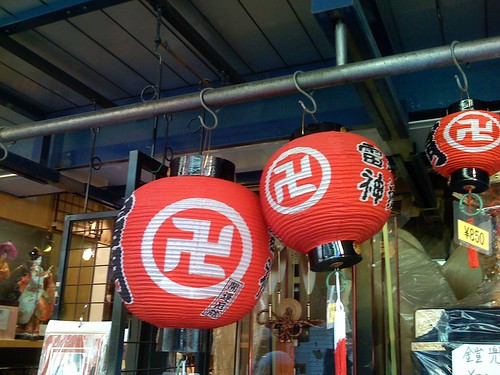
This is always a shocker. Of course, the swastika's arms are going the other way from the Nazi one, and it's an ancient mark used for thousands of years.
This kid was really surprised when I translated his T-shirt for him.
I discovered place where famous people had put their hand prints. This is film director Takeshi Kitano...
...who has the same size hand as me.
(The answer to the above quiz is, a frankfurt, which is what a frankfurter with no bun around it is called.)


Friday, October 12, 2007
Nuances of how you call people in Japanese, writing systems in Japanese and how they've changed, and gaijin fingerprinting
First, we apologize for an outage on the J-List and JBOX.com websites, which was caused by a bad router at our ISP. During part of the problem, the J-List site was functional but search and shopping cart functions were broken (ouch). The issue has been fixed and the site is up and ready for you right now.
One interesting aspect of Japanese relationships are the invisible rules that govern what you should call others, which can be very complex can nuance-filled. A man named Taro Yamada might be called "Yamada-san" by his co-workers (polite), "Yamada" by his boss at work or his male friends, and "Taro" by his family or his girlfriend. What you call someone is important, since it defines your perception of your relationship with the other person, and choosing the "wrong" thing to call them might lead to misunderstandings or bad feelings. In an episode of an anime I'm watching now, a girl and boy who've started dating struggle to get past calling each other by their family names, which places a distance between them that neither wants. When the girl's younger sister asks why the boyfriend calls her sister by her last name, the two turn red-faced as they struggle to get used to using each other's first names so their relationship can progress. What's interesting to me is that this is such a conscious, out-in-the-open thing that everyone is aware of, not under the surface at all. As usual, my impressions of Japan are filtered through my experiences as an American, and I often get the sense that some of the customs that seem odd to me might not feel so strange to someone from the U.K. -- in the Narnia books, for example, I've noticed dialogue between characters that seemed to follow these Japanese-style naming rules even though it was in English. It wouldn't be the first time I was confused by someone I encountered in Japan only to have it turn out to be somehow related to England instead.
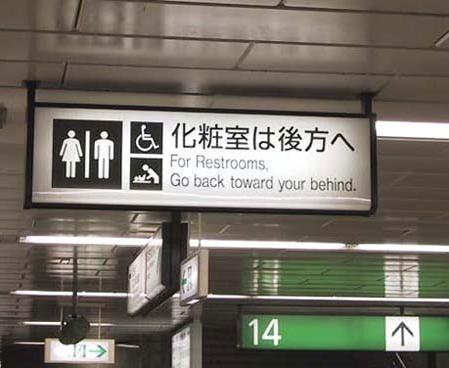
You may know that there there are a total of four writing systems used in Japan: hiragana, a syllable-based script for writing basic Japanese words and grammatical particles; katakana, a mirror of hiragana that's used to express foreign loan words and names; kanji, the Chinese writing system used for more complex verbs, nouns and adjectives; and unofficially, the Roman alphabet romaji, for expressing concepts like FOR RESTROOMS, GO BACK TOWARDS YOUR BEHIND. While constantly mixing multiple writing systems sounds like a confusing mess, learning to read Japanese effectively isn't nearly as difficult as you may think -- it's a logical framework that you can approach in a methodical fashion. Reading Japanese from a different era, however, can be quite a challenge, and even Japanese written around World War II can be quite hard to read, between archaic versions of kanji and hiragana (like the always fun ゐ or ゑ), writing that sometimes went left-to-right and other times right-to-left, and decidedly odd ways of writing kana resulting in something about as strange to my eye as Shakespere must look to Japanese readers. It turns out that after the war ended, there was a movement to standardize and modernize the Japanese language, which eliminated a lot of weird and unused characters, resulting in a much more approachable language overall. I'd like to say, on behalf of gaijin everywhere, thanks to whoever was in charge of this.
The next time you come to Japan, you will probably be fingerprinted and photographed in accordance with a new program about to be put in motion by the Japanese government. It's not that big a deal, of course -- every foreign visitor to the U.S. has been going through the same process for years, smiling for the camera and presenting their right forefinger. While part of the impetus for the move is embarrassment that a member of Al Qaeda managed to enter Japan in 2004, I know the move for what it really is: the latest example of Japan following the lead of West, in this case specifically the U.S. In many areas, Japan as a nation seems content to follow behind the United States and Europe, taking cues on everything from its laws on seku-hara (sexual harassment in the workplace) to how much money you can bring into the country in cash (US$10,000), and the fingerprinting of incoming foreigners (Japan-born Koreans are exempt) is just another way of imitating America. Another factor is probably Japan's desire to feel that it's a part of the global "war on terror" despite the fact that Japan is a pretty peaceful place that's not generally hated by most of the world -- Japan clearly wants to be nakama-iri (part of the same in-group) as the U.S. and Europe. Considering that all terrorist attacks in Japan have come from domestic elements like the Aum religious cult and the Japanese Red Army, I predict the whole finferprinting project will be a big boondoggle that does nothing but create a database of information that no one will ever look at.
Interested in learning some Japanese? Whether you'd like to just learn the basics of hiragana and katakana, learn some fun phrases that can make you the life of the party or make an organized plan to master the entire language, J-List offers a wide range of textbooks, kanji study cards, workbooks, electronic dictionaries and other useful tools that can really help you reach your goal. Why not browse our lineup of study related items now?


One interesting aspect of Japanese relationships are the invisible rules that govern what you should call others, which can be very complex can nuance-filled. A man named Taro Yamada might be called "Yamada-san" by his co-workers (polite), "Yamada" by his boss at work or his male friends, and "Taro" by his family or his girlfriend. What you call someone is important, since it defines your perception of your relationship with the other person, and choosing the "wrong" thing to call them might lead to misunderstandings or bad feelings. In an episode of an anime I'm watching now, a girl and boy who've started dating struggle to get past calling each other by their family names, which places a distance between them that neither wants. When the girl's younger sister asks why the boyfriend calls her sister by her last name, the two turn red-faced as they struggle to get used to using each other's first names so their relationship can progress. What's interesting to me is that this is such a conscious, out-in-the-open thing that everyone is aware of, not under the surface at all. As usual, my impressions of Japan are filtered through my experiences as an American, and I often get the sense that some of the customs that seem odd to me might not feel so strange to someone from the U.K. -- in the Narnia books, for example, I've noticed dialogue between characters that seemed to follow these Japanese-style naming rules even though it was in English. It wouldn't be the first time I was confused by someone I encountered in Japan only to have it turn out to be somehow related to England instead.
You may know that there there are a total of four writing systems used in Japan: hiragana, a syllable-based script for writing basic Japanese words and grammatical particles; katakana, a mirror of hiragana that's used to express foreign loan words and names; kanji, the Chinese writing system used for more complex verbs, nouns and adjectives; and unofficially, the Roman alphabet romaji, for expressing concepts like FOR RESTROOMS, GO BACK TOWARDS YOUR BEHIND. While constantly mixing multiple writing systems sounds like a confusing mess, learning to read Japanese effectively isn't nearly as difficult as you may think -- it's a logical framework that you can approach in a methodical fashion. Reading Japanese from a different era, however, can be quite a challenge, and even Japanese written around World War II can be quite hard to read, between archaic versions of kanji and hiragana (like the always fun ゐ or ゑ), writing that sometimes went left-to-right and other times right-to-left, and decidedly odd ways of writing kana resulting in something about as strange to my eye as Shakespere must look to Japanese readers. It turns out that after the war ended, there was a movement to standardize and modernize the Japanese language, which eliminated a lot of weird and unused characters, resulting in a much more approachable language overall. I'd like to say, on behalf of gaijin everywhere, thanks to whoever was in charge of this.
The next time you come to Japan, you will probably be fingerprinted and photographed in accordance with a new program about to be put in motion by the Japanese government. It's not that big a deal, of course -- every foreign visitor to the U.S. has been going through the same process for years, smiling for the camera and presenting their right forefinger. While part of the impetus for the move is embarrassment that a member of Al Qaeda managed to enter Japan in 2004, I know the move for what it really is: the latest example of Japan following the lead of West, in this case specifically the U.S. In many areas, Japan as a nation seems content to follow behind the United States and Europe, taking cues on everything from its laws on seku-hara (sexual harassment in the workplace) to how much money you can bring into the country in cash (US$10,000), and the fingerprinting of incoming foreigners (Japan-born Koreans are exempt) is just another way of imitating America. Another factor is probably Japan's desire to feel that it's a part of the global "war on terror" despite the fact that Japan is a pretty peaceful place that's not generally hated by most of the world -- Japan clearly wants to be nakama-iri (part of the same in-group) as the U.S. and Europe. Considering that all terrorist attacks in Japan have come from domestic elements like the Aum religious cult and the Japanese Red Army, I predict the whole finferprinting project will be a big boondoggle that does nothing but create a database of information that no one will ever look at.
Interested in learning some Japanese? Whether you'd like to just learn the basics of hiragana and katakana, learn some fun phrases that can make you the life of the party or make an organized plan to master the entire language, J-List offers a wide range of textbooks, kanji study cards, workbooks, electronic dictionaries and other useful tools that can really help you reach your goal. Why not browse our lineup of study related items now?
Here are some pictures, if you want them. I took a trip to Tokyo on the Shinkansen on Thursday. Snapping random shots out the window, I just happened to catch this love hotel.
Our destination was Asakusa, a popular tourist spot since they have a famous temple there, and a lot of shops. This is the famous "Unko Building" (it's an Asahi Beer creation that looks like golden poop to everyone) with one of the famous Rick-Shaws (which is 人力車 in Japanese in case you were wondering).
We were walking and happened to bump into the headquarters of Bandai.
Ultraman, Doraemon, all the cool characters were out to play.
Passed by a really old used book store that had to have been there since the Taisho Era. This old-style sign is mighty cool, I thought.
Wednesday, October 10, 2007
Internalizing a foreign culture through gestures, the current state of English conversation in Japan, and guess what day to day is?
Living in a foreign country means more than just learning that country's language. It also means subtly taking the local culture inside you, something that can really sneak up on a person -- one day you're shunning natto and forgetting to take your shoes off when you enter a house, and the next you're serving "coffee jelly" to foreign guests for dessert. An interesting yardstick for how much of this culture a person has internalized are the gestures that we all use every day, since unlike spoken language, gestures are something we don't consciously think about. A big part of body language in Japan involves bowing, and Japanese are known to bow out of reflex even when talking on the phone -- nothing is funnier than seeing a gaijin do this too. Another famous gesture is "tegatana," meaning hand-katana, made as you move throw a crowd while simultaneously bowing and cutting an invisible path with your hand, karate-style. You can communicate some complex concepts using a simple gesture; for example, one salaryman might pantomime throwing back a sake glass to his friend ("Do you want to stop for drinks on the way home?"), while his friend might make little demon's horns with his forefingers and shake his head ("I can't, my wife would be really angry").
The word eikaiwa means "English Conversation," and this is probably one of the first Japanese words a person interested in teaching ESL in Japan encounters. The market for helping Japanese people learn English quite large, and is mainly dominated by the four chain schools ECC, AEON, GEOS, and the largest school, Nova. Unfortunately for the 5000+ native English speakers who work in Nova's "study abroad in front of your local train station" schools, the company is currently going through a rough period that might result in its total meltdown. When most foreigners have experience with Nova it's usually as a teacher -- there are plenty who will give you an earful of the various abuses of the company -- but in my own case I actually considered having my daughter study English there, a considerably rare thing for an American living in Japan to do. It soon became apparent that the company was really interested in signing us up for a 5 year contract in which we were required to pay, even if our situation changed or teachers that we liked at our local school left, with no refunds, either. Turns out, the Japanese Supreme Court ruled this practice illegal, and Nova was ordered to suspend part of its business for six months as penalty. Now it seems that the company is having trouble paying its foreign staff as it tries to keep out of bankruptcy. Incidentally, I generally advise anyone interested in coming to Japan to teach English to steer clear of these large chain schools if you can, since based on my own experience you'll be happier at a smaller school that will provide a more personal approach to teaching English.
I've written before about how the Japanese like to commemorate interesting days. June 4th is Mushi no Hi (Bug Day), when we should all appreciate the things that the insect world does for us, while March 11 is Panda Day, the date when the first panda bears were discovered by a French missionary in China in 1869, and who could forget Fried Chicken Day on November 21st, the date the first KFC opened in Japan back in 1970. October 10 is is Moé no Hi, the day to celebrate the Japanese concept of moé (pronounced mo-EH), which is a slang term that essentially describes the warm, fuzzy feeling you get when looking at your favorite anime or dating-sim game character, although the character itself just means "bud" or "sprout." The reason today is Moé Day is rather silly -- it's the 10th day of the 10th month, and when you line up the kanji for 'ten' above the characters for 'day' and 'month' you get a large version of the moé kanji. If you like the look of this kanji character, we've got a really cool moé calligraphy T-shirt, available on the site now.
There's been lots of news for fans of Japan's PC dating-sim games recently, including the recent announcement that the upcoming game Bazooka Cafe had gone "golden master" and would be shipping in a couple of weeks -- can't wait for that. We've also got a new game coming from the creator of Bible Black, called Discipline, which features an amazing game story and huge lineup of memorable characters that will quite blow your mind. Preorder this great game now!
J-List sells many T-shirts that use kanji, hiragana and katakana to creat fun and wacky designs that are fun to wear. This month's "Wacky Japanese T-Shirt of the Month" is our famous "It Is Forbidden To Urinate Here" design, which is -- incredibly -- a sign you can see quite often in Japan. It seems that Japanese males aren't shy about taking a leak in rice fields, by the side of the road, or sometimes near people's houses, and so you can see these signs forbidding tachishon, that is, outdoor urinating. Our T-shirt features a great symbol of a torii, a traditional Japanese arch, since one place these signs are common are near Shinto shrines (don't want to offend the gods by peeing near them). This shirt is available at a special price this month only!
The word eikaiwa means "English Conversation," and this is probably one of the first Japanese words a person interested in teaching ESL in Japan encounters. The market for helping Japanese people learn English quite large, and is mainly dominated by the four chain schools ECC, AEON, GEOS, and the largest school, Nova. Unfortunately for the 5000+ native English speakers who work in Nova's "study abroad in front of your local train station" schools, the company is currently going through a rough period that might result in its total meltdown. When most foreigners have experience with Nova it's usually as a teacher -- there are plenty who will give you an earful of the various abuses of the company -- but in my own case I actually considered having my daughter study English there, a considerably rare thing for an American living in Japan to do. It soon became apparent that the company was really interested in signing us up for a 5 year contract in which we were required to pay, even if our situation changed or teachers that we liked at our local school left, with no refunds, either. Turns out, the Japanese Supreme Court ruled this practice illegal, and Nova was ordered to suspend part of its business for six months as penalty. Now it seems that the company is having trouble paying its foreign staff as it tries to keep out of bankruptcy. Incidentally, I generally advise anyone interested in coming to Japan to teach English to steer clear of these large chain schools if you can, since based on my own experience you'll be happier at a smaller school that will provide a more personal approach to teaching English.
I've written before about how the Japanese like to commemorate interesting days. June 4th is Mushi no Hi (Bug Day), when we should all appreciate the things that the insect world does for us, while March 11 is Panda Day, the date when the first panda bears were discovered by a French missionary in China in 1869, and who could forget Fried Chicken Day on November 21st, the date the first KFC opened in Japan back in 1970. October 10 is is Moé no Hi, the day to celebrate the Japanese concept of moé (pronounced mo-EH), which is a slang term that essentially describes the warm, fuzzy feeling you get when looking at your favorite anime or dating-sim game character, although the character itself just means "bud" or "sprout." The reason today is Moé Day is rather silly -- it's the 10th day of the 10th month, and when you line up the kanji for 'ten' above the characters for 'day' and 'month' you get a large version of the moé kanji. If you like the look of this kanji character, we've got a really cool moé calligraphy T-shirt, available on the site now.
There's been lots of news for fans of Japan's PC dating-sim games recently, including the recent announcement that the upcoming game Bazooka Cafe had gone "golden master" and would be shipping in a couple of weeks -- can't wait for that. We've also got a new game coming from the creator of Bible Black, called Discipline, which features an amazing game story and huge lineup of memorable characters that will quite blow your mind. Preorder this great game now!
J-List sells many T-shirts that use kanji, hiragana and katakana to creat fun and wacky designs that are fun to wear. This month's "Wacky Japanese T-Shirt of the Month" is our famous "It Is Forbidden To Urinate Here" design, which is -- incredibly -- a sign you can see quite often in Japan. It seems that Japanese males aren't shy about taking a leak in rice fields, by the side of the road, or sometimes near people's houses, and so you can see these signs forbidding tachishon, that is, outdoor urinating. Our T-shirt features a great symbol of a torii, a traditional Japanese arch, since one place these signs are common are near Shinto shrines (don't want to offend the gods by peeing near them). This shirt is available at a special price this month only!
Monday, October 08, 2007
Learning about Japan through first- and second-person pronouns, the relationship of Japan and Hawaii, and more fun with Japanese superstitions
Strangely enough, you can learn a lot about Japan through its first and second person pronouns: there are several of each for use by different individuals depending on the "TPO," or time, place, and occasion. For the pronoun "I" you could choose from watashi (私, formal, used more often by women, also read わたくし), boku (僕, semi-polite, usually used by younger males), and ore (俺、OH-reh, mainly used by "manly" men); and words for "you" include anata (あなた、formal, used by women more often than men); kimi (君、familiar, used by guys to their girlfriends or by anyone talking to a younger person, and just because the character also means "Emperor" don't think it's okay to use this word with him); and omae (お前, oh-MAH-eh, again, a "macho" sounding word generally used by guys). This last word is especially interesting since it basically asserts the superiority of the speaker over the person he's speaking to, a concept that doesn't exist in English, at least openly. When a man uses the word omae to a female he's got a relationship with, the implication is that the girl "belongs to" him in a romantic sense. This generally will make some girls swoon with affection, while others -- those who speak more English and have lived outside of Japan -- may be offended by being thought of as an object to be possessed. I once got in quite a bit of trouble when I accidentally used this word with a friend's girlfriend soon after arriving in Japan. Who would have thought that words like "I" or "you" could be so complex?
J-List's manga and photobook meister Yasu just got back from a trip to Hawaii, where he spent a week with his wife and two daughters. Hawaii is, of course, a major destination for Japanese travellers, and the monthly number of tourists from Japan is tracked as if it were an economic indicator like the Consumer Price Index. In a way, Hawaii is perfect for Japanese tourists because it's a part of the U.S. without being all the way across the Pacific, so it's a lot more accessible. Also, the high amount of Japanese fluency at hotels and other places frequented by tourists makes the place a lot less threatening for travelers who might otherwise be overwhelmed. The most popular island with Japanese tourists is Oahu, which has plenty of beaches for fun seaside activities, and during peak times of year the place is fairly brimming with J-tourists. The history of Japan and Hawaii have been intertwined for a long time, starting with waves of immigration of Japanese workers at sugar plantations in the 19th and 20th centuries. Now, there are more than a few actors and singers active in Japan who grew up in the Japanese communities that comprise 16% of the local population of the state. I guess being a Japanese raised in Hawaii adds an "exotic" flavor, and being fluent in English can't hurt a person's career, either.

I've talked before about how the Japanese can be quite superstitious at times. Don't cut your fingernails at night, or you won't be able to be with your parents when they die. If you see a hearse, you should hide your thumbs inside your fists, or the same thing will happen (this is due to the fact that the word for thumb in Japanese means "parent finger"). Don't whistle at night, or snakes will come an get you. When you sneeze twice, it means someone is gossiping about you, a joke that pops up in anime quite a lot. If you see a spider in the morning, it's good luck, so don't kill it. Don't sleep with your head facing north, as only dead people do this, and never pass food from chopsticks to chopsticks. If you want to check the weather tomorrow, throw your shoe as far as you can; if it lands sole down, it will be sunny, but if it's on its side, it will rain. Here's another superstition for you: supposedly, it's good luck for a man to carry a hair from his girlfriend's, er, nether region in his wallet when playing sports or gambling. We're not so sure about that one, but anything is possible with the Japanese.
J-List sells many fun and unique T-shirts that make use of Japanese kanji, hiragana and katakana in their designs. We've always been fascinated by how the Japanese adapt their 3000+ writing system to a standard computer keyboard. We love the way Japanese keyboards look, with the kana characters printed on each key, and decided to make a T-shirt featuring this cool design. Shirts for guys and girls are both posted on the site right now.
J-List's manga and photobook meister Yasu just got back from a trip to Hawaii, where he spent a week with his wife and two daughters. Hawaii is, of course, a major destination for Japanese travellers, and the monthly number of tourists from Japan is tracked as if it were an economic indicator like the Consumer Price Index. In a way, Hawaii is perfect for Japanese tourists because it's a part of the U.S. without being all the way across the Pacific, so it's a lot more accessible. Also, the high amount of Japanese fluency at hotels and other places frequented by tourists makes the place a lot less threatening for travelers who might otherwise be overwhelmed. The most popular island with Japanese tourists is Oahu, which has plenty of beaches for fun seaside activities, and during peak times of year the place is fairly brimming with J-tourists. The history of Japan and Hawaii have been intertwined for a long time, starting with waves of immigration of Japanese workers at sugar plantations in the 19th and 20th centuries. Now, there are more than a few actors and singers active in Japan who grew up in the Japanese communities that comprise 16% of the local population of the state. I guess being a Japanese raised in Hawaii adds an "exotic" flavor, and being fluent in English can't hurt a person's career, either.
I've talked before about how the Japanese can be quite superstitious at times. Don't cut your fingernails at night, or you won't be able to be with your parents when they die. If you see a hearse, you should hide your thumbs inside your fists, or the same thing will happen (this is due to the fact that the word for thumb in Japanese means "parent finger"). Don't whistle at night, or snakes will come an get you. When you sneeze twice, it means someone is gossiping about you, a joke that pops up in anime quite a lot. If you see a spider in the morning, it's good luck, so don't kill it. Don't sleep with your head facing north, as only dead people do this, and never pass food from chopsticks to chopsticks. If you want to check the weather tomorrow, throw your shoe as far as you can; if it lands sole down, it will be sunny, but if it's on its side, it will rain. Here's another superstition for you: supposedly, it's good luck for a man to carry a hair from his girlfriend's, er, nether region in his wallet when playing sports or gambling. We're not so sure about that one, but anything is possible with the Japanese.
J-List sells many fun and unique T-shirts that make use of Japanese kanji, hiragana and katakana in their designs. We've always been fascinated by how the Japanese adapt their 3000+ writing system to a standard computer keyboard. We love the way Japanese keyboards look, with the kana characters printed on each key, and decided to make a T-shirt featuring this cool design. Shirts for guys and girls are both posted on the site right now.
Friday, October 05, 2007
Questions about ice cream in Japan, on Japanese students who use their dictionaries too much, and funny corporate slogans in English
I was once asked if the Japanese eat any flavors of ice cream other than Green Tea. The answer, of course, is a resounding yes -- they're quite into various types of ice cream, from standard flavors that everyone knows to some unique varieties that may seem a little odd to you or me. Take a trip to a Japanese ice cream shop and you'll see plenty of familiar flavors, like vanilla and chocolate and sakura (cherry), as well as some flavors that might be new to you, like ume (Japanese plum), sweet potato or traditional sweet azuki beans. Often, ice cream makers base new flavors on food trends, like rose flavored ice cream to make your body smell nice from the inside out, healthy "black sesame" ice cream, or this year's big boom, mango. Every once in a while I run across articles about really rare flavors of ice cream in Japan, like crab, octopus, beer or wasabi. While these products do exist, they're not generally eaten by the average Japanese person, and usually represent some region of the country's efforts to define themselves as the "squid ink flavored ice cream capital of Japan" or something. Since the Japanese like to pretend they're culturally closer to Europe than to Asia, ice cream is often consumed in the form of gelato, although "soft cream" (what soft-serve ice cream is called here) is also popular. One of our family's favorite treats is to take standard vanilla ice cream and sprinkle matcha powder over the top, which is great when it all starts to melt together. By happy coincidence, we just happen to have gotten some matcha powder in stock today.
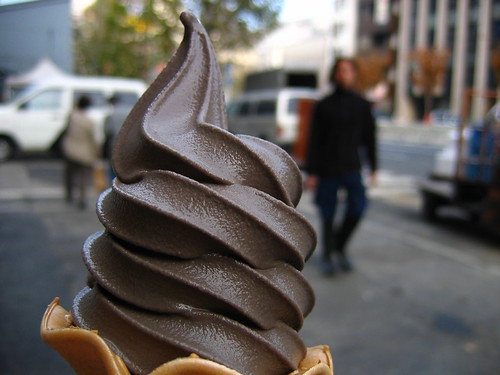
Yes, Virginia, there really is squid ink ice cream...
One thing that always frustrated me as an ESL teacher was my students' over-reliance on dictionaries. Language is about communication, and as a general rule conversations stop when one party puts their nose in a dictionary to look up a word. It's therefore important to learn how to get around difficult words that would otherwise create a linguistic roadblock, to be able to explain a concept in a different way. I once went hitchhiking up to Northern Japan, and during my trip I decided I wanted to buy a flashlight so I could read in dark places. Trouble was, I didn't know the word for flashlight in Japanese, so I had to describe what I meant in other ways until I want I wanted -- it was surprisingly challenging. In ESL class I'd split my students up into groups and have them describe various words to each other, to help them get used to communicating ideas indirectly. This is extremely important when, say, talking about Japan to people form other countries. Let's say a Japanese person wanted to describe a kotatsu -- a low table with a heater inside and a blanket over the top, which is used in the winter to warm your legs -- to someone from another country. No dictionary will help since the concept is totally foreign, and it's important for them to learn how to find other words for what they want to say.
"Netz. Make the style." This is the official slogan of Toyota's "Nets" showrooms in Japan, used in most of their TV commercials. I'm not quite sure why virtually every Japanese company has to have a slogan in English -- perhaps it's tied to my theory that use of English allows advertisers to access emotions in viewers that couldn't be reached any other way -- but nearly every company has one. They're designed to give you a positive image of the company in encapsulated form, such as small-car maker Daihatsu's "We Do Compact" or UCC Coffee's "Good Smile Coffee." The Meiji chocolate company's slogan is "Delicious...open!" which brings to mind opening one of their packages to find something good inside. When Mitsubishi started having problems with its vehicles, it quietly changed its official slogan from "Heart-Beat Motors" to "Changes for the Better" to show that they were working to fix their products, although I'm sure no one noticed by us gaijin. One of my favorites company slogans belongs to Hitachi, creator of many products from electronics to the bullet trains. Their slogan is "Inspire the Next," and they use it both in and outside of Japan, despite its slightly wonky sound -- good for them. It's not hard to find odd-sounding company slogans. For example, my wife shops at a drug store that declares itself the "Wellness Business for National Confidence." Pretty good for a small chain of drug stores located in one city in Japan!
Yes, Virginia, there really is squid ink ice cream...
One thing that always frustrated me as an ESL teacher was my students' over-reliance on dictionaries. Language is about communication, and as a general rule conversations stop when one party puts their nose in a dictionary to look up a word. It's therefore important to learn how to get around difficult words that would otherwise create a linguistic roadblock, to be able to explain a concept in a different way. I once went hitchhiking up to Northern Japan, and during my trip I decided I wanted to buy a flashlight so I could read in dark places. Trouble was, I didn't know the word for flashlight in Japanese, so I had to describe what I meant in other ways until I want I wanted -- it was surprisingly challenging. In ESL class I'd split my students up into groups and have them describe various words to each other, to help them get used to communicating ideas indirectly. This is extremely important when, say, talking about Japan to people form other countries. Let's say a Japanese person wanted to describe a kotatsu -- a low table with a heater inside and a blanket over the top, which is used in the winter to warm your legs -- to someone from another country. No dictionary will help since the concept is totally foreign, and it's important for them to learn how to find other words for what they want to say.
"Netz. Make the style." This is the official slogan of Toyota's "Nets" showrooms in Japan, used in most of their TV commercials. I'm not quite sure why virtually every Japanese company has to have a slogan in English -- perhaps it's tied to my theory that use of English allows advertisers to access emotions in viewers that couldn't be reached any other way -- but nearly every company has one. They're designed to give you a positive image of the company in encapsulated form, such as small-car maker Daihatsu's "We Do Compact" or UCC Coffee's "Good Smile Coffee." The Meiji chocolate company's slogan is "Delicious...open!" which brings to mind opening one of their packages to find something good inside. When Mitsubishi started having problems with its vehicles, it quietly changed its official slogan from "Heart-Beat Motors" to "Changes for the Better" to show that they were working to fix their products, although I'm sure no one noticed by us gaijin. One of my favorites company slogans belongs to Hitachi, creator of many products from electronics to the bullet trains. Their slogan is "Inspire the Next," and they use it both in and outside of Japan, despite its slightly wonky sound -- good for them. It's not hard to find odd-sounding company slogans. For example, my wife shops at a drug store that declares itself the "Wellness Business for National Confidence." Pretty good for a small chain of drug stores located in one city in Japan!
Wednesday, October 03, 2007
Linguistic foibles in Japanese, "made-in-Japan" English words for people who like mayonnaise, and questions about inflation
The other day my wife asked me what a "window-breaker" was. I assumed she was asking about a type of jacket designed to protect you from the wind, but she just might have been talking about a person whose occupation it was to break windows. The problem is that Japanese is a syllable-based language, and generally not blessed in terms of the range of sounds you can produce with it. Foreign words like "wind" are written with the katakana writing system, but because you can only produce the sounds da, di, du, de or do but never "d" all by itself, the word "wind" always comes out a bit like "window," something that takes getting used to. There are other phonetic rough spots built into the language, too. When Lord of the Rings (ロード・オブ・ザ・リング) was released here, a lot of fans thought it was Road of the Rings, due to the lack of differentiated L and R (ロード could also be "load"). Another problem area is that the sound "si" is pronounced as "shi" in Japanese, which means that a simple word like "sit" can be extremely embarrassing -- and don't even consider trying to use the English word "pushy" here, it will not mean what you think it will mean. Some other words that can't be accurately rendered in Japanese are "love" and "rub," which effectively become the same word; "curb" and "curve," which also get reduced to a single concept; "cone" and "corn," prompting millions to assume that the thing that ice cream sits on is made of corn; and the extremely hard-to-pronounce trio of "clash" "crash" and "crush."
The Japanese are well known for using the grammatical rules of English to create new words, which are called wasei eigo or "Made in Japan English." One of the most famous examples of these is "nighter," which is what a night game of baseball is called here. Adding this "-er" suffix to words is a popular way to create new words, and there's an extensive body of slang that makes use of this mechanism. For example, the word for "part time job" in Japanese is arubaito, borrowed from the German word arbeit, so naturally a person working such a job is an arubaitaa (arubeiter), also known as a freeter (for "free-lance albeiter"). Often these new words are invented to define a sub-group of society, for example people who love mayonnaise are widely referred to as mayoraa (mayo-ers), while people who love to collect Hello Kitty products are defined as Kitty-raa (Kittylers). There seems to be a connection to general otaku culture, too. It's possible to extend the ending vowel of the word Akihabara to produce something like Akihaballer (egads, that's hard to transliterate), which means otaku who spend lots of time in Tokyo's electronics and anime hub. Of course, these silly words come and go all the time, so don't expect to find them in a dictionary.
I saw a news report the other day that a major producer of instant noodles in Japan will be raising prices by 10-20 yen soon in response to the rising costs of raw materials to make their products. It seemed interesting to me that this was even news, since in the U.S. at least, most people take the slow creeping of inflation for granted, assuming that most things will be more expensive next year than they were a year ago. But for some odd reason, this rule doesn't generally apply to Japan, where the inflation rate always seems to be low. Except for one hike in train fares a few years ago, I'd be hard pressed to name many prices that have gone up appreciably over the past decade -- and in fact, some of prices have fallen, like when Yoshinoya lowered the price of their trademark Beef Bowl. Recently, however, the rising cost of oil has started to put real inflationary pressure on the country, with a liter of gasoline going for around $1.25, which works out to $4.50 a gallon. My wife is also mad because these useful plastic drawers we use to organize our house have shot way up in price.
The Japanese are well known for using the grammatical rules of English to create new words, which are called wasei eigo or "Made in Japan English." One of the most famous examples of these is "nighter," which is what a night game of baseball is called here. Adding this "-er" suffix to words is a popular way to create new words, and there's an extensive body of slang that makes use of this mechanism. For example, the word for "part time job" in Japanese is arubaito, borrowed from the German word arbeit, so naturally a person working such a job is an arubaitaa (arubeiter), also known as a freeter (for "free-lance albeiter"). Often these new words are invented to define a sub-group of society, for example people who love mayonnaise are widely referred to as mayoraa (mayo-ers), while people who love to collect Hello Kitty products are defined as Kitty-raa (Kittylers). There seems to be a connection to general otaku culture, too. It's possible to extend the ending vowel of the word Akihabara to produce something like Akihaballer (egads, that's hard to transliterate), which means otaku who spend lots of time in Tokyo's electronics and anime hub. Of course, these silly words come and go all the time, so don't expect to find them in a dictionary.
I saw a news report the other day that a major producer of instant noodles in Japan will be raising prices by 10-20 yen soon in response to the rising costs of raw materials to make their products. It seemed interesting to me that this was even news, since in the U.S. at least, most people take the slow creeping of inflation for granted, assuming that most things will be more expensive next year than they were a year ago. But for some odd reason, this rule doesn't generally apply to Japan, where the inflation rate always seems to be low. Except for one hike in train fares a few years ago, I'd be hard pressed to name many prices that have gone up appreciably over the past decade -- and in fact, some of prices have fallen, like when Yoshinoya lowered the price of their trademark Beef Bowl. Recently, however, the rising cost of oil has started to put real inflationary pressure on the country, with a liter of gasoline going for around $1.25, which works out to $4.50 a gallon. My wife is also mad because these useful plastic drawers we use to organize our house have shot way up in price.
Monday, October 01, 2007
You've been in Japan too long when you 'teach' someone your phone number, all about the history of Panasonic, and fun with English phrases in Japan
"You've been in Japan too long when you 'teach' someone your phone number." Of course, we all use different words for different functions, and even within dialects of a single language words are "mapped" quite differently -- for example, if you're in North America, do you consider a carbonated beverage to be 'soda,' 'pop,' 'coke' or a 'soft drink'? It varies linguistically by region. In Japanese, certain words are used in situations that seem odd to English speakers at first. For example, when you ask someone to tell you their phone number, you'd use the word oshiete, which means "please teach me," which takes some getting used to. Similarly, in my dialect of English I "buy" (kau) gas for my car, but in Japan you always use the verb "put in" (ireru) instead, and my Japanese friends kept correcting me when I'd use the wrong word. The strange word mapping goes the other way, too. In Japanese the concept of "good" taste (oishii) and "good" quality (ii, pronounced like "ee") are completely separate, so there's a tendency for Japanese to not like using the word "good" about how food tastes -- their brain rebels against the violation of its internal rules, which is why you may notice that Japanese people sometimes over-use the word 'delicious' when they speak English, such as "Don't eat that, it's not delicious."
Like most people, the Japanese have a lot of respect for the business leaders who have created enduring organizations, with Thomas Edison very near to the top of the list. Another man who is well respected in Japan is Konosuke Matsushita. Very poor as a child, he was forced to leave school in the 4th grade and start working to help support the family. Trained as an electrician's assistant, he soon got an idea for a new kind of electric socket, and in 1918 he founded a company to manufacture it with his wife and brother-in-law. This was the beginning of the Matsushita Electronics Company, more famous under its other name of Panasonic, which managed to grow from a tiny shop in Osaka into the largest electronics maker in Japan. That's not bad for a guy with no education or capital doing business in a country that lacks an American-style "two guys named Steve in a garage" type of entrepreneurial tradition. Like all Japanese companies, Matsushita is into a few businesses that might surprise you, including racing bicycles, home construction (as "Panahome"), and elevators. After he retired, Konosuke went on to write books on his approach to business, and founded a Dale Carnagie type management school. He's said that the man he respects the most is Hideyoshi Toyotomi, one of the three "unifiers" of Japan who started out as a peasant but managed to work his way up to the position of de facto shogun of Japan. Like Hideyoshi, Konosuke said he never shied away from any job that was assigned to him, no matter how menial or dirty it was, which was one secret of his success.

For one reason or another, there are certain phrases in English have burned themselves on the collective consciousness of the Japanese, and are quite famous here. When an American named Dr. Clark (universally known as "Clark-hakase") went to Sapporo to help establish what would become Hokkaido University, he left the following advice to his Japanese hosts: "Boys, be ambitious!" (i.e., strive to dream large in all that you do). These three words managed to become extremely famous, and there isn't a Japanese person who doesn't know them. Song lyrics and famous movie lines also provide a bridge to the English language, and speeches by Dr. Martin Luther King Jr. and Abraham Lincoln ("Government for the people, by the people, and of the people") are studied in school the same way we studied Shakespeare in the U.S., too.
Great news for fans of our 2008 Japanese calendars: the first batch of calendars have come in, and are being posted to the site right now. We've currently got lots of stock of such great calendars as My Neighbor Totoro and the oh-so-nice Studio Ghibli calendar, with all new art from the Hayao Miyazaki films; other popular TV anime (Naruto, Bleach, Katekyo Hitman Reborn); beautiful Japanese idols like Yoko Kumada, Misako Yasuda and Yuko Ogura; JPOP stars like Kumi Koda and Morning Musume; and much more. These calendars are in stock and ready for your immediate order, so check them out!


Like most people, the Japanese have a lot of respect for the business leaders who have created enduring organizations, with Thomas Edison very near to the top of the list. Another man who is well respected in Japan is Konosuke Matsushita. Very poor as a child, he was forced to leave school in the 4th grade and start working to help support the family. Trained as an electrician's assistant, he soon got an idea for a new kind of electric socket, and in 1918 he founded a company to manufacture it with his wife and brother-in-law. This was the beginning of the Matsushita Electronics Company, more famous under its other name of Panasonic, which managed to grow from a tiny shop in Osaka into the largest electronics maker in Japan. That's not bad for a guy with no education or capital doing business in a country that lacks an American-style "two guys named Steve in a garage" type of entrepreneurial tradition. Like all Japanese companies, Matsushita is into a few businesses that might surprise you, including racing bicycles, home construction (as "Panahome"), and elevators. After he retired, Konosuke went on to write books on his approach to business, and founded a Dale Carnagie type management school. He's said that the man he respects the most is Hideyoshi Toyotomi, one of the three "unifiers" of Japan who started out as a peasant but managed to work his way up to the position of de facto shogun of Japan. Like Hideyoshi, Konosuke said he never shied away from any job that was assigned to him, no matter how menial or dirty it was, which was one secret of his success.
For one reason or another, there are certain phrases in English have burned themselves on the collective consciousness of the Japanese, and are quite famous here. When an American named Dr. Clark (universally known as "Clark-hakase") went to Sapporo to help establish what would become Hokkaido University, he left the following advice to his Japanese hosts: "Boys, be ambitious!" (i.e., strive to dream large in all that you do). These three words managed to become extremely famous, and there isn't a Japanese person who doesn't know them. Song lyrics and famous movie lines also provide a bridge to the English language, and speeches by Dr. Martin Luther King Jr. and Abraham Lincoln ("Government for the people, by the people, and of the people") are studied in school the same way we studied Shakespeare in the U.S., too.
Great news for fans of our 2008 Japanese calendars: the first batch of calendars have come in, and are being posted to the site right now. We've currently got lots of stock of such great calendars as My Neighbor Totoro and the oh-so-nice Studio Ghibli calendar, with all new art from the Hayao Miyazaki films; other popular TV anime (Naruto, Bleach, Katekyo Hitman Reborn); beautiful Japanese idols like Yoko Kumada, Misako Yasuda and Yuko Ogura; JPOP stars like Kumi Koda and Morning Musume; and much more. These calendars are in stock and ready for your immediate order, so check them out!
Some pictures of my daughter's sports day of a week ago. Here are some kids running a race.
As usual, I had great fun scoping out funny English on people's T-shirts. This woman apparently has many amorous stories for us.
This guy had on an anime T-shirt, of all things. That's rare has heck in Japan.
Decision shaking, appear & existence."
Criminal?
Nice to know there's a difference.
This is the marching band, playing the Yamato theme song like they do every year (it's a local tradition). It was so hot I was happy to stand out in the middle of the ground with my mother-in-law's frilly lace parasol, just to keep out of the direct sun.
There's some strange connection between the Japanese and Cream Soda, because I had a friend who lived in an apartment called Apartment Cream Soda.
Friday, September 28, 2007
Thoughts on how the Japanese define "family," confusion over English lyrics in Japanese songs, and how to tell a Korean from a Japanese
We've got a bit of a running joke in our family. South Korean television dramas are popular in Japan, and whenever my kids and I catch one on TV we call out to my wife to let her know that "her TV show is on." It seems that for some reason, my Japanese wife seems to be mistaken for a Korean whenever she sets foot outside of her native country. For example, when we fly to the U.S., we sometimes take Korean Airlines since the bibimbap is good, and when the flight attendants get to my wife's seat to ask her if she'd like more tea, they always switch from Japanese to Korean. While this often reaps various benefits -- retailers in Hawaii will give her better discounts if they can't tell she's from Japan -- we always wonder what mechanism is at work. Of course, it's neigh on impossible to tell what nationality a person is just by looking at them, although that doesn't stop Japanese from assuming that every Caucasian must be from the U.S. or Canada.

What is exactly is a "family"? Different people might have different uses for the word, describing members of the same household, or perhaps including a wider range of relatives. In Japan there's no vagueness at all, as the concept of "family" is set by the koseki, or the official family register that's maintained in every Japanese city. An extremely old system -- the first family register dates back to the year 645, although the system in use today was begun in 1872 -- the koseki is a complete record of the lives of every Japanese citizen, including every major event that happens to them, with western ideas such as birth or death certificates and marriage licenses all working through the koseki registry. When a baby is born, he's added to the the family's registry entry, and when a woman gets married she's removed from her father's registry and added to her husband's. Gaijin living in Japan aren't always happy with the family registry system, though. Since we're not citizens, foreigners aren't allowed to be listed officially in the family register except in the comments section. As a result, it looks on paper like my wife is a single mother of two kids, and we've had visits from social workers in our city to check up on the poor woman who has no husband.
When dealing with Japan, it's natural to encounter some "WTF" moments, like seeing a strawberry & whipped cream sandwich for sale in a convenience store for the first time; that first encounter with an ita-sha, a car decked out as a mobile shrine to an anime character; or being asked if having blue eyes meant I saw the world through a blue tint. I remember being confused by the tendency of Japanese songwriters to put seemingly random English phrases in Japanese songs. Reading through my old CDs, I'd see bizarre phrases like HEART CHECK or BLUE RAY, LEMON or GET CHANCE AND LUCK or FAD, FAD, WITH SOMETHING COOL, LIKE A HIDDEN LUMINARY. After a while I came to appreciate that to the Japanese, English represents an emotional investment of (usually) six years of hard work spent memorizing grammar and vocabulary, and songwriters can use English to bring out feelings in listeners that couldn't be accessed otherwise. Plus, English is just so darned kakko ii (cool), so adding a splash of OH PLEASE BE FREEDOM into the middle of a song gives it a special mystique. Another theory might be that the Japanese songwriters are putting bizarre English phrases into their songs to mess with the minds of foreigners who try to comprehend their language, a thought that occurred to me when watching the original Macross movie the other day, with the line "[Small white dragon]...is a very messiah." Is that some obscure Dragonriders of Pern reference? I just can't figure it out...
2008 calendars season is in full swing, and now is the perfect time to browse our extensive selection of over 200 large-format poster-sized calendars that are normally only available to people living inside Japan. From all the hottest anime to gorgeous Japanese actresses and swimsuit idols to kanji and art and traditional images of Japan, I really believe there's something that everyone will love in our great lineup. Personally I recommend the Studio Ghibli calendars, which are a treat every year. The large Ghibli calendar is especially nice because it features all-new and original images from the films of Hayao Miyazaki, including insight into the movies that can't be gleaned from any other source -- for example, through the calendars you can learn what happens several years after the My Neighbor Totoro movie ends. Remember that are great calendars are the perfect gift for anyone who's fascinated with Japan this Christmas season.
What is exactly is a "family"? Different people might have different uses for the word, describing members of the same household, or perhaps including a wider range of relatives. In Japan there's no vagueness at all, as the concept of "family" is set by the koseki, or the official family register that's maintained in every Japanese city. An extremely old system -- the first family register dates back to the year 645, although the system in use today was begun in 1872 -- the koseki is a complete record of the lives of every Japanese citizen, including every major event that happens to them, with western ideas such as birth or death certificates and marriage licenses all working through the koseki registry. When a baby is born, he's added to the the family's registry entry, and when a woman gets married she's removed from her father's registry and added to her husband's. Gaijin living in Japan aren't always happy with the family registry system, though. Since we're not citizens, foreigners aren't allowed to be listed officially in the family register except in the comments section. As a result, it looks on paper like my wife is a single mother of two kids, and we've had visits from social workers in our city to check up on the poor woman who has no husband.
When dealing with Japan, it's natural to encounter some "WTF" moments, like seeing a strawberry & whipped cream sandwich for sale in a convenience store for the first time; that first encounter with an ita-sha, a car decked out as a mobile shrine to an anime character; or being asked if having blue eyes meant I saw the world through a blue tint. I remember being confused by the tendency of Japanese songwriters to put seemingly random English phrases in Japanese songs. Reading through my old CDs, I'd see bizarre phrases like HEART CHECK or BLUE RAY, LEMON or GET CHANCE AND LUCK or FAD, FAD, WITH SOMETHING COOL, LIKE A HIDDEN LUMINARY. After a while I came to appreciate that to the Japanese, English represents an emotional investment of (usually) six years of hard work spent memorizing grammar and vocabulary, and songwriters can use English to bring out feelings in listeners that couldn't be accessed otherwise. Plus, English is just so darned kakko ii (cool), so adding a splash of OH PLEASE BE FREEDOM into the middle of a song gives it a special mystique. Another theory might be that the Japanese songwriters are putting bizarre English phrases into their songs to mess with the minds of foreigners who try to comprehend their language, a thought that occurred to me when watching the original Macross movie the other day, with the line "[Small white dragon]...is a very messiah." Is that some obscure Dragonriders of Pern reference? I just can't figure it out...
2008 calendars season is in full swing, and now is the perfect time to browse our extensive selection of over 200 large-format poster-sized calendars that are normally only available to people living inside Japan. From all the hottest anime to gorgeous Japanese actresses and swimsuit idols to kanji and art and traditional images of Japan, I really believe there's something that everyone will love in our great lineup. Personally I recommend the Studio Ghibli calendars, which are a treat every year. The large Ghibli calendar is especially nice because it features all-new and original images from the films of Hayao Miyazaki, including insight into the movies that can't be gleaned from any other source -- for example, through the calendars you can learn what happens several years after the My Neighbor Totoro movie ends. Remember that are great calendars are the perfect gift for anyone who's fascinated with Japan this Christmas season.
Wednesday, September 26, 2007
The mechanisms of Japan's group structures, big differences in education between Japan and the U.S., and some useful Japanese words
The Japanese, as I've written many times, are quite group oriented, and it's interesting to observe some of the actual mechanisms that support this aspect of society. In virtually my entire education from the 7th grade on, I've had mixed schedules -- math in second period with Mr. Johnson, English in third period with Mr. Mihalka and so on, with different students around me each hour. In Japan, the system is quite different: students are are assigned to a class that they stay in all year long, with teachers coming and going each hour. Being with the same students all day for a year often has the effect of bringing them closer together, and it's probably more common for Japanese to maintain those connections throughout their lives than for Americans. Japanese usually get two sets of these special school groups: those they attended Elementary and Junior High School with, usually kids from the same neighborhood; and friends from High School, which is not part of compulsory education, thus students are free to choose which school they want to go to based on their study goals. My son commutes to school with several boys, a group that calls themselves Hosoya-gumi since they get off the train at Hosoya Station. It wouldn't surprise me if they maintained their friendship throughout their lives.
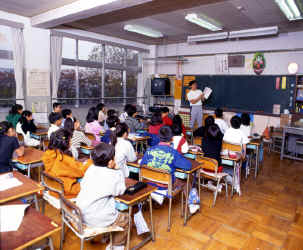
One aspect of this group-centered approach to education is, what do you when students who must study together are at different levels? When I took Spanish in High School, there were students of all ages in the class with me, since we were all at the same level Espanolically speaking. But in Japan, with its stricter senpai-kohai relationships, it's inconceivable that students of different school years would study together for any reason. If there are students who have trouble keeping up in a certain subject, they are required to take extra lessons and do more homework, since everyone must progress through the same material together. The concepts of a very smart student skipping a grade or a slower student being held back a year are rare here, part of the reason why parents of extremely gifted children often move to the U.S. or Europe, where special talents can be treated as a positive thing. When my daughter gets to Junior High School she's going to have a big shock, since she'll be taking English along with the other kids and learning phrases like "this is a pen" or "I am a boy" despite the fact that she's bilingual already.
It's funny how sometimes a single word of Japanese can carry so much meaning, and there's a group of especially descriptive three-syllable words that can be quite challenging for foreigners to learn. One of word you run across a lot is sokkuri (so-KU-ri), meaning "almost exactly the same as," so if you had a friend who looked like a guy named John, you'd say say "John ni sokkuri desu" (you are the spitting image of John). The Japanese like to do things the proper way, which is expressed in the word shikkari (shi-KAI-ri, proper, correct), and just about the kindest praise you can heap on someone is that they're shikkari shiteiru (they are upstanding and proper in all ways). Another word from this group is "sappari" (sa-PAH-ree, fresh, clean), as in the phrase "sappari shita!" (I feel so refreshed!), said after you get out of a hot bath. Other words from this group include gakkari (gah-KAH-ree), the feeling of being let down or disappointed; kossori (koh-SOH-ree), doing something secretly; and pittari (pi-TAH-ree), describing a perfect fit. Since one valid approach to learning a foreign language is "memorize whatever phrases will make cute female speakers of that language squeal with amusement," consider memorizing some of these words and pulling them out at the right moment to see what happens.
Well, darned if we don't have even more 2008 calendars posted for preorder today. There are lots of nice new calendars up on the site, including the gorgeous upcoming calendar for the all-new Evangelion movies, new Hello Kitty offerings, kanji calendars to learn Japanese with, cute idols like more of the popular "Hao Hao Baby Panda" calendars, several new anime calendars, and a great "Doraemon's Go-Anywhere Door" offering for 2008.
One aspect of this group-centered approach to education is, what do you when students who must study together are at different levels? When I took Spanish in High School, there were students of all ages in the class with me, since we were all at the same level Espanolically speaking. But in Japan, with its stricter senpai-kohai relationships, it's inconceivable that students of different school years would study together for any reason. If there are students who have trouble keeping up in a certain subject, they are required to take extra lessons and do more homework, since everyone must progress through the same material together. The concepts of a very smart student skipping a grade or a slower student being held back a year are rare here, part of the reason why parents of extremely gifted children often move to the U.S. or Europe, where special talents can be treated as a positive thing. When my daughter gets to Junior High School she's going to have a big shock, since she'll be taking English along with the other kids and learning phrases like "this is a pen" or "I am a boy" despite the fact that she's bilingual already.
It's funny how sometimes a single word of Japanese can carry so much meaning, and there's a group of especially descriptive three-syllable words that can be quite challenging for foreigners to learn. One of word you run across a lot is sokkuri (so-KU-ri), meaning "almost exactly the same as," so if you had a friend who looked like a guy named John, you'd say say "John ni sokkuri desu" (you are the spitting image of John). The Japanese like to do things the proper way, which is expressed in the word shikkari (shi-KAI-ri, proper, correct), and just about the kindest praise you can heap on someone is that they're shikkari shiteiru (they are upstanding and proper in all ways). Another word from this group is "sappari" (sa-PAH-ree, fresh, clean), as in the phrase "sappari shita!" (I feel so refreshed!), said after you get out of a hot bath. Other words from this group include gakkari (gah-KAH-ree), the feeling of being let down or disappointed; kossori (koh-SOH-ree), doing something secretly; and pittari (pi-TAH-ree), describing a perfect fit. Since one valid approach to learning a foreign language is "memorize whatever phrases will make cute female speakers of that language squeal with amusement," consider memorizing some of these words and pulling them out at the right moment to see what happens.
Well, darned if we don't have even more 2008 calendars posted for preorder today. There are lots of nice new calendars up on the site, including the gorgeous upcoming calendar for the all-new Evangelion movies, new Hello Kitty offerings, kanji calendars to learn Japanese with, cute idols like more of the popular "Hao Hao Baby Panda" calendars, several new anime calendars, and a great "Doraemon's Go-Anywhere Door" offering for 2008.
Tuesday, September 25, 2007
The next Prime Minister of Japan is decided, more thoughts on how the Japanese keep their politics peaceful, and things to do in Tokyo
Well, the race for the leadership of Japan's Liberal Democratic Party is over, and the calm, moderate Yasuo Fukuda has emerged victorious. Japanese leaders need to be consensus-builders, and when LDP politicians compared the calm, steady Mr. Fukuda (71) to his younger, more fiery colleague Taro Aso (66), it didn't take long for them to decide which was the safer choice, even if Fukuda does look like a parody of a Japanese salaryman complete with "bar code hair." While I was hoping for avid anime and manga fan Aso to be chosen -- I can just see the cabinet appointments he'd have made, with Rumiko Takahashi and Katsuhiro Otomo heading up the various government ministries -- I guess I can't fault the lawmakers' logic. Mr. Fukuda happens to be from J-List's home prefecture of Gunma, the fourth Japanese leader to emerge from our sort-of rural, sort-of urban part of the country, and it's no small point of pride here to have so many Prime Ministers springing from this humble land. Mr. Fukuda has promised to continue to support the U.S. in its current operations and work for better ties with China and South Korea. To that end, he's agreed to refrain from visiting Yasukuni Shrine, a private Buddhist temple in Tokyo where thousands of Japanese soldiers are interred, including some of the primary war criminals. That alone will be a refreshing change.

The new Prime Minister is famous for cracking jokes
It was interesting to compare the process by which Japan's next leader was chosen with the way that parties pick candidates back home. There can be a lot of political blood shed between candidates vying for a nomination in the States, yet the two hopefuls for the top LDP job avoided any negativism whatsoever in their statements, speaking nothing but words of praise and respect for each other as they slowly worked to win the trust of their party. One impression I had was that very few people seemed to be involved in the process, with most discussions going on behind closed doors -- which is one of those sho ga nai (it can't be helped) areas of Japanese politics, I guess. One of the words batted around this time was "thoroughbred" (the Japanese sounds funny, サローブレッド, "saro-breddo"), indicating the long history both Mr. Fukuda and Mr. Aso have had in politics, being the son and grandson of former Prime Ministers, respectively. This mattered enormously to the political establishment in this country where true outsiders and political mavericks are few and far between.
I often get asked by readers who are coming to Tokyo for a visit what they should do while here. While the Kanto region of Japan pales in cultural significance to the greatness of cities like Kyoto, Nara, and Himeji about 400 km down the Shinkansen line, there is plenty to see and do here. Tokyo has a lot of beauty to be found, and shrines like Asakusa and Meiji are popular with foreign visitors, or else take a stroll through Ueno Park and check out the many museums found inside. Shopping is always a fun activity, and there's plenty of good things to buy here, from high-end department stores all the way down to the shopping streets of Ameyoko, which grew out of a black market during the occupation of Japan. There are some good short day trips out of the Tokyo region, including the lovely town of Kamakura, home of the second largest Buddha statue in the country; and Nikko, a breathtaking collection of temples and shrines and a 5-story pagoda. Being from San Diego, I've always felt an affinity for our sister city of Yokohama, and that city is definitely great for doing some sightseeing, especially the Chinatown area. Part of the fun of visiting Japan can be going to places you've seen in movies, manga or anime, such as the Shibuya 109 building, or the inverted pyramid of Tokyo Big Sight, or Tokyo Tower, the scale replica of the Eifel Tower featured in dozens of anime series. If you're ever looking for a hotel in Tokyo, I always recommend the Mets Hotel Chain operated by JR, a convenient and modern chain of hotels built into major train stations for extra convenience.
Good news for fans of our large-format 2008 Japanese calendars: we've posted *even more* amazing anime, JPOP and sexy idol calendars to the site, allowing you to browse what we have and put your preorder in now. Japanese calendars are extra-special because the printing is so large and beautiful, and since the calendars are not generally available outside of Japan, they're a unique way to bring a slice of Japan to your life all year long. Today's calendars include the relaxing Rilakkuma ("Relax Bear"), beautiful women like Shoko Hamada and Yuka Kosaka and and China Fukunaga; anime series like Xenoglossia, a great sci-fi series using characters from the IdolMasters universe; a calendar of baby pandas, a calendar that teaches you Japanese, and much more! Browse our 2008 calendars now!
The new Prime Minister is famous for cracking jokes
It was interesting to compare the process by which Japan's next leader was chosen with the way that parties pick candidates back home. There can be a lot of political blood shed between candidates vying for a nomination in the States, yet the two hopefuls for the top LDP job avoided any negativism whatsoever in their statements, speaking nothing but words of praise and respect for each other as they slowly worked to win the trust of their party. One impression I had was that very few people seemed to be involved in the process, with most discussions going on behind closed doors -- which is one of those sho ga nai (it can't be helped) areas of Japanese politics, I guess. One of the words batted around this time was "thoroughbred" (the Japanese sounds funny, サローブレッド, "saro-breddo"), indicating the long history both Mr. Fukuda and Mr. Aso have had in politics, being the son and grandson of former Prime Ministers, respectively. This mattered enormously to the political establishment in this country where true outsiders and political mavericks are few and far between.
I often get asked by readers who are coming to Tokyo for a visit what they should do while here. While the Kanto region of Japan pales in cultural significance to the greatness of cities like Kyoto, Nara, and Himeji about 400 km down the Shinkansen line, there is plenty to see and do here. Tokyo has a lot of beauty to be found, and shrines like Asakusa and Meiji are popular with foreign visitors, or else take a stroll through Ueno Park and check out the many museums found inside. Shopping is always a fun activity, and there's plenty of good things to buy here, from high-end department stores all the way down to the shopping streets of Ameyoko, which grew out of a black market during the occupation of Japan. There are some good short day trips out of the Tokyo region, including the lovely town of Kamakura, home of the second largest Buddha statue in the country; and Nikko, a breathtaking collection of temples and shrines and a 5-story pagoda. Being from San Diego, I've always felt an affinity for our sister city of Yokohama, and that city is definitely great for doing some sightseeing, especially the Chinatown area. Part of the fun of visiting Japan can be going to places you've seen in movies, manga or anime, such as the Shibuya 109 building, or the inverted pyramid of Tokyo Big Sight, or Tokyo Tower, the scale replica of the Eifel Tower featured in dozens of anime series. If you're ever looking for a hotel in Tokyo, I always recommend the Mets Hotel Chain operated by JR, a convenient and modern chain of hotels built into major train stations for extra convenience.
Good news for fans of our large-format 2008 Japanese calendars: we've posted *even more* amazing anime, JPOP and sexy idol calendars to the site, allowing you to browse what we have and put your preorder in now. Japanese calendars are extra-special because the printing is so large and beautiful, and since the calendars are not generally available outside of Japan, they're a unique way to bring a slice of Japan to your life all year long. Today's calendars include the relaxing Rilakkuma ("Relax Bear"), beautiful women like Shoko Hamada and Yuka Kosaka and and China Fukunaga; anime series like Xenoglossia, a great sci-fi series using characters from the IdolMasters universe; a calendar of baby pandas, a calendar that teaches you Japanese, and much more! Browse our 2008 calendars now!
Friday, September 21, 2007
More about the "second childhood" you get when learning a language, my daughter's Sports Day, and all about the Toyoya Prius and Tezuka Osamu
Last time I mentioned the "second childhood" I'd enjoyed as a student of Japanese. It's true -- learning a foreign language as an adult is not so different from a child acquiring his first language, and there are many similarities between the two. For example, there's word play, joining this word and that to see what happens as you explore the boundaries of grammar and vocabulary. While native speakers of a given language are shackled by social rules and expectations, new learners are free to be creative since they don't yet know what can't be said. This is where we get phrases like "happiness blows on me" (a shampoo marketing tag line) and "Happy Ice Cream!" (what a kid says when they accidentally say the same thing as their friend) and sports drink named Pocari Sweat. Back when I was an ESL teacher, I had a lot of evening classes teaching English to elementary school kids, and many of the silly jokes they would come up were very amusing to the as-yet unsophisticated Japanese part of my brain. One such joke is Inochi kakeru? (EE-no-chi ka-KEH-roo? 命かける?), which means "Would you bet your life on that?" Since the word kakeru could also mean "to be able to write," the phrase could be alternately taken to mean "Can you write the kanji for 'life'?" (命書ける?) which the other person must promptly demonstrate. I had never heard this joke and laughed heartily at it, although it's about as funny as a screen door on a submarine to Japanese who grew up here. Learning a foreign language is fun because it's one of the few situations where you can act like a child without being self-conscious about it.
Autumn is upon us in Japan, and that means one thing: School Sports Day, a special event held at all elementary schools where kids run relays, do tug-of war, have egg toss competitions, perform dances or brass band numbers that they've been practicing for months, and so on. (The band at my daughter's school plays the Space Battleship Yamato/Star Blazers theme every year without fail.) Tomorrow is our turn to "oo" and "ah" at our daughter's school as the kids celebrate youth and sports, and we've got everything ready, from folding chairs to cameras to bento. Companies know that parents are really "oya-baka" ("parent-fools" who go ga-ga over their own kids), and target them with new devices that will allow them to record their children for posterity. The newest offering from Panasonic promises to put "full hi-vision into Mama's hand" with a small video camera that records 1920x1080 resolution video on SD cards. I'm not sure if smaller electronics are considered a feature for mothers rather than fathers, or if Panasonic is being smart by aiming at the person who controls the household's purse strings (as women usually do in Japan), but it's a darned nice video camera, anyway. (Click here to see this year's commercial. Flash required.)
Recently the Toyota Prius had its 10th anniversary as a shipping product, and to celebrate, Toyota licensed the characters of Osamu Tezuka to promote the successful car. As the creator of many of the early smash hits in manga and animation, Tezuka holds a special place in Japan today as the"God of Manga." He created his first manga at the age of nine, and went on to pen over 150,000 pages during his lifetime. He's credited with inventing the famous large eyes seen in Japanese animation, although he was just imitating Walt Disney and Betty Boop, and he was the first person to successfully bring animation of manga-style images to the television screen. The list of his contributions to Japan's manga and anime world are long, including Jungle Emperor Leo (aka Kimba the White Lion), Tetsuwan Atom (Astro Boy), Hi no Tori (the Phoenix, one of my all-time favorites), biographical stories about the lives of Buddha and Beethoven, and the long-running Black Jack. Stanley Kubrick was a fan of Tezuka and wanted him on the design staff for 2001: A Space Odyssey, but the artist couldn't take the time away from his comics drawing.
Autumn is upon us in Japan, and that means one thing: School Sports Day, a special event held at all elementary schools where kids run relays, do tug-of war, have egg toss competitions, perform dances or brass band numbers that they've been practicing for months, and so on. (The band at my daughter's school plays the Space Battleship Yamato/Star Blazers theme every year without fail.) Tomorrow is our turn to "oo" and "ah" at our daughter's school as the kids celebrate youth and sports, and we've got everything ready, from folding chairs to cameras to bento. Companies know that parents are really "oya-baka" ("parent-fools" who go ga-ga over their own kids), and target them with new devices that will allow them to record their children for posterity. The newest offering from Panasonic promises to put "full hi-vision into Mama's hand" with a small video camera that records 1920x1080 resolution video on SD cards. I'm not sure if smaller electronics are considered a feature for mothers rather than fathers, or if Panasonic is being smart by aiming at the person who controls the household's purse strings (as women usually do in Japan), but it's a darned nice video camera, anyway. (Click here to see this year's commercial. Flash required.)
Recently the Toyota Prius had its 10th anniversary as a shipping product, and to celebrate, Toyota licensed the characters of Osamu Tezuka to promote the successful car. As the creator of many of the early smash hits in manga and animation, Tezuka holds a special place in Japan today as the"God of Manga." He created his first manga at the age of nine, and went on to pen over 150,000 pages during his lifetime. He's credited with inventing the famous large eyes seen in Japanese animation, although he was just imitating Walt Disney and Betty Boop, and he was the first person to successfully bring animation of manga-style images to the television screen. The list of his contributions to Japan's manga and anime world are long, including Jungle Emperor Leo (aka Kimba the White Lion), Tetsuwan Atom (Astro Boy), Hi no Tori (the Phoenix, one of my all-time favorites), biographical stories about the lives of Buddha and Beethoven, and the long-running Black Jack. Stanley Kubrick was a fan of Tezuka and wanted him on the design staff for 2001: A Space Odyssey, but the artist couldn't take the time away from his comics drawing.
Wednesday, September 19, 2007
Learning about Japan through late-night TV, update on international marriage in Japan, and learning Chinese "for free"
I watch more than a little late-night Japanese TV, and I enjoy its light- hearted goofiness. The other night I caught a show featuring Zomahoun, an African from the Republic of Benin who was one of the foreigners to become TV personalities here through a show broadcast a few years ago in which Japanese-bilingual gaijin from various countries would debate issues related to life in Japan on TV. He was being officially initiated into the comedy talent agency run by director Takeshi Kitano, a ceremony which involved the poor man having to put a chameleon in his pants. (This is funny, trust me.) During the show, there was a little window showing a panel of "hosts" who watched the VTR (er, the video feed) along with us, the audience, and the screen would occasionally cut back to these people to get their reaction to what was currently happening. This is a common model for television in Japan -- essentially allowing you, the viewer, to experience something as part of a group alongside TV personalities, to cry with them after watching a moving clip, to laugh as Takeshi hits someone over the head with his little squeaking hammer, and so on. I'm sure the "togetherness" viewers feel from watching along with hosts adds something important (or at least makes people watching TV late at night feel less lonely).

Kokusai kekkon, or international marriage, is more popular than ever, as both Japanese men and women become open to the idea of marrying someone from another country. Currently, around 10% of marriages in Japanese cities are international, amazing considering the fact that the gaijin population of Japan is only around 1.5%. While most of the statistics come from Japanese men marrying women from places like China or South Korea, there are plenty of Japanese women marrying foreigners from the West, too. Japanese females often have a rose-colored view of what it must be like to be married to an American, and my wife's friends often speak enviously of her. "I'll bet your husband does the dishes every night," they'll say (in reality, my wife won't let me in the kitchen, since I mess up her organization). I'm also assumed to hold doors and chairs, cook an occasional romantic meal, and say "I love you" as I head out the door to work every morning (Japanese husbands are famous for never showing affection). Children produced by such a marriage must surely be kawaii, just like having your own living Licca-chan doll (Licca is a popular fashion doll who is half-Japanese, half-French). While I do my best, my wife would be the first to admit that I'm just a regular guy who just happens to be good at noticing things that a normal Japanese husband would miss, like, "if sashimi (刺身) is written with characters that mean 'stabbing meat' then why am I not allowed to stab it with my chopsticks?" We get along not because of what country we're each from, but because of our shared experiences -- we both know how hard it is to learn each other's language, we both grew up watching Mobile Suit Gundam and Fist of the North Star (although in my case, it was my "second childhood" as a Japanese learner, but you know what I mean).

One good thing about learning Japanese: as a bonus, you pick up a little Chinese as well. Since the Japanese writing system is based on kanji, I can figure out the meaning of about 20% of Chinese if I try to read it, which is about the amount of French I get to understand for "free," courtesy of William the Conqueror. I've got a copy of the original Star Wars trilogy on DVD from China, and it's fun to puzzle out what's being said through the subtitles. One big difference is that Chinese lacks a way to express foreign words (katakana), hence words like "Death Star" or "the Force" get translated into kanji, resulting in "star of mortality" (死亡的星) or "the spiritual power" (精力). Just as eau d'toilette doesn't mean what English speakers think it means the first time we see it, there's some shifting of meanings of kanji words from Chinese to Japanese. The character for "festival" (matsuri、祭) is used for funerals in China, making for some real confusion. In Japanese, the characters hand + paper (手紙) represent a letter you'd write to someone, but the same characters mean "toilet paper" in Chinese. J-List's "Emergency Exit" T-shirt (非常口) has been a popular seller over the years, but these same characters translate as "abnormal mouth" in the language of the Middle Kingdom.
Speaking of kanji, in addition to tasty snacks, plush toys, PC dating-sim games and our patented "wacky things from Japan," we sell a lot of study related items. Today we're posting the top-of-the-line electronic dictionary from Casio, which features about a bazillion internal dictionaries, a great keyboard, backlit screen, support for SD cards and connectivity via USB, and a great kanji input pad that allows you to look up characters by writing it directly, so you can find a kanji even if you don't know how to pronounce it. A great item for serious students of Japanese!
Kokusai kekkon, or international marriage, is more popular than ever, as both Japanese men and women become open to the idea of marrying someone from another country. Currently, around 10% of marriages in Japanese cities are international, amazing considering the fact that the gaijin population of Japan is only around 1.5%. While most of the statistics come from Japanese men marrying women from places like China or South Korea, there are plenty of Japanese women marrying foreigners from the West, too. Japanese females often have a rose-colored view of what it must be like to be married to an American, and my wife's friends often speak enviously of her. "I'll bet your husband does the dishes every night," they'll say (in reality, my wife won't let me in the kitchen, since I mess up her organization). I'm also assumed to hold doors and chairs, cook an occasional romantic meal, and say "I love you" as I head out the door to work every morning (Japanese husbands are famous for never showing affection). Children produced by such a marriage must surely be kawaii, just like having your own living Licca-chan doll (Licca is a popular fashion doll who is half-Japanese, half-French). While I do my best, my wife would be the first to admit that I'm just a regular guy who just happens to be good at noticing things that a normal Japanese husband would miss, like, "if sashimi (刺身) is written with characters that mean 'stabbing meat' then why am I not allowed to stab it with my chopsticks?" We get along not because of what country we're each from, but because of our shared experiences -- we both know how hard it is to learn each other's language, we both grew up watching Mobile Suit Gundam and Fist of the North Star (although in my case, it was my "second childhood" as a Japanese learner, but you know what I mean).
One good thing about learning Japanese: as a bonus, you pick up a little Chinese as well. Since the Japanese writing system is based on kanji, I can figure out the meaning of about 20% of Chinese if I try to read it, which is about the amount of French I get to understand for "free," courtesy of William the Conqueror. I've got a copy of the original Star Wars trilogy on DVD from China, and it's fun to puzzle out what's being said through the subtitles. One big difference is that Chinese lacks a way to express foreign words (katakana), hence words like "Death Star" or "the Force" get translated into kanji, resulting in "star of mortality" (死亡的星) or "the spiritual power" (精力). Just as eau d'toilette doesn't mean what English speakers think it means the first time we see it, there's some shifting of meanings of kanji words from Chinese to Japanese. The character for "festival" (matsuri、祭) is used for funerals in China, making for some real confusion. In Japanese, the characters hand + paper (手紙) represent a letter you'd write to someone, but the same characters mean "toilet paper" in Chinese. J-List's "Emergency Exit" T-shirt (非常口) has been a popular seller over the years, but these same characters translate as "abnormal mouth" in the language of the Middle Kingdom.
Speaking of kanji, in addition to tasty snacks, plush toys, PC dating-sim games and our patented "wacky things from Japan," we sell a lot of study related items. Today we're posting the top-of-the-line electronic dictionary from Casio, which features about a bazillion internal dictionaries, a great keyboard, backlit screen, support for SD cards and connectivity via USB, and a great kanji input pad that allows you to look up characters by writing it directly, so you can find a kanji even if you don't know how to pronounce it. A great item for serious students of Japanese!
Monday, September 17, 2007
"Respect for the Aged Day" in Japan, various ideas about the grammar of Japanese, and the joy of shared popular culture
Today is a holiday in Japan: Keiro no Hi, or Respect for the Aged Day. Celebrated nationally since 1966 -- originally on September 15th, but recently moved to the following Monday under the "Happy Monday" initiative -- it's a day to honor and show respect for the older people in our lives. It's a good idea for Japan, the country with the highest percentage of people aged 65 or older in the world, currently 20% (in case you were curious, Florida has 17%). The number of centenarians in Japan is high, too, more than 32,000, although the U.S. has more due to its higher population. Today there will be TV specials highlighting the lives and accomplishments of older Japanese, and they'll no doubt be asked what their secret for staying so genki (healthy) is -- and the answer will probably be something like, a daily serving of pickled fish intestines over rice. My kids took a train ride to neighboring Maebashi today to buy a present for their grandmother and grandfather. It was their first trip away from home without their parents tagging along, and they were thrilled to be out shopping on their own. If there's an elderly person in your life, why not do something nice for them today?
The grammar of the Japanese language is, of course, very different from English. While there is some debate about the linguistic history -- the best guess seems to be that Japanese and Okinawan represent a unique language group not directly related to any other language, except possibly Korean -- the fact remains that learning Japanese is very different than tackling, say, one of the Romance languages of Europe. First of all, Japanese is a subject + object + verb language, so a sentence like "I study Japanese" would be formatted differently. One of the more unique aspects of Japanese are the grammatical particles, little words that "mark" the parts of your sentence, almost as if you were making a sentence diagram. For example, there's wa, the subject marker, and ga, the other subject marker, aalthough knowing which one to use in a given situation can be tricky. The marker that defines the object of your sentence is o, and the word that indicates direction is ni, or the word "in" spelled backwards -- both very convenient. Although learning Japanese was more of an "alien" experience than studying Spanish, in effect the difference wasn't really that big. I mean, whether the brain is learning to assign arbitrary genders to nouns (la pluma, el lapiz) or learning to deal with sentences with grammatical markers takes written in a syllable-based writing system didn't seem to me to be all that different.

While the various cultural gulfs that separate Japan from the West can feel vast at times, it's also amazing how similar things can be, too. I like to go to karaoke, and have learned my share of Japanese by memorizing songs I wanted to sing there. Once I was asked to sing "September" by Earth, Wind and Fire by a student of mine, who wanted more than anything to hear it sung by a "nama no gaijin" (a foreigner in the flesh). I obliged, amazed at the time that the Japanese would have an affinity for pop music from the 70's. Similarly, my wife has always surprised me with knowledge of obscure American television that was shown in Japan, like Charlie's Angels, Knight Rider and the Greatest American Hero. She was also a big fan of "My Wife is a Witch" (Okusama wa Majo, aka Bewitched), and so we're able to have discussions about which Darren was better, even though we came from opposite sides of the planet. Sharing pop culture is fun!
J-List sells many products from Japan, and one of the most popular categories is our extensive lineup of rare and fun Japanese snacks. Happily, it's cooled off in Japan enough that we can add delicious chocolate snacks to the site again. Today we're happy to have the first new Japan Kit Kat on the site, with two new flavors, yummy Matcha Milk (Green Tea & Milk) and Melon flavor. As usual, you can buy individual boxes of these delicious treats, or buy sealed boxes and get a discount when you check out. Incidentally, Kit Kat in Japan is the "real" stuff, since it's made by Nestle -- Kit Kat in the U.S. is made under license by Hershey's.
The grammar of the Japanese language is, of course, very different from English. While there is some debate about the linguistic history -- the best guess seems to be that Japanese and Okinawan represent a unique language group not directly related to any other language, except possibly Korean -- the fact remains that learning Japanese is very different than tackling, say, one of the Romance languages of Europe. First of all, Japanese is a subject + object + verb language, so a sentence like "I study Japanese" would be formatted differently. One of the more unique aspects of Japanese are the grammatical particles, little words that "mark" the parts of your sentence, almost as if you were making a sentence diagram. For example, there's wa, the subject marker, and ga, the other subject marker, aalthough knowing which one to use in a given situation can be tricky. The marker that defines the object of your sentence is o, and the word that indicates direction is ni, or the word "in" spelled backwards -- both very convenient. Although learning Japanese was more of an "alien" experience than studying Spanish, in effect the difference wasn't really that big. I mean, whether the brain is learning to assign arbitrary genders to nouns (la pluma, el lapiz) or learning to deal with sentences with grammatical markers takes written in a syllable-based writing system didn't seem to me to be all that different.
While the various cultural gulfs that separate Japan from the West can feel vast at times, it's also amazing how similar things can be, too. I like to go to karaoke, and have learned my share of Japanese by memorizing songs I wanted to sing there. Once I was asked to sing "September" by Earth, Wind and Fire by a student of mine, who wanted more than anything to hear it sung by a "nama no gaijin" (a foreigner in the flesh). I obliged, amazed at the time that the Japanese would have an affinity for pop music from the 70's. Similarly, my wife has always surprised me with knowledge of obscure American television that was shown in Japan, like Charlie's Angels, Knight Rider and the Greatest American Hero. She was also a big fan of "My Wife is a Witch" (Okusama wa Majo, aka Bewitched), and so we're able to have discussions about which Darren was better, even though we came from opposite sides of the planet. Sharing pop culture is fun!
J-List sells many products from Japan, and one of the most popular categories is our extensive lineup of rare and fun Japanese snacks. Happily, it's cooled off in Japan enough that we can add delicious chocolate snacks to the site again. Today we're happy to have the first new Japan Kit Kat on the site, with two new flavors, yummy Matcha Milk (Green Tea & Milk) and Melon flavor. As usual, you can buy individual boxes of these delicious treats, or buy sealed boxes and get a discount when you check out. Incidentally, Kit Kat in Japan is the "real" stuff, since it's made by Nestle -- Kit Kat in the U.S. is made under license by Hershey's.
Friday, September 14, 2007
The possibility of Japan's first "otaku" Prime Minister, various thoughts on bilingualism, and all about Japanese health drinks (and other potions)
The rush is on to choose a successor to Prime Minister Abe after his sudden resignation on Wednesday. I saw that some of the newspapers in the U.K. were calling for a bolder, more dynamic Japanese leader this time, and I agree, although I know what a challenge it's likely to be. The difference between a Prime Minister and a President is, of course, that the former is chosen by his party and the latter is chosen directly by voters, essentially making a Japanese leader's relationship with the other members in his party more important in a way than that of his own people. In group-oriented Japan, it's difficult for any individual leader to stand out too much without being knocked back in line by his peers, an effect known as deru kui wa utareru or "the standing nail will be hammered down." It seems that any show of real imagination in a politician leads to them immediately being opposed by just about everyone, and Japan has gone through 11 PMs since I've been in Japan, where Britain has had just three. That's why Junichiro Koizumi was such a breath of fresh air in Japanese politics -- a charismatic bachelor who liked rock music, a maverick who had the popularity to chop much of the deadwood out of the Old Guard of Japanese politics and reign in Japan's (largely wasteful) public works projects. He even looked like George Washington. Currently the leading candidate to replace Abe looks to be Taro Aso, who was the Minister of Foreign Affairs in the past two governments. Although everything is still very much up in the air, he is an interesting candidate, having studied at Stanford and in London. He's also a big fan of anime culture, and was the force behind the creation of a "Nobel Prize in Manga" to promote Japan's pop culture around the world. He reads thirty manga volumes a week, and I hear he likes Rozen Maiden. Could we be looking at Japan's first otaku Prime Minister? Or will former Cabinet Secretary Yasuo Fukada, who happens to be from our prefecture of Gunma (Yasu lives in his district) be able to get more support?
After living in Japan for 15+ years, my language skills are as good as I need them to be. But bilingualism is never absolute, a fact I am reminded of whenever I turn the channel and catch Raw Debate Until Morning, a news discussion program broadcast every couple of months in which politicians and economists debate the issues of the day from midnight all the way til the sun comes up on live television -- that show is hard to follow. When you're learning a foreign language, it's important to get input from a variety of sources. I had a Japanese friend who arrived in the U.S. and taught herself English by watching daytime soap operas, and as a result she was really good at any conversation involving romance or adultery, but not much else. Like many anime fans interested in learning Japanese, I got a lot more exposure to anime and manga than from any other source, and I learned at some cost that people don't really speak like Kenshiro from Fist of the North Star. It's better to broaden your interest, exploring different kinds of media like Japanese music, Japanese dramas or films, and whatever else seems interesting.
Ever heard of Zena, Yunker and Aspara? They're Japanese energy drinks, a major category of product in Japan that promises to improve your health, remove tiredness and give you the energy you need to be successful in business. Although the small single-serving bottles usually provide nothing more than caffeine and vitamins in a sweet syrup, the marketing muscle behind the drinks has turned them into a consumer sub-culture, Japan style, and Japan consumes more energy and sports drinks than any other country. The first health drink was Lipovitan, released in 1962 by Taisho Pharmaceutical, and it's still the industry leader, with a staggering 2 million bottles sold every day. For four decades Lipovitan's TV commercials featuring a pair of burley men who cry out Faito! Ippatsu! ("Fight! One more push!") as they perform some athletic activity have been as famous as Mr. Whipple (er, is he still famous? I've been in Japan too long to know for sure). Back in the 90s another Japanese energy drink, Regain, served as a symbol of the differences between Japan, Inc. and the U.S., and their current commercial showing Japanese businessmen scaling a building in their eagerness to get to work is one of their best ever. In addition to giving you back your "genki" (pep), some of these energy drinks promise to revitalize men (wink wink) with Chinese herbs, cure your cold symptoms, and remove your hangover in record time.
Speaking of energy drinks, all Japan has been buzzing about the Final Fantasy 10th Anniversary Potion, an extremely limited boxed set that includes a gorgeous potion in a glass and metal container and a commemorative art book, which seemed to sell out completely in Tokyo's otaku mecca of Akihabara today. Although supply has been extremely limited, we've been able to get some stock of this item for J-List customers. Featuring the official logo of the Shinra Company, it's a great item that all FF7 fans should be sure and check out. Get yours before they're gone!


After living in Japan for 15+ years, my language skills are as good as I need them to be. But bilingualism is never absolute, a fact I am reminded of whenever I turn the channel and catch Raw Debate Until Morning, a news discussion program broadcast every couple of months in which politicians and economists debate the issues of the day from midnight all the way til the sun comes up on live television -- that show is hard to follow. When you're learning a foreign language, it's important to get input from a variety of sources. I had a Japanese friend who arrived in the U.S. and taught herself English by watching daytime soap operas, and as a result she was really good at any conversation involving romance or adultery, but not much else. Like many anime fans interested in learning Japanese, I got a lot more exposure to anime and manga than from any other source, and I learned at some cost that people don't really speak like Kenshiro from Fist of the North Star. It's better to broaden your interest, exploring different kinds of media like Japanese music, Japanese dramas or films, and whatever else seems interesting.
Ever heard of Zena, Yunker and Aspara? They're Japanese energy drinks, a major category of product in Japan that promises to improve your health, remove tiredness and give you the energy you need to be successful in business. Although the small single-serving bottles usually provide nothing more than caffeine and vitamins in a sweet syrup, the marketing muscle behind the drinks has turned them into a consumer sub-culture, Japan style, and Japan consumes more energy and sports drinks than any other country. The first health drink was Lipovitan, released in 1962 by Taisho Pharmaceutical, and it's still the industry leader, with a staggering 2 million bottles sold every day. For four decades Lipovitan's TV commercials featuring a pair of burley men who cry out Faito! Ippatsu! ("Fight! One more push!") as they perform some athletic activity have been as famous as Mr. Whipple (er, is he still famous? I've been in Japan too long to know for sure). Back in the 90s another Japanese energy drink, Regain, served as a symbol of the differences between Japan, Inc. and the U.S., and their current commercial showing Japanese businessmen scaling a building in their eagerness to get to work is one of their best ever. In addition to giving you back your "genki" (pep), some of these energy drinks promise to revitalize men (wink wink) with Chinese herbs, cure your cold symptoms, and remove your hangover in record time.
Speaking of energy drinks, all Japan has been buzzing about the Final Fantasy 10th Anniversary Potion, an extremely limited boxed set that includes a gorgeous potion in a glass and metal container and a commemorative art book, which seemed to sell out completely in Tokyo's otaku mecca of Akihabara today. Although supply has been extremely limited, we've been able to get some stock of this item for J-List customers. Featuring the official logo of the Shinra Company, it's a great item that all FF7 fans should be sure and check out. Get yours before they're gone!
Just some random pics I had in my camera. Does Starbuck's sell a scoop of ice cream in their ice coffee? They're missing out here...
This is from our favorite Kyoto style ramen restaurant. They specialize in matcha stuff, and the matcha ice (meaning matcha ice cream) is just delicious.
In Karuizawa there's this little cafe that (oddly) serves great yakiniku (Korean BBQ) inside. Cooked over actual coals!
In commemoration of the release of the iPod Touch, I thought I'd give you my favorite wallpaper. I love this Haruhi pic.
Or if you're a Heroes fan, this works too...
Wednesday, September 12, 2007
Frustration at teaching English in Japan, "sorry" to see Prime Minister Abe go, how to pronounce Japanese, and "see you later, bald person"
My wife has decided to volunteer at my daughter's elementary school as an assistant in the English classes they have once a week. I knew it was a bad idea to have her help out, since English education here is not exactly the model of our tax dollars well spent, and I knew it would frustrate her. The lessons are taught by a Japanese teacher rather than a native English speaker, although there is a separate English lesson another day that has a native gaijin -- maybe it's to instill in the kids a sense that "English" and "English conversation" are separate and should never be confused. As with all English classes here, the lesson began with the ubiquitous "How are you? Fine, thanks, and you?" (My daughter likes to throw a wrench into the works there, saying, "Actually, I've got a headache, so I don't feel fine at all" just to see the looks on the teacher's face.) For the first half of the class, the students listened to an audio tape that taught English phonetics ("ba-NA-na, not BA-na-na"). Things went pretty smoothly until the teacher started having the students repeat "I can skating! I can skiing!" My wife desperately wanted to correct the teacher's erroneous English, but could never do so in front of the students, and in the end, she wasn't even able to bring the issue up with after the class was over. Incidentally, the funny English phrase among elementary school kids in Japan is to say "See you hage!", substituting the word for "bald" (HAH-gay) for the English word "again," resulting in "See you, bald person!" Now you can amaze your Japanese friends with this fun phrase.
We've got some breaking news for you today: Shinzo Abe has just announced that he'll be stepping down as Japan's 90th Prime Minister. The issues are many, but in the end his inability to bring about any of his major goals and his party's poor showing at the recent elections caused him to throw in the towel. Japan's youngest-ever Prime Minister and the first born after World War II, he got off to a good start, trying to bring the theme of a "Beautiful Country, Japan" to his administration. Bad luck set in quickly, though, with several scandals, including the problem of missing National Pension payments (which stemmed from the 1980s, so it's not really his fault) and some impropriety with public funds on the part of his Minister of Agriculture that resulted in the man committing suicide. One of the biggest defeats was the fight with the opposition parties over the continuing participation of Japan's support for the U.S. War on Terror, especially supplying oil to U.S. ships off Afghanistan. Mr. Abe's timing is odd since he just gave a speech to the Diet two days ago in which he outlined many of his new ongoing policies, then he quits two days later. One interesting thing about Japanese politicians: they never really leave. Even after major scandals that cause Prime Ministers to step down, they often hold onto their Diet seats, sometimes for a decade or longer. So if you need Abe-san for any reason, he'll probably still be around.
Every once in a while I like to revisit the rules of Japanese pronunciation, since I distinctly remember looking at at a book called Flying Origami as a child and wondering how the heck I was supposed to pronounce this incredibly alien word. First, understand that Japanese is a syllable-based language, meaning that sounds always come in consonant + vowel syllable pairs (e.g. ka, ki, ku, ke, or ko, never just a "k" sound by itself), or as a single vowel syllable. The exception is the letter "n," the only consonant that can appear by itself, without which we wouldn't have the word "ramen" (and that would be a travesty). Vowels are easy as pie in Japanese -- there are only five, identical to the ones in Spanish. They are:
A - "ah" rhyming with "fall"
I - "ee" rhyming with "feel"
U - "oo" rhyming with "fool"
E - "eh" rhyming with "let"
O - "oh" rhyming with "go"
Some things to keep in mind. First of all, discard if you can the spelling rules of English, like double "o" being read like "soon" and the "silent e" on the ends of words. Every syllable is pronounced, so that beach volleyball idol Miwa Asao's last name would be pronounced "ah-sah-oh." Although America had a famous president named Honest Abe, the current Japanese Prime Minister (for a few more days anyway) is pronounced "AH-beh." There is no short "a" sound (as in "cat") in Japanese, so if you find yourself saying words like kanji (Chinese characters) or the final syllable of ichi man (the number 10,000) like the word "at" or "fan," try to say "KAHN-ji" and "ee-chi MAHN" instead. If you're interested in learning Japanese, I always recommend textbooks and study guides that force you to work in the "native" Japanese writing system, hiragana, as its much easier to pronounce well if you move away from Romanized Japanese. The Kanji Practice Flashcards from White Rabbit are an example of a really good system for learning, as they avoid writing any Japanese words in the Roman alphabet, forcing you to learn to read and pronounce correctly.
Announcing the return of Pocky to J-List! Every summer we're forced to remove all chocolate items from the site, due to the heat and humidity of Japan in the warmer months. Now that it's cooled off some, we're happy to announce that Pocky is back! We're posting delicious Marble Pocky, brand new for the season: see Green Tea and and Mild & Bitter on the site now. As always, you can buy shrinkwrapped boxes of 10 and get an extra discount.
2008 Calendar Season continues at J-List, as we add even more great anime, JPOP, Japanese bikini idol, and other large-format 2008 Japanese calendars posted for you to check out now. From pretty faces like Yuko Ogura or Maki or the cute girls of Morning Musume to the all-new Ghost in the Shell: Stand Alone Complex calendar by Shirow Masamune to great animation calendars like Gintama, Inuyasha and more, J-List has a great way to bring a little bit of Japan to your wall all year long. Calendars can be preordered now, and will start shipping in October. Check out our great lineup now!
We've got some breaking news for you today: Shinzo Abe has just announced that he'll be stepping down as Japan's 90th Prime Minister. The issues are many, but in the end his inability to bring about any of his major goals and his party's poor showing at the recent elections caused him to throw in the towel. Japan's youngest-ever Prime Minister and the first born after World War II, he got off to a good start, trying to bring the theme of a "Beautiful Country, Japan" to his administration. Bad luck set in quickly, though, with several scandals, including the problem of missing National Pension payments (which stemmed from the 1980s, so it's not really his fault) and some impropriety with public funds on the part of his Minister of Agriculture that resulted in the man committing suicide. One of the biggest defeats was the fight with the opposition parties over the continuing participation of Japan's support for the U.S. War on Terror, especially supplying oil to U.S. ships off Afghanistan. Mr. Abe's timing is odd since he just gave a speech to the Diet two days ago in which he outlined many of his new ongoing policies, then he quits two days later. One interesting thing about Japanese politicians: they never really leave. Even after major scandals that cause Prime Ministers to step down, they often hold onto their Diet seats, sometimes for a decade or longer. So if you need Abe-san for any reason, he'll probably still be around.
Every once in a while I like to revisit the rules of Japanese pronunciation, since I distinctly remember looking at at a book called Flying Origami as a child and wondering how the heck I was supposed to pronounce this incredibly alien word. First, understand that Japanese is a syllable-based language, meaning that sounds always come in consonant + vowel syllable pairs (e.g. ka, ki, ku, ke, or ko, never just a "k" sound by itself), or as a single vowel syllable. The exception is the letter "n," the only consonant that can appear by itself, without which we wouldn't have the word "ramen" (and that would be a travesty). Vowels are easy as pie in Japanese -- there are only five, identical to the ones in Spanish. They are:
A - "ah" rhyming with "fall"
I - "ee" rhyming with "feel"
U - "oo" rhyming with "fool"
E - "eh" rhyming with "let"
O - "oh" rhyming with "go"
Some things to keep in mind. First of all, discard if you can the spelling rules of English, like double "o" being read like "soon" and the "silent e" on the ends of words. Every syllable is pronounced, so that beach volleyball idol Miwa Asao's last name would be pronounced "ah-sah-oh." Although America had a famous president named Honest Abe, the current Japanese Prime Minister (for a few more days anyway) is pronounced "AH-beh." There is no short "a" sound (as in "cat") in Japanese, so if you find yourself saying words like kanji (Chinese characters) or the final syllable of ichi man (the number 10,000) like the word "at" or "fan," try to say "KAHN-ji" and "ee-chi MAHN" instead. If you're interested in learning Japanese, I always recommend textbooks and study guides that force you to work in the "native" Japanese writing system, hiragana, as its much easier to pronounce well if you move away from Romanized Japanese. The Kanji Practice Flashcards from White Rabbit are an example of a really good system for learning, as they avoid writing any Japanese words in the Roman alphabet, forcing you to learn to read and pronounce correctly.
Announcing the return of Pocky to J-List! Every summer we're forced to remove all chocolate items from the site, due to the heat and humidity of Japan in the warmer months. Now that it's cooled off some, we're happy to announce that Pocky is back! We're posting delicious Marble Pocky, brand new for the season: see Green Tea and and Mild & Bitter on the site now. As always, you can buy shrinkwrapped boxes of 10 and get an extra discount.
2008 Calendar Season continues at J-List, as we add even more great anime, JPOP, Japanese bikini idol, and other large-format 2008 Japanese calendars posted for you to check out now. From pretty faces like Yuko Ogura or Maki or the cute girls of Morning Musume to the all-new Ghost in the Shell: Stand Alone Complex calendar by Shirow Masamune to great animation calendars like Gintama, Inuyasha and more, J-List has a great way to bring a little bit of Japan to your wall all year long. Calendars can be preordered now, and will start shipping in October. Check out our great lineup now!
Monday, September 10, 2007
More about "standing out in a crowd," what Steven Spielberg has to do with learning Japanese, and ways that Japanese people save space
I talked last time about how the dynamic of "standing out in a crowd" can work a little differently when 98.5% of the people around you are of similar genetic and cultural stock. It may be hard for Westerners to believe, but the idea of being futsu (foo-TSOO), meaning usual or normal or the same as everyone else, has a much more positive image here than it might in the U.S. and Europe. It's interesting to see how advertisers pay attention to the delicate balance between Japanese consumers' natural desire to fit in with society at large with the yearning to be a little "unique." While few in Japan would like to think of themselves as strange (hen) or even different (chigau), I've seen the term chotto kawatteru ("just a little different") used to promote products aimed at young people -- if you use this eyeliner or lip gloss, you'll be a tiniest shade different from your classmates. You can almost feel the copywriters straining to find just the right word that will appeal to viewers without alienating them by going too far. During one of Kodak's attempts at making market share gains in the Japanese film market, they hired pretty actress Asuka Seto who brandied a bright yellow Kodak camera around while walking through a Japanese temple. "What's so bad about standing out?" she proclaimed in the commercial.
That Steven Spielberg, he's really good at making movies. You could say he's "Jaws." In Japanese, the word for being "good at" something is jozu (JOH-zoo), which happens to be how the English movie title Jaws is pronounced, hence making a fun (?) little pun. Making word connections like this is one of the ways I helped myself learn the language -- I still remember doodling a little shark coming out of the water in my textbook next to this word -- and it's one way to help "trick" your brain into remembering new information. Coming up with mnemonic ways to learn Japanese is quite helpful. For example, you might picture famous Beatle Ringo Starr eating an apple (which is ringo in Japanese), or the classic shinu (to die), which I memorized using the sentence "She knew he was going to die." Having trouble remembering the word yurasu, to shake? Well, get out on the dance floor and shake yurasu! The word nobiru means to stretch, to extend, but if you don't reach out for the frosty mug on the counter, you'll get no beer. The word for duck in Japanese is ahiru, but a duck with a cape might just be a hero. And so on. Learning languages is fun because it gives you insight into how your own brain works. I'll bet that when we all learned our first language, something similar was going on in our own brains, and "baby talk" is just the verbal expression of this.

How would you feel if the owner of the Round Table Pizza in your neighborhood lived on the second floor of the restaurant with his family, and as you went in to eat you could catch a glimpse of his wife hanging their laundry on the balcony above? This wouldn't be rare in Japan at all, a country where usable land is scarce and people must be more efficient with it. As a result, a whole range of businesses from beauty parlors to convenience stores to the liquor shop that my Japanese family runs are built with the shop and the living area in the same unit. There are even koban (police boxes) which feature a small police station below and a space for the officers stationed there to eat and sleep upstairs. In cities like Tokyo, it's common to see family restaurants like Denny's raised off the ground, so that the entire restaurant occupies the second floor, leaving a cavernous parking lot for customers underneath. Although Western-style beds are getting more and more common (my wife's parents just bought the first beds they've ever owned in their lives), traditional futons, which fold up and slide into the closet when not in use, are a great space-saver. If you've ever been to Japan, you might have noticed those toilets with a faucet at the top, which lets you wash your hands with the new water as it flows into the tank, eliminating the need for a separate sink.
2008 Japanese Calendars Season started two weeks ago with the initial posting of the gorgeous Japanese photography, sushi, bento, and traditional calendars we bring you every year. Today we're happy to a announce the second big volley of great calendars, including our most popular anime, JPOP/JROCK, idol and other offerings. As usual, it's interesting to see which Japanese entertainer will grab the coveted "CL-1" slot, reserved for the most popular "talent" in Japan that year. In past years its been singers Amuro Namie, Kumi Koda and Ayumi Hamasaki, actress Aya Ueto, and so on. This year the top slot was grabbed by Masami Nagasawa, the cute-as-a-button actress who was voted the girl most Japanese men would like to marry. We've posted 40+ new 2008 calendars for you today, including red-hot anime calendars (Bleach, Naruto, Death Note), new anime you may not have discovered yet (D.Gray-Man, Katekyo Hitman), true classics (Totoro, Studio Ghibli), JPOP calendars (BoA, Ayumi Hamasaki), beautiful idols (Aki Hoshino, Satomi Ishihara), and more. There's even a great 2008 Domo-kun calendar this year. Browse our extensive selection now!
That Steven Spielberg, he's really good at making movies. You could say he's "Jaws." In Japanese, the word for being "good at" something is jozu (JOH-zoo), which happens to be how the English movie title Jaws is pronounced, hence making a fun (?) little pun. Making word connections like this is one of the ways I helped myself learn the language -- I still remember doodling a little shark coming out of the water in my textbook next to this word -- and it's one way to help "trick" your brain into remembering new information. Coming up with mnemonic ways to learn Japanese is quite helpful. For example, you might picture famous Beatle Ringo Starr eating an apple (which is ringo in Japanese), or the classic shinu (to die), which I memorized using the sentence "She knew he was going to die." Having trouble remembering the word yurasu, to shake? Well, get out on the dance floor and shake yurasu! The word nobiru means to stretch, to extend, but if you don't reach out for the frosty mug on the counter, you'll get no beer. The word for duck in Japanese is ahiru, but a duck with a cape might just be a hero. And so on. Learning languages is fun because it gives you insight into how your own brain works. I'll bet that when we all learned our first language, something similar was going on in our own brains, and "baby talk" is just the verbal expression of this.
How would you feel if the owner of the Round Table Pizza in your neighborhood lived on the second floor of the restaurant with his family, and as you went in to eat you could catch a glimpse of his wife hanging their laundry on the balcony above? This wouldn't be rare in Japan at all, a country where usable land is scarce and people must be more efficient with it. As a result, a whole range of businesses from beauty parlors to convenience stores to the liquor shop that my Japanese family runs are built with the shop and the living area in the same unit. There are even koban (police boxes) which feature a small police station below and a space for the officers stationed there to eat and sleep upstairs. In cities like Tokyo, it's common to see family restaurants like Denny's raised off the ground, so that the entire restaurant occupies the second floor, leaving a cavernous parking lot for customers underneath. Although Western-style beds are getting more and more common (my wife's parents just bought the first beds they've ever owned in their lives), traditional futons, which fold up and slide into the closet when not in use, are a great space-saver. If you've ever been to Japan, you might have noticed those toilets with a faucet at the top, which lets you wash your hands with the new water as it flows into the tank, eliminating the need for a separate sink.
2008 Japanese Calendars Season started two weeks ago with the initial posting of the gorgeous Japanese photography, sushi, bento, and traditional calendars we bring you every year. Today we're happy to a announce the second big volley of great calendars, including our most popular anime, JPOP/JROCK, idol and other offerings. As usual, it's interesting to see which Japanese entertainer will grab the coveted "CL-1" slot, reserved for the most popular "talent" in Japan that year. In past years its been singers Amuro Namie, Kumi Koda and Ayumi Hamasaki, actress Aya Ueto, and so on. This year the top slot was grabbed by Masami Nagasawa, the cute-as-a-button actress who was voted the girl most Japanese men would like to marry. We've posted 40+ new 2008 calendars for you today, including red-hot anime calendars (Bleach, Naruto, Death Note), new anime you may not have discovered yet (D.Gray-Man, Katekyo Hitman), true classics (Totoro, Studio Ghibli), JPOP calendars (BoA, Ayumi Hamasaki), beautiful idols (Aki Hoshino, Satomi Ishihara), and more. There's even a great 2008 Domo-kun calendar this year. Browse our extensive selection now!
Subscribe to:
Posts (Atom)